
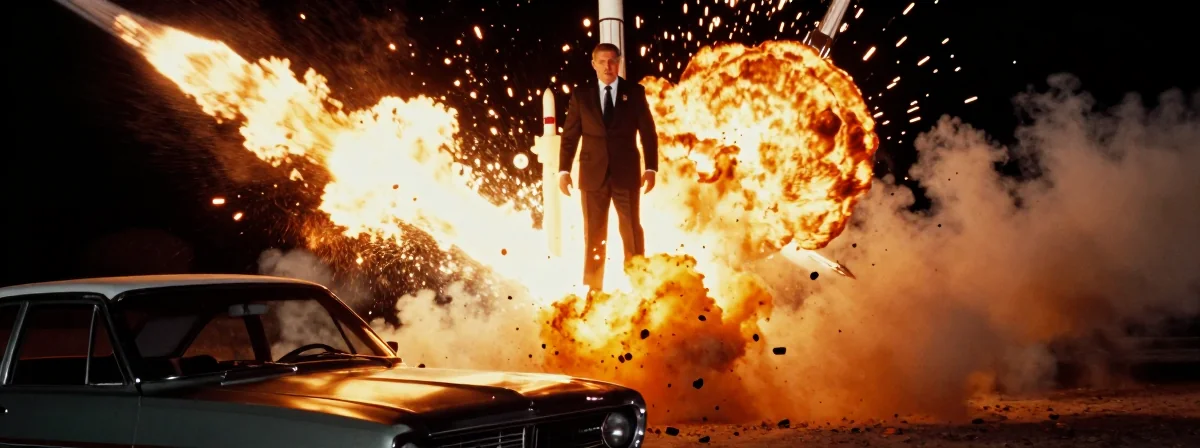
In the annals of political assassinations, few stories are as bizarre as the one where a prime minister’s car became a makeshift rocket. On December 20, 1973, Luis Carrero Blanco, Spain’s powerful prime minister under General Franco, was driving through Madrid when a massive explosion sent his vehicle 66 feet into the air—before crashing back to earth. The event became legendary, spawning rhymes, conspiracy theories, and even comparisons to astronauts. But amid the chaos, one detail often gets overlooked: the car itself. Was it really a Dodge Dart, as folklore claims? Or was there more to the story than meets the eye?
The truth, as it turns out, is far more complex—and far more revealing—than the simple rhyme suggests. The car wasn’t just any vehicle; it was a product of Spain’s peculiar automotive history, a modified version of Chrysler’s design built to comply with local manufacturing rules. And its role in the assassination raises questions that extend beyond mechanics—into politics, economics, and even the art of misdirection.
Was Carrero Blanco Really Driving a Dodge Dart? The Car That Time Forgot
For decades, the popular narrative held that Carrero Blanco’s car was a 1970s Dodge Dart. The rhyme “nació en la tierra, vivió en el mar, subió al cielo en un Dodge Dart” (born on land, lived at sea, went to heaven in a Dodge Dart) cemented this in collective memory. But the burden of proof lies elsewhere. Evidence suggests the car was actually a Dodge 3700GT—a Spanish-built, heavily modified version of the Dart designed to meet local content requirements.
The Dodge 3700GT wasn’t just a rebranded Dart; it was a symbol of Chrysler’s short-lived ambitions in Europe. To comply with Spanish laws requiring at least 60% local parts, engineers tweaked the Dart’s design, giving it a distinct grille, longer wheelbase, and a more luxurious interior. It was even the most expensive car available in Spain without being an import at the time. The irony? This “upscale” vehicle, considered too large for many Spanish streets, became the stage for one of the country’s most dramatic political events.
Why the Confusion? The Power of a Simple Rhyme
How did the Dodge Dart myth take hold if the car was actually a 3700GT? The answer lies in the rhyme’s clever construction. Replace “Dart” with “GT,” and the rhythm falls apart. But swap it back, and it flows perfectly. This linguistic trick, combined with the Dart’s greater fame, created a false narrative that persisted for decades. The case for the rhyme’s influence is clear: it’s far easier to remember a catchy phrase than a technical specification.
But the Dodge Dart wasn’t just a poetic convenience; it was a symbol of American automotive dominance in Europe. By associating Carrero Blanco with a car perceived as cheap or unreliable (as some forum discussions noted, citing floor rust and weak construction), the assassins—or perhaps just history—subtly undermined his image. Was this intentional? We can’t know for sure, but the symbolism is undeniable. A leader driving a “rustbucket” sends a different message than one behind the wheel of a bespoke, locally built luxury car.
The Car as a Political Statement: Frugality or Failure?
Some leaders value the appearance of frugality, driving modest cars to project humility. Others, like the founder of IKEA (reportedly driving a 20-year-old Oldsmobile), genuinely prefer simplicity. Carrero Blanco’s choice of the Dodge 3700GT—whether accurate or not—straddles this line. On one hand, it was a high-end vehicle for Spain in the 1970s. On the other, it was still a Chrysler product, not a European luxury marque.
The case for frugality is weak. The Dodge 3700GT was no Kia Picanto or Dodge Dart; it was a statement piece, even if Spain’s economic reality at the time made it seem less ostentatious than a Mercedes or Rolls-Royce. The country was still recovering from decades of isolation under Franco, and locally produced cars like the Seat 850 (a common car for the era, as one forum user pointed out) were the norm for most citizens. A prime minister driving a Dodge 3700GT was neither overly humble nor excessively flashy—just… there.
But what if the car wasn’t about frugality at all? What if it was about practicality? Spain’s poor infrastructure and narrow streets made larger European cars difficult to navigate. The Dodge 3700GT, with its American proportions, might have been a poor choice—except it was modified to fit Spanish roads. This raises another question: was the car’s size a factor in the assassination? The bomb, planted beneath the street, needed a high-riding vehicle to achieve maximum lift. The Dodge 3700GT’s height and weight made it the perfect target.
The Assassination as a Mythbusters Episode: How High Could It Really Go?
The physics of the event are almost too incredible to believe. A car bomb strong enough to launch a 1.8-ton vehicle 66 feet into the air? The burden of proof is high, but the evidence suggests it’s possible. The bomb, consisting of 80 pounds of dynamite, was placed in a shallow trench along the car’s route. When Carrero Blanco’s car passed over, the explosion sent it airborne before gravity pulled it back down with devastating force.
Some have called it the first practical application of the Big Bang Theory—others, a “fucking accomplishment,” as one forum user quipped. The event even inspired jokes about Spain’s “Basque Space Program,” a dark humor that underscores the absurdity of the situation. But beneath the jokes lies a grim reality: the assassination was meticulously planned, and the car was chosen for a reason.
Could this have been a Mythbusters episode? Absolutely. The team might have tested whether a car could truly fly that high, or whether the rhyme was just poetic license. But the truth is more compelling: this wasn’t an experiment; it was a political act. The car, the bomb, the trajectory—all were tools in a larger strategy to destabilize Franco’s regime.
The CIA Connection: Fact or Fiction?
One of the most persistent myths is CIA involvement in the assassination. The argument goes: the CIA, frustrated with Carrero Blanco’s progressive stance (he was seen as a potential reformer within the regime), might have helped leftist ETA militants carry out the attack. The evidence for this is thin, however. As one forum user noted, “Helping left-wing terrorists murder a troublesome right-wing leader is exactly the thing which would allow a right-wing government to enact stricter oppression.” The CIA’s history suggests they were more likely to support right-wing forces than to aid leftists in such a direct way.
The case for CIA involvement is further weakened by timing. A meeting between Franco and U.S. Secretary of State Henry Kissinger occurred just weeks before the assassination, and preparations for the bombing were nearly complete by then. Coincidence? Perhaps. But without concrete proof, the allegation remains an urban legend—one that adds to the mystique but doesn’t change the facts.
Franco’s Reaction: A Cold Blood Turned Calculating
What’s truly strange is General Franco’s response. Known for his icy demeanor, he reportedly said, “Everything has a silver lining” after learning of Carrero Blanco’s death. He then appointed the son of the former king as his successor, a move that surprised even his closest advisors. Was this a calculated power play? Or just the cold blood of a dictator? The assassination, whether CIA-backed or not, clearly opened a door Franco was ready to walk through.
The Dodge 3700GT, in this light, was more than a car; it was a catalyst. It carried a man to his death, launched a legend, and indirectly shaped Spain’s transition from dictatorship to democracy. Without it, the story would be different—less dramatic, less memorable.
Reframing the Legend: The Car That Defied Gravity—and History
When you strip away the myths, the Dodge 3700GT’s role in the assassination is both mundane and extraordinary. Mundane, because it was just a car—a product of Chrysler’s European missteps and Spain’s industrial policies. Extraordinary, because it became the centerpiece of a political drama that reshaped a nation.
The lesson here isn’t about cars or conspiracies; it’s about how symbols take on lives of their own. The Dodge Dart rhyme endured because it was catchy, not because it was accurate. The “Basque Space Program” joke persists because it’s absurd—and funny. And the assassination itself remains a touchstone of Spanish history because it was so audacious.
The next time you hear a story that seems too wild to be true, ask yourself: what’s the real engine behind it? Is it fact, or is it the rhyme? In the case of Carrero Blanco and his flying car, the answer is both—and that’s what makes history so fascinating. The car didn’t just fly; it carried a nation’s future with it.