
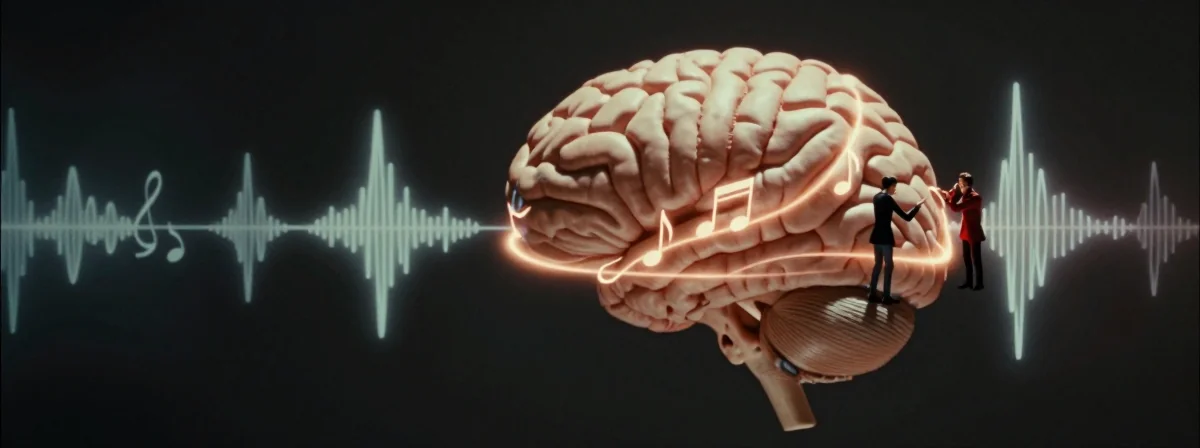
You know the feeling. One moment you’re thinking about your day, the next you’re trapped in a loop of that one song you can’t stand. It’s not just a random annoyance—it’s your brain’s deepest secret, and it’s trying to tell you something. This isn’t just a quirk; it’s a fundamental glitch in how your mind processes sound.
This Changes Everything
Your Brain Hates Incomplete Patterns
Think about it: why does a catchy jingle get stuck but not a complex symphony? Your mind craves closure. When you hear a fragment—especially from a song you dislike—the auditory cortex fires a neural pattern that gets stuck because it’s incomplete. It’s like your brain is a detective with only one clue and no case file. The loop continues because your mind is desperately trying to solve the puzzle.It’s Always the Hook, Never the Bridge
Ever notice how it’s never the boring part of the song that gets stuck? That’s because your brain latches onto the strongest neural encoding—usually the chorus or hook. These sections are designed to be repetitive and memorable, like a song’s secret weapon. Your brain can’t resist the magnetic pull of the part it knows best, even if you consciously despise it.The Zeigarnik Effect Is Real
This isn’t just a theory—it’s a proven psychological phenomenon. Your brain fixates on unfinished tasks, and a song fragment is the ultimate unfinished task. The loop continues because your mind is subconsciously trying to “finish” the song, but it can’t. It’s like being stuck in a maze with only one wall—your brain keeps hitting the same barrier over and over.
- Trying to Stop It Makes It Worse
Here’s the cruel twist: actively trying to suppress the song only makes it stronger. This is ironic process theory in action—just like trying not to think about a white bear makes you think of one even more. The harder you fight the earworm, the more your brain doubles down on the loop. It’s a trap you can’t escape through willpower alone.
The Solution Is Simpler Than You Think
Want to break the loop? Listen to the full song. Seriously. Your brain is just looking for completion. When you provide the missing piece, the neural pattern can finally resolve. It’s like giving your mind the key to unlock the door it’s been rattling for hours. Sometimes the simplest solutions are the most revolutionary.It’s Not OCD—It’s Human
Don’t pathologize this universal experience. Yes, it feels like a glitch, but it’s just your brain doing what it evolved to do: seek patterns and completion. The next time you’re stuck on a song you hate, remember—you’re not broken. You’re just human, and your brain is trying to solve a puzzle it can’t crack alone.
The next time an earworm takes hold, don’t fight it—understand it. Your brain isn’t malfunctioning; it’s trying to tell you something about the way you process the world. And maybe, just maybe, the song you hate is the one thing that can finally break you free.