
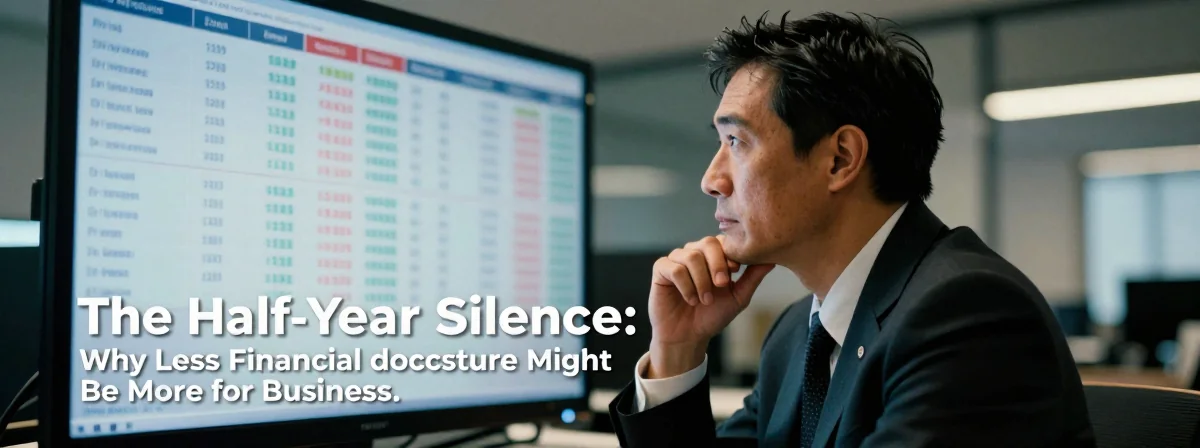
The market breathes on quarterly reports like a tide on the shore—constantly checking in, adjusting, reacting. But what if we paused that rhythm? What if the waves of financial disclosure came every six months instead of three? It’s a shift that feels jarring, even unsettling, at first. But beneath the surface, it’s a conversation about balance—about what truly serves the health of business and the clarity of investment.
The Perspective
Big Business Sips From a Thimble of Savings. The idea that companies will pocket “significant” savings by halving their reporting frequency is like counting the grains of sand on a beach and calling it a fortune. For the behemoths of industry, the cost of compiling reports is marginal compared to their operational budgets. It’s more of a gentle sip from a thimble than a gulp from a wellspring. The real saving isn’t in the numbers—it’s in the quiet hours executives gain, unburdened by the relentless sprint of quarterly expectations.
Internal Eyes Never Close. Think of a company’s internal accounting as the steady hum of a forest. It’s always there, always tracking, always aware. The data for public reports is simply a curated snapshot of that ongoing awareness. The cost of formalizing that snapshot? A whisper in the grand scheme of things. Companies already know their pulse; the reports are just a way to share it. Less sharing doesn’t mean less knowing.
The Investor’s Blind Spot. This is where the shift stings. Less frequent reports mean investors are navigating with fewer beacons. The market, already prone to turbulence, might find itself in murkier waters. But is constant visibility always clarity? Sometimes, the calm between the waves offers a clearer view of the horizon. It’s a trade-off: less data points, perhaps, but more time to reflect on the bigger picture.

- Short-Term Sprints vs. Long-Run Marathons. Quarterly reports have turned business into a series of 90-day sprints. The pressure to hit short-term targets can lead to decisions that favor immediate gains over sustainable growth. Slowing down the reporting cadence might give companies the runway to think long-term, to plant trees instead of just picking flowers. It’s a shift from reacting to the moment to anticipating the future.

The Unseen Hand of Lenders. While investors might feel the sting of less frequent disclosure, lenders often have their own rhythm. Many companies are already preparing financial statements for lenders on a quarterly basis. This creates an interesting tension: will lenders adapt to a six-month cycle, or will companies continue to prepare quarterly reports regardless of public disclosure requirements? The dance between internal needs and external demands continues.
Volatility’s Constant Companion. In a world where markets can shift on the wings of global events, timely information feels like a lifeline. But even with quarterly reports, the market often reacts to whispers and rumors before the official numbers are out. The real question isn’t whether we get reports every three or six months, but whether the quality of those reports truly captures the essence of a company’s health. Two mediocre reports don’t add up to one clear picture.
The Quiet Strength of Choice. Here’s a counterintuitive truth: even if mandated reports come every six months, the need for transparency might push companies to share more, faster. Just as audited financial statements were widely used before they were mandated, companies that recognize the value of transparency might voluntarily release quarterly reports. The market demands clarity, and companies often rise to meet that demand—whether they’re told to or not.
Less Noise, More Signal. In the cacophony of daily market movements, quarterly reports can sometimes feel like noise rather than signal. Slowing down might filter out some of that noise, allowing investors to focus on what truly matters: the long-term trajectory of a company. It’s not about the frequency of the reports; it’s about the depth of the insight they provide.
The Unlikely Ally of Passive Funds. The biggest players in the market—passive funds and conservative pension investments—often play the long game. They’re less swayed by quarterly fluctuations and more interested in the enduring value of a company. For them, the shift to semi-annual reports might be less of a disruption than it seems. The market’s biggest movers might find comfort in the quiet.
Quality Over Quantity. At the end of the day, the frequency of reports isn’t the be-all and end-all. What matters is the quality of the information shared. A detailed, honest report, whether quarterly or semi-annually, is worth more than a rushed, superficial one. The real challenge isn’t how often we report, but how well we report.
The shift to semi-annual reports isn’t about hiding information—it’s about rethinking how and when we share it. It’s a chance to step back, breathe, and consider what truly serves the health of business and the clarity of investment. The market doesn’t stop breathing just because the reports are delayed. The world keeps turning, and so does the business landscape. Maybe, just maybe, a little less noise will help us hear its rhythm more clearly.