
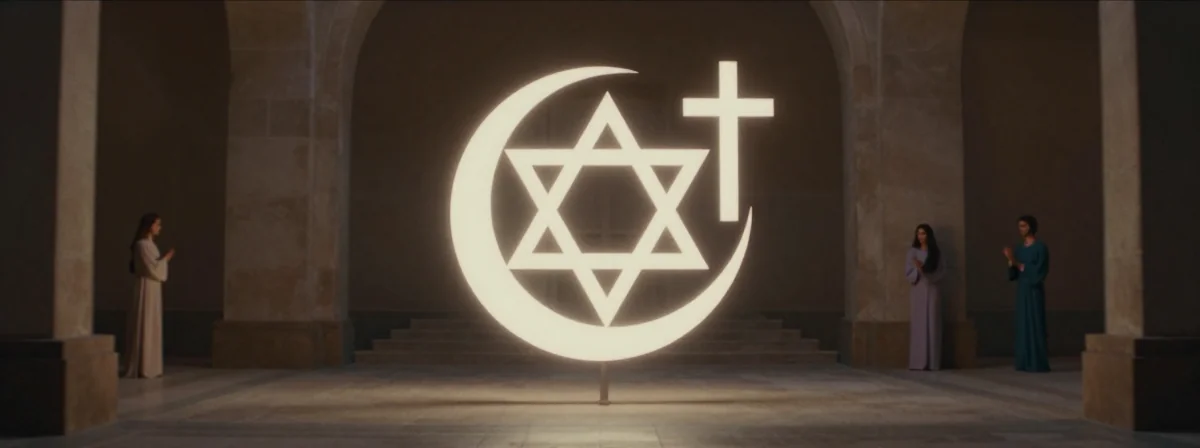
Most people approach religious discussions with the wrong framework. They focus on the differences—Christ vs. Mohammed, trinity vs. unity, kosher vs. halal—and miss the forest for the trees. The real question isn’t “How are they different?” but “What fundamental assumption do they all share that’s worth examining?”
The answer lies in what brought them together in the first place. Forget the surface-level disagreements that fill headlines and divide communities. There’s one core belief that connects Jews, Christians and Muslims in a way that transcends their disagreements.
Judaism, Christianity and Islam didn’t emerge in a vacuum. They all trace their origins to Abraham, the patriarch whose covenant with God forms the foundation of all three faiths. This shared ancestry isn’t just historical—it’s theological, shaping how each religion views its purpose and relationship with the divine.
Why Focusing on Differences Misses the Point
When you walk into a synagogue, church or mosque, you’re entering spaces built on fundamentally similar principles. The differences—Jesus’s divinity, the Quran’s revelations, the Torah’s laws—are significant to believers, but they sit atop a shared foundation that most outsiders never notice.
Consider this: Muslims can eat kosher food because their dietary laws evolved from common roots. Jews and Muslims both practice circumcision as a religious obligation. Christians, Jews and Muslims all follow calendars marked by similar cycles of fasting and celebration. These aren’t coincidences—they’re remnants of a shared heritage.
The problem isn’t that people notice differences; it’s that they assume these differences invalidate the common ground. A Christian who argues Catholics aren’t “real” Christians, or a Muslim who denies Jewish prophets, or a Jew who dismisses Islamic revelations—all are missing the bigger picture. The Abrahamic framework isn’t about picking one “correct” version; it’s about recognizing multiple paths that stem from the same source.
The Single Belief That Connects Them All
Here it is: All three religions believe they’re the rightful inheritors of God’s covenant with humanity. This isn’t just a theological technicality—it’s the core of their identity. Each faith sees itself as the true fulfillment of Abraham’s legacy, the correct interpretation of God’s will.
Judaism believes it’s the original covenant people, the chosen nation through whom God’s laws were first revealed. Christianity sees itself as the fulfillment of Jewish prophecy, with Jesus as the messiah who established a new covenant. Islam views itself as the final, complete revelation that confirms and corrects previous messages, with Muhammad as the last prophet in a line that includes Abraham, Moses and Jesus.
This shared sense of divine purpose explains why each religion views the others with both respect and suspicion. They’re not just different; they’re competing claims to the same legacy. That’s why debates about who “owns” Abraham or which scripture is the true word of God are so heated—they’re not just theological arguments; they’re identity wars.
The Practical Implications You Need to Understand
This shared belief has real-world consequences that most people never consider. When religious conflicts flare up, they’re rarely just about politics or culture—they’re about which version of the Abrahamic legacy is correct.
Take the Israeli-Palestinian conflict. It’s often framed as a territorial dispute, but at its core, it’s about which people hold the rightful claim to Abraham’s covenant land. The same applies to debates about religious symbols in public spaces or religious exemptions to laws—these aren’t just about freedom of religion; they’re about which Abrahamic interpretation should prevail.
Even within religions, this dynamic plays out. Lutherans who dismiss Catholics aren’t just making theological distinctions; they’re asserting their version of the Abrahamic legacy as superior. Muslims who emphasize their practice as the “final” revelation aren’t just stating a belief; they’re positioning Islam as the culmination of Abraham’s covenant.
How This Changes Your Perspective
When you understand this shared belief system, religious conflicts start making more sense. You can see why interfaith dialogue often fails—because participants are operating from fundamentally different understandings of the same legacy. You can also see why radical interpretations are so dangerous—they claim exclusive ownership of the Abrahamic covenant, dismissing other paths as invalid.
The most surprising realization? The biggest differences between these religions aren’t about God at all. Jews, Christians and Muslims all worship the same divine concept—the God of Abraham. Their disagreements center on how that God reveals himself, what laws he gives, and who carries his message forward.
This doesn’t make the differences unimportant. It does, however, provide a framework for understanding them without resorting to simplistic “they’re all the same” or “they’re all different” explanations. The truth lies in recognizing both the shared foundation and the divergent paths built upon it.
The Real Reason This Matters Today
In a world where religious identities are increasingly politicized, understanding this shared Abrahamic framework offers a path forward. It doesn’t require you to accept any particular religious truth claim, but it does demand that you recognize the common ground that exists beneath the surface conflicts.
When you see religious debates through this lens, you can identify which disagreements are truly fundamental and which are secondary concerns. You can recognize when political actors are manipulating religious identities for their own purposes. And you can participate in interfaith conversations with a deeper understanding of what’s actually at stake.
The next time you encounter religious conflict or dialogue, ask yourself: Are we disagreeing about the foundation or the structure built upon it? Are we arguing about the source or the interpretation? Are we claiming exclusive ownership or recognizing shared heritage?
The answer might surprise you—and it just might change how you think about religion forever.