
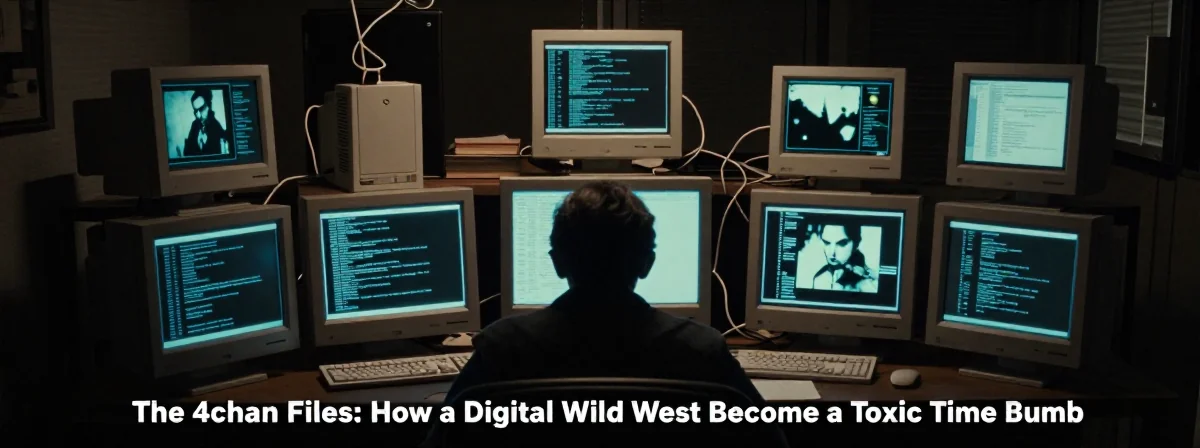
Some places on the internet aren’t just websites — they’re cultural fault lines. Think about the ones that make you squirm. The ones where you wonder how something so broken could still exist, let alone thrive. 4chan is one of those places. It started as an experiment, became a phenomenon, and then… well, you know the rest. But the real question is: how did it happen? And could it happen again?
What I Found
The Original Vision Was Lost Almost Immediately
It started as a place for creative exchange, modeled after Japanese image boards. The founders genuinely believed in a “utopia” of web 1.0 where communities self-regulated through technical barriers. But as soon as those barriers fell, the floodgates opened. The first clue? The site’s own creator admitted it was supposed to be “A” but became “B” — a far cry from the creative haven they envisioned. The evidence is in the archives: early 4chan had genuine art threads and thoughtful discussions. Then came the wave.The “Eternal September” Was No Coincidence
Remember when 4chan hit mainstream media? Attack of the Show’s special in 2008 didn’t just expose the site — it weaponized it. The user base shifted overnight. What was once a niche community became a battleground for attention seekers. The pattern repeats itself: every major influx of new users brought a new low. By 2010, with the politics board and Anonymous coverage, the site had transformed into something its creators would barely recognize. The timeline isn’t speculation — it’s documented in the site’s own growth metrics.“Containment Boards” Were a Joke From Day One
The idea that you could quarantine toxicity by creating special boards (/b/, /pol/, etc.) is like trying to contain a wildfire with a garden hose. It didn’t work then, and it doesn’t work now. In fact, those boards became recruiting grounds. People who visited them didn’t stay there — they infected other sections of the site. The moderators knew this. The archives show internal discussions about how these “solutions” were just kicking the can down the road. The proof? The same toxic patterns emerged in every new board created.The Epstein Connection Is More Than Conspiracy Talk
Here’s where it gets uncomfortable. The creation of /pol/ followed a suspiciously timed meeting between the site’s founder and Epstein. Emails later surfaced showing coordination between Epstein’s circle and the site’s moderation. Was it a PsyOp? The evidence suggests yes. The board’s sudden shift in tone, the coordinated campaigns, the timing — it all points to external manipulation. The founder’s later attempts to sanitize his legacy (with projects like Canv.as) only make the original timeline more suspicious. This wasn’t organic growth.
The Platform’s Business Model Fueled the Fire
Unlike sites that rely on ads, 4chan operated on donations for years. That independence should have meant better content. Instead, it meant no accountability. When corporate interests finally did step in, the damage was done. The lack of profit motive didn’t save it — it accelerated the decline. Compare that to SomethingAwful, which had strict moderation from day one. The contrast is telling: one thrived with active curation, the other rotted with “freedom.” The lesson? Someone always moderates — either you choose who, or the chaos chooses for you.The “Creative” Era Was a Mirage
Nostalgia paints early 4chan as a bastion of creativity. The reality? It was always toxic. Even in the “good old days,” racism, misogyny, and homophobia were rampant. The difference was that back then, people at least pretended to be ironic. Now, they’re unironic. The book “It Came Something Awful” nails this: 4chan wasn’t a rebellion against mainstream culture — it was mainstream culture’s dark reflection. The early users weren’t counterculture heroes; they were the precursors to the alt-right. The archives don’t lie.The Community Killed Itself With “Freedom”
This is the crux of it. 4chan believed in “freedumb” — freedom without responsibility. The result? A self-fulfilling prophecy of toxicity. Every time moderators tried to intervene, the community pushed back harder. The site became a paradox: it claimed to hate corporations, yet mimicked their worst traits — scale over substance, engagement over quality. The final clue? By 2016, even the founder had abandoned ship. The site died not from external attacks, but from internal rot. The digital equivalent of a supernova.
The Verdict
The internet didn’t get worse — we just built faster ways for the worst parts of humanity to connect. 4chan’s story isn’t an outlier; it’s a warning. Every platform that prioritizes “freedom” over structure eventually becomes what it feared. The next time you hear about a new “unmoderated” platform, remember the digital ruins of 4chan. The question isn’t if it will happen again — it’s whether we’ve learned enough to stop it. Or whether we’re just waiting for the next generation of trolls to fill the void.