
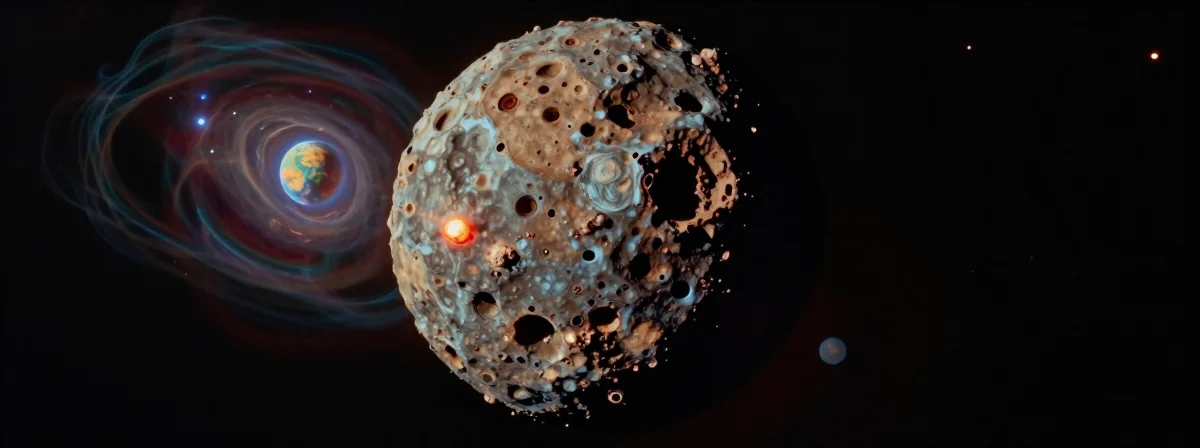
The silence of the cosmos has always been our greatest deception. While we gaze at stars thinking we’re alone, the universe is teeming with possibilities we can barely comprehend. What if the most profound truth about our existence isn’t that we’re special, but that we’re merely one iteration in an infinite cosmic experiment? The asteroid that ended dinosaurs’ reign wasn’t just a random event—it was a cosmic punctuation mark in Earth’s evolutionary story, and similar marks are being made across the universe right now.
This isn’t just theoretical speculation. The patterns we see in our own planet’s history provide a template for understanding what might be happening elsewhere. But first, we need to confront a fundamental question that challenges everything we think we know about life, death, and the vastness between stars.
Could Another Planet Have Dinosaurs, Or Are We Deluding Ourselves?
The notion that other planets might host life similar to Earth’s dinosaurs is both compelling and fundamentally flawed. When we imagine extraterrestrial life taking familiar forms, we’re projecting our limited perspective onto an infinite canvas. Dinosaurs weren’t inevitable on Earth—they were the result of specific environmental conditions, evolutionary pressures, and yes, a catastrophic asteroid impact that cleared the way for mammals to eventually dominate.
Consider this: Earth’s atmosphere has changed dramatically over its 4.5 billion-year history. The oxygen levels during the Permian period were different from those during the Jurassic, which in turn differ from today’s composition. These subtle atmospheric variations influenced everything from metabolic rates to evolutionary pathways. On a planet with similar conditions, we might see convergent evolution producing organisms that superficially resemble dinosaurs, but biologically they would be as different from Earth’s dinosaurs as octopuses are from mammals—both are intelligent, but their evolutionary paths couldn’t be more different.
The arrogance lies in assuming evolution follows a predetermined script. On Earth, we’ve seen fish evolve into amphibians, reptiles into birds, and mammals into whales—each adaptation a response to environmental pressures. On another world, entirely different solutions might emerge to solve the same basic problems of survival, reproduction, and energy acquisition. The universe doesn’t care about our taxonomic classifications.
What Would It Actually Take For Dinosaurs To Exist Elsewhere?
Let’s get specific about the conditions required for dinosaur-like organisms to evolve. We’re not just talking about any carbon-based life; we’re talking about large, terrestrial, warm-blooded (or at least highly active) organisms with complex respiratory and circulatory systems. This requires:
- A planetary atmosphere with specific gas compositions
- Continental configurations that support diverse ecosystems
- Geological stability that allows for long-term evolutionary development
- A similar timeline of evolutionary progression from simple to complex life
The odds seem astronomical, but consider this: our galaxy alone contains hundreds of billions of stars, many with their own planetary systems. If even a tiny fraction of these systems develop life, and an even tinier fraction develops complex life, the number of potentially dinosaur-like planets could still be in the millions.
But here’s where it gets truly mind-bending: even if another planet develops organisms that look like dinosaurs, they won’t be dinosaurs. “Dinosaur” isn’t just a physical description—it’s a specific branch on Earth’s evolutionary tree. Any similar organisms elsewhere would have evolved through entirely different genetic pathways, making them as alien to Earth’s dinosaurs as we are to them.
Why The Asteroid Impact Scenario Is More Common Than You Think
The 10km asteroid that struck Earth 66 million years ago wasn’t a one-in-a-trillion cosmic fluke. It was part of a predictable pattern of celestial mechanics. Our solar system is littered with objects large enough to cause regional devastation, and occasionally, extinction-level events. The key insight is that impacts capable of wiping out dominant species but leaving the planet intact aren’t rare—they’re statistically inevitable over cosmic timescales.
Consider the mathematics: in our solar system alone, we’ve identified thousands of Near-Earth Objects (NEOs) larger than 140 meters—enough to cause significant regional damage. Objects in the 1-10km range, capable of global extinction events, are less common but still numerous. Given that Earth has existed for 4.5 billion years and has experienced multiple mass extinction events, it’s clear that such impacts are part of planetary development, not anomalies.
This pattern likely repeats throughout the universe. Planets with conditions suitable for complex life will inevitably face cosmic threats. Some will experience impacts that reset evolutionary clocks, others will develop life forms with resilience to such events, and still others might develop technological civilizations capable of planetary defense. The universe doesn’t guarantee any single outcome—it simply provides the stage for cosmic drama to unfold.
What Truly Limits Evolutionary Convergence Across Planets?
The most profound limitation on evolutionary convergence isn’t physical—it’s informational. On Earth, we’ve seen remarkable examples of convergent evolution: wings in birds, bats, and insects; eyes in vertebrates and cephalopods; similar limb structures in mammals, birds, and reptiles. These similarities arise because certain solutions to environmental challenges are more efficient than others.
But here’s the critical distinction: these convergences occur within the same planetary ecosystem, sharing the same basic physical laws and elemental building blocks. Extraterrestrial life might face similar challenges—gravity, radiation, energy acquisition—but the solutions could be utterly alien. Consider how differently life might evolve on a planet with:
- Different atmospheric pressure
- Higher or lower gravity
- Different magnetic field strengths
- Unique elemental compositions
- Alternative biochemistries (silicon-based instead of carbon-based)
The possibilities extend beyond just physical form. What if extraterrestrial intelligence develops through entirely different sensory modalities? What if their equivalent of “vision” is based on magnetic fields rather than light? What if their equivalent of “communication” is through chemical signals or seismic vibrations? The evolutionary pathways could diverge so dramatically that comparison becomes meaningless.
How Do Mass Extinctions Shape The Cosmic Narrative?
Mass extinctions aren’t cosmic tragedies—they’re evolutionary catalysts. On Earth, each of the five major extinction events cleared ecological space, allowing surviving species to diversify and fill newly available niches. The asteroid that ended the dinosaurs didn’t just create conditions for mammals to thrive; it fundamentally altered the trajectory of terrestrial evolution.
This pattern likely repeats across the universe. Planets that experience mass extinction events might see accelerated evolutionary innovation as survivors adapt to changed conditions. Some might develop greater resilience to future threats, others might evolve entirely new biological strategies, and some might even develop intelligence as a means of understanding and mitigating existential risks.
The most fascinating possibility is that mass extinctions aren’t just destructive—they’re creative forces that push evolution in new directions. Just as the Permian-Triassic extinction (the “Great Dying”) led to the rise of dinosaurs, and the Cretaceous-Paleogene extinction led to the rise of mammals, extraterrestrial mass extinctions might similarly clear the way for new forms of complexity and intelligence.
What Does This Mean For Our Place In The Cosmos?
The realization that we might not be alone—indeed, that complex life might be widespread but take forms we can’t yet imagine—fundamentally changes how we understand our place in the universe. It moves us from a position of cosmic loneliness to one of cosmic connectedness, where the challenges and triumphs of life on Earth are just one chapter in a much larger story.
This perspective doesn’t diminish our significance—it expands it. If complex life exists elsewhere, then the struggles, innovations, and eventual triumphs of life on Earth become part of a universal narrative of consciousness emerging from matter. The questions we ask about our origins, our purpose, and our future become part of a larger conversation that spans light-years and millennia.
The most profound truth isn’t that we’re alone, or that we’re typical. It’s that we’re part of something much larger than ourselves—a cosmic experiment in consciousness that’s playing out across countless worlds, each with its own unique story to tell. And in that vastness, the most important question isn’t whether we’re alone, but whether we have the wisdom to recognize our connection to all that is.