
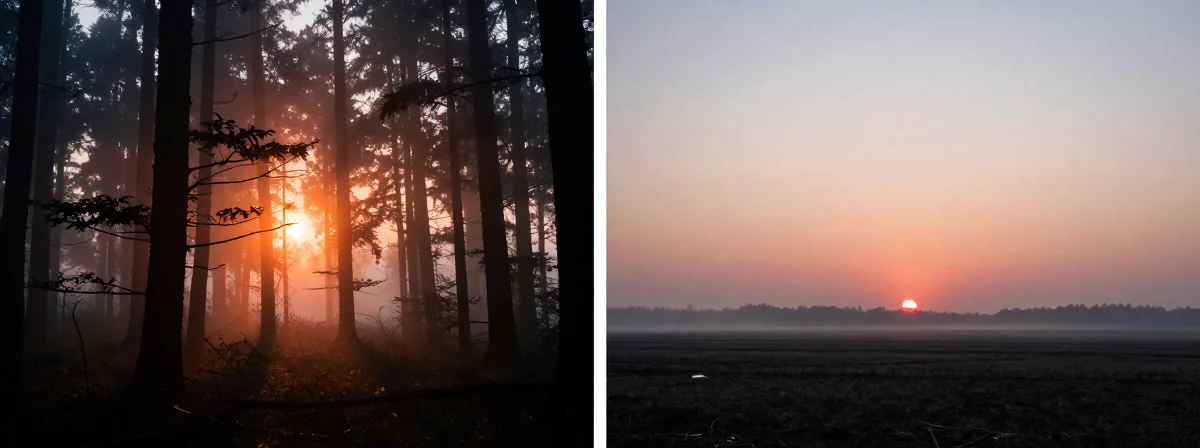
Ever wondered why some sunrises look like a celestial masterpiece while others barely register as a yawn in the sky? You’re not alone. Most of us have stared at a gray, uninspiring dawn and thought, “Is this it? Is this the best the universe can do?” Spoiler alert: No. The difference isn’t in your mood or your luck—it’s in the air. Literally.
The color of a sunrise isn’t some mystical, unpredictable force. It’s a predictable, almost mundane reaction between sunlight and whatever junk happens to be floating around. And if you think that’s boring, well, at least you’re not wrong—but you’re missing the point.
Let’s break down why some sunrises are the atmospheric equivalent of a beige sofa, while others are a flaming explosion of color.
Why Do Some Sunrises Look Like the Universe Forgot to Add Color?
The simple answer? Clean air. Yeah, I know, it sounds anticlimactic. But when the air is as pure as a politician’s promise, sunlight passes through with barely a hitch. The shorter wavelengths (blue and violet) scatter easily, leaving the longer wavelengths (red and orange) to dominate. But wait—doesn’t that mean clean air should make sunrises red? Technically, yes. But “red” in this case is the atmospheric equivalent of a 50-shades-of-gray book cover: dull, uninspiring, and something you’d rather not stare at for too long.
The real magic happens when the air isn’t so clean. Dust, water vapor, pollution—these particles act like tiny, invisible disco balls, scattering sunlight in every direction. The more particles, the more dramatic the effect. Suddenly, those longer wavelengths get bounced around like a pinball, creating the fiery oranges, pinks, and purples we all Instagram. It’s not magic; it’s just physics being a little more generous with its visual effects.
The Ugly Truth About “Boring” Sunrises
Let’s be honest: a sunrise that lacks color is like a joke without a punchline. It sets up the premise—sunrise!—and then just… stops. No payoff, no wow factor, just a gentle reminder that the sun exists. And while some might romanticize this as “peaceful” or “minimalist,” let’s call it what it is: underwhelming.
The real kicker? We’ve been conditioned to expect boring sunrises. We see them so often that we’ve normalized mediocrity. It’s like expecting a fast-food burger to taste like a Michelin-star meal—sure, it’s edible, but don’t pretend it’s anything special. The next time you see a sunrise that looks like someone spilled gray paint across the sky, don’t just accept it. Ask yourself: What’s missing?
How Pollution Can Actually Make Sunrises Better (Yes, Really)
This might sound like a twisted paradox, but hear me out: pollution can make sunrises more spectacular. When you’ve got smog, dust, or even volcanic ash in the air, those particles amplify the colors. It’s like adding extra seasoning to a bland dish—the more junk in the air, the more the light has to work with, and the more vibrant the result.
Of course, this doesn’t mean you should celebrate smoggy days. The health implications are obvious. But from a purely aesthetic standpoint, those particles are doing something right. They’re turning a mundane sunrise into a showstopper. It’s like the universe’s way of saying, “I know I messed up with this pollution thing, but at least I can make it look pretty.”
Why You Should Stop Taking Sunrise Photos Without Thinking
Before you whip out your phone the next time a sunrise looks “nice,” consider this: are you capturing the real story? Most of us snap photos of sunrises without understanding what makes them special—or lackluster. We’re chasing the visual, not the science. And that’s fine, until you realize you’ve been taking the same beige sunrise photo for years, thinking it’s unique.
The next time you see a sunrise, take a moment to observe. Is the air clean? Is there a hint of dust or moisture? Are the colors muted or explosive? Understanding the why behind the beauty (or lack thereof) can turn a routine photo into a meaningful capture. It’s not about the pixels; it’s about the particles.
The Particle Problem: Why We Keep Missing the Point
Here’s the thing: we’re so focused on the visual that we forget the mechanics. We see a stunning sunrise and call it “magical,” when really, it’s just physics doing its job with a little extra flair. We see a boring sunrise and call it “meh,” when it’s actually a perfect example of how light behaves in a vacuum. We’re so busy reacting to the colors that we don’t stop to think about what’s causing them.
And that’s the real shame. The beauty of a sunrise isn’t just in its colors—it’s in the story those colors tell. It’s about the air, the light, the particles, the conditions. It’s a reminder that even the simplest things have complex, fascinating explanations. So next time you see a sunrise, don’t just admire it. Try to decode it. You might find that the most boring sunrises are actually the most revealing.
Sunrise as a Reflection of Our Own Attitudes
Think about it: we tend to romanticize the dramatic, the vibrant, the “wow” moments. A sunrise that’s just… there? We dismiss it. But isn’t that how we approach life, too? We chase the big, flashy moments—the promotions, the vacations, the grand gestures—and forget to appreciate the quiet, everyday stuff. The “boring” sunrises are like the quiet days: they’re not exciting, but they’re necessary. They’re the baseline against which the spectacular is measured.
So the next time you see a sunrise that lacks color, don’t just write it off. See it as a reminder that not every moment needs to be a firework display. Some days are just… days. And that’s perfectly okay. The truly interesting part is what happens when the conditions are just right—and when you’re paying enough attention to notice.