
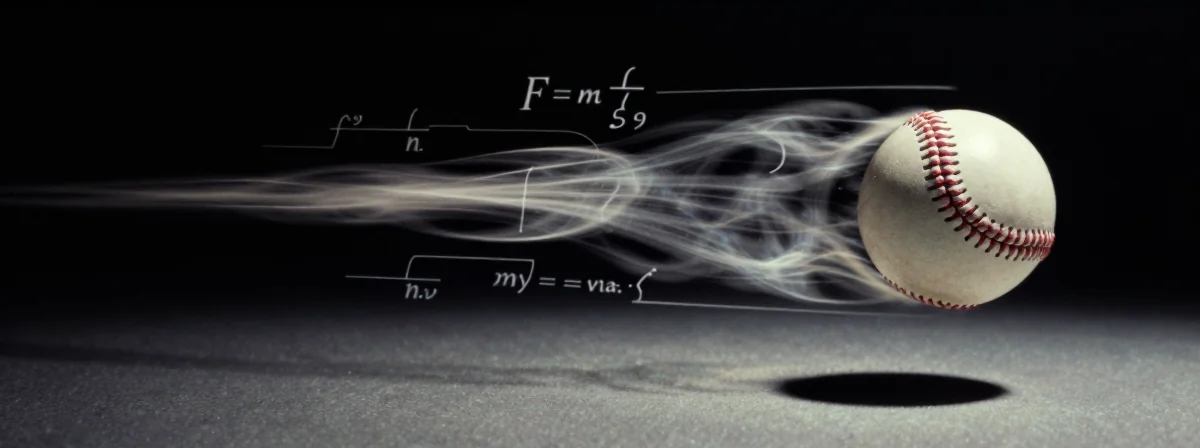
Have you ever wondered why a professional baseball player can hit a ball pitched at 90 mph so much farther than the same player hitting a stationary ball from a tee? The difference isn’t just about timing or technique—it’s about fundamental physics that most fans never consider. When a pitched ball meets a bat, something extraordinary happens at the moment of impact that transforms how energy flows through the system.
The baseball itself acts as a compressed spring, designed to deform and then rapidly return to its original shape. This isn’t just theoretical physics; it’s the reason why a baseball can travel so far when struck properly. Understanding this phenomenon reveals surprising connections between sports, car crashes, and even everyday objects around us.
The counterintuitive truth is that a pitched ball contains additional energy that gets transferred during impact, creating a synergistic effect that amplifies the result far beyond what either object could achieve alone.
Why a Pitched Ball Travels Further Than a Tee Ball
When a baseball is pitched at 90 mph toward a stationary bat, both objects bring energy to the collision. The bat carries kinetic energy from the batter’s swing, while the ball carries energy from the pitcher’s throw. At the moment of impact, these energies combine in a remarkable way.
The baseball compresses dramatically—up to 30% of its diameter—storing elastic potential energy like a spring. This compression happens faster than your eye can see, occurring in just milliseconds. When the ball decompresses, it releases this stored energy in addition to the energy transferred from the bat, creating what physicists call an “elastic collision with energy amplification.”
Consider this analogy: Imagine compressing a spring between your hands and then suddenly releasing it. The spring would launch forward with significant force. Now imagine someone else pushing on the other end of that spring while you compress it. When released, the spring would launch with even greater force because both forces combined during compression.
This principle explains why even a light swing at a pitched ball can send it flying, while the same swing at a stationary ball produces a much weaker result. The pitched ball’s forward momentum contributes to the compression, creating more stored energy to be released during the decompression phase.
The Surprising Similarity Between Baseballs and Newton’s Cradle
You might think that understanding baseball physics requires advanced engineering knowledge, but the same principles appear in simpler systems we encounter every day. Consider Newton’s Cradle—those desk toys with metal balls suspended in a row.
When you lift one ball and release it, it strikes the next ball and stops abruptly, while the ball at the opposite end flies outward at nearly the same speed. This demonstrates conservation of momentum and energy transfer. Now imagine scaling up Newton’s Cradle to baseball size.
Interestingly, when engineers built larger-scale Newton’s Cradle models, they discovered something unexpected: the balls began to dent instead of perfectly transferring energy. This denting absorbs some energy, reducing the height of the final ball’s swing. The same principle applies to baseballs—the more a baseball deforms during impact, the more energy it can store and release.
This connection reveals a fundamental truth about energy transfer: systems with deformable objects behave differently than rigid systems. In baseball, this deformation isn’t a flaw—it’s the mechanism that allows batters to hit home runs.
How Car Crashes Reveal the Same Physics
The physics of baseball hitting has an unexpected parallel in automotive safety. When two identical cars collide head-on, each traveling at 50 mph, the impact is remarkably similar to one car hitting a brick wall at 50 mph. This seems counterintuitive at first glance, but the physics explains why.
In both scenarios, the car experiences the same change in velocity—from 50 mph to 0 mph. The crumple zones in modern cars are designed to absorb this energy through deformation, protecting occupants. However, when a smaller car hits a larger, more rigid object like a semi-truck, the physics changes dramatically.
In that case, the smaller car experiences a much greater change in velocity—potentially from 50 mph to -45 mph (rebounding in the opposite direction), while the truck barely slows down. This creates an impact effect closer to hitting a wall at 100 mph, explaining why these collisions are so dangerous.
This automotive example mirrors baseball hitting: when a bat (the larger, more massive object) meets a ball (the smaller, deformable object), the ball’s deformation and subsequent energy release create a more powerful result than when hitting a stationary ball.
The Bunt: A Perfect Illustration of Energy Transfer
Professional baseball players rarely bunt for power, but the bunt provides an excellent demonstration of the physics we’ve been discussing. When a batter holds the bat still to bunt a pitched ball, the ball compresses dramatically against the bat and then decompresses, sending it forward with significant velocity.
Now consider what happens when a batter bunts a ball on a tee. With no forward momentum from the pitch, the ball compresses much less against the stationary bat, resulting in far less energy being released. The ball might barely move forward or even drop straight down.
This simple comparison highlights how crucial the ball’s initial momentum is to the energy transfer process. Even a bunt, which appears to be a gentle contact, relies on the ball’s compression to generate any significant movement at all.
The same principle explains why MLB players can still hit home runs off a tee—they apply enough force to overcome the lack of additional energy from the pitch, but the result is always less powerful than hitting a pitched ball with the same contact quality.
Corking Bats: The Physics Behind a Popular Myth
For decades, baseball players have experimented with “corking” bats—removing material from the barrel and replacing it with lighter substances like cork or rubber—to gain an advantage. The conventional wisdom was that this created a “trampoline effect” that would make the ball travel farther.
However, the physics reveals a more complex truth. While corking does make the bat lighter (allowing for faster swing speeds), it actually reduces the bat’s ability to transfer energy to the ball. The “springiness” that players hoped for doesn’t significantly enhance performance because wooden bats don’t deform enough during impact to benefit from the trampoline effect.
In fact, studies show that corked bats may actually reduce batted ball velocity because the loss of mass outweighs any potential benefits from increased swing speed. This demonstrates how intuitive ideas about physics often conflict with actual physical principles.
The most significant benefit of lighter bats comes from the additional time they give batters to identify pitches and make better contact—not from any magical energy transfer effect. This counterintuitive result shows why understanding the actual physics matters more than following popular beliefs.
Beyond Baseball: The Universal Nature of Energy Transfer
The principles we’ve explored in baseball apply to countless other situations. Consider how a trampoline works—your body’s deformation stores energy that propels you higher than your initial jump. Or think about how a golf ball’s dimples create turbulence that reduces drag and allows it to travel farther.
These examples all demonstrate the same fundamental principle: deformable objects can store and release energy in ways that rigid objects cannot. This principle explains why baseballs fly farther when pitched, why car crashes behave as they do, and why many sports equipment innovations work the way they do.
The next time you watch a baseball game, pay attention to the difference between hits off pitches and off tees. You’ll notice that even professional players can’t generate the same power from a stationary ball. This isn’t about skill—it’s about physics.
Understanding these principles not only enhances our appreciation for sports but also helps us design better products, improve safety systems, and even appreciate the physics in everyday objects around us. The baseball diamond becomes a laboratory where fundamental physics principles reveal themselves in spectacular ways.