
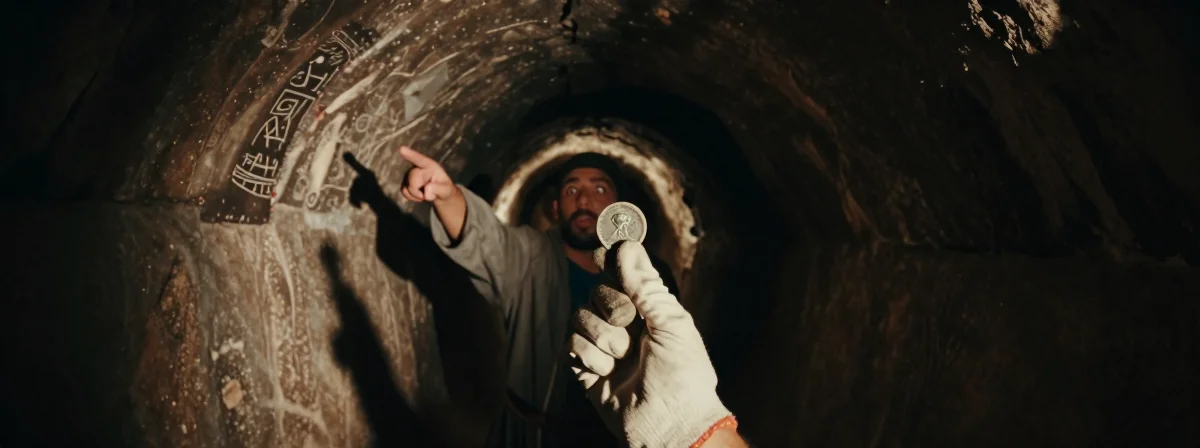
My grandmother taught me that history isn’t written—it’s unearthed. She’d hold ancient coins to the light, her fingers trembling with the weight of time, and say, “These aren’t just metal. They’re whispers from the dead.” Now, I stand in the shadow of a discovery that makes even her words pale. The story of Dura Europos isn’t just history. It’s a revelation that shatters everything we thought we knew about war.
The year is etched in sulfur and blood. A Persian tunnel, dug to collapse a Roman fortress, becomes a tomb. And inside? The coins—hundreds of them—dated to 256 AD. But the truth isn’t in the metal. It’s in the pits. Fossilized date pits. Left atop each coin like a morbid signature. The Persians weren’t just fighting. They were taunting. They were warning. And they were rewriting the rules of war.
How Roman Coins Became Time Bombs
You think a coin tells you when it was made? Think again. My family’s collection taught me this: coins tell you when they mattered. A Roman legionnaire wouldn’t carry old coins. His pay came straight from the mint. If every coin says 256, that’s not just a date. That’s a timestamp for a massacre. The Persians knew this. They left no room for doubt.
But the real horror wasn’t in the coins. It was in the tunnel. The Persians didn’t just dig to breach the walls. They dug to poison the air. Sulfur. Bitumen. Fire. A chemical storm designed to suffocate. And it worked. Roman skeletons, halfway out of their breastplates, their hands still clutching shields. They died running. They died fighting. They died in a gas chamber.
This wasn’t just warfare. This was genocide. The Persians didn’t just win. They redefined terror.
Why the “Fossilized Date Pits” Are the Real Warning
You’d think the gas would be the horror. You’d be wrong. The pits—those fossilized date pits—are the key. They weren’t accidental. They were deliberate. A Persian ritual. A curse. A message to future generations: “We knew what we were doing. We knew what you’d find.”
My grandmother would’ve recognized this. In her world, small details held the biggest truths. The pits weren’t just organic matter. They were proof. Proof that the Persians understood decomposition. Proof they planned for discovery. Proof they wanted their victory remembered—not as a battle, but as a crime.
The archaeologists missed it at first. They saw the coins. They saw the bones. They saw the sulfur. But they didn’t see the pits. Not until one of them—inspired by local legends—started digging deeper. And what they found wasn’t just a tunnel. It was a confession.
The Forgotten History of Persia’s Innovations
We talk about Rome. Concrete. Aqueducts. Underfloor heating. But Persia? We reduce them to “guys who lost to the Greeks.” The truth is buried deeper. Persia invented algebra. Medicine. The postal system. And chemical warfare. Not just in tunnels. But in honey. In snakes. In everything they could weaponize.
The Peloponnesian Wars? “Mad honey.” Rhododendron nectar left for invaders. A gift. A poison. A legend. Until you realize the Persians perfected it. Hannibal with snakes? Child’s play. The Persians didn’t just use snakes. They used fear. They used psychology. They turned war into a nightmare.
And we barely mention them. Because history is written by the victors. Or so they say.
Why ISIS Destroyed the Proof
Dura Europos. The earliest Christian house church. The Persian tunnel. The Roman massacre. It was all there. Until ISIS. Until the bulldozers. Until the smoke. They didn’t just destroy a site. They tried to erase a truth. A truth that connects us to something darker. Something more human.
My grandmother would’ve wept. Not just for the lost history. But for the lost lesson. War isn’t just about weapons. It’s about memory. About what we choose to remember. About what we choose to forget.
The Coins Were Just the Beginning
You think you know ancient warfare? You don’t. You think you know history? You don’t. The coins in Dura Europos weren’t just currency. They were markers. The pits weren’t just organic matter. They were signatures. The tunnel wasn’t just a breach. It was a declaration.
The next time you hold a coin. The next time you read a history book. Remember this: some truths are buried for a reason. Some stories are told to be forgotten. And some tunnels—some wars—are never truly over. They just wait for us to dig them up.