
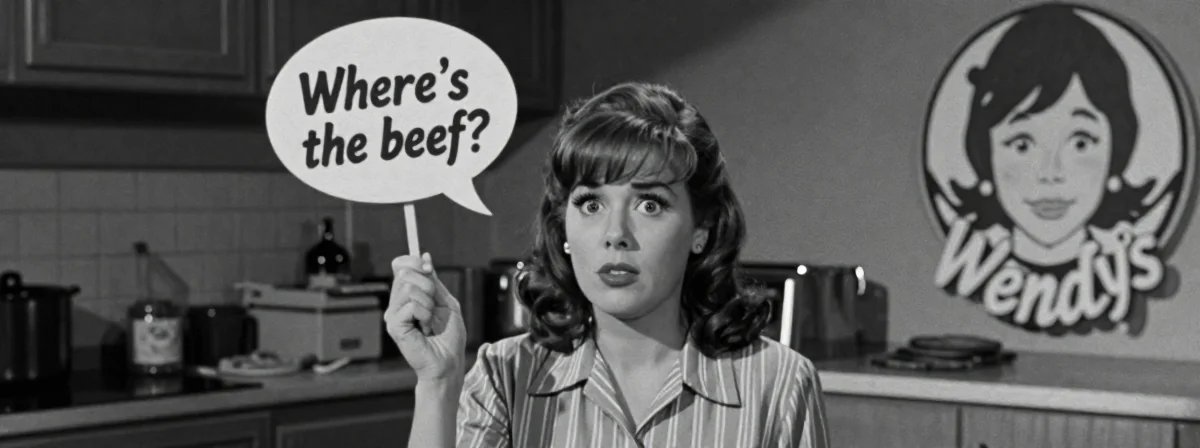
Some ads become footnotes; others rewrite the rules. The Wendy’s “Where’s the Beef?” commercial didn’t just win a Super Bowl ad award—it became a cultural touchstone that still echoes in marketing today. But what most people miss is how this simple question dismantled advertising norms and accidentally exposed the emptiness of political promises.
The ad, featuring 83-year-old Clara Peller, wasn’t just funny. It was a masterclass in cutting through the noise. Wendy’s wasn’t just selling burgers; it was selling substance over style—a message so sharp it even found its way into a 1984 Democratic debate. But the real story is darker, more complicated, and still relevant.
Few ads have been so dissected, so misunderstood, and so undervalued. Here’s what actually happened.
Why Did “Where’s the Beef?” Resonate So Hard?
The joke was obvious: Wendy’s burger had more meat than its competitors. But the truth is, it wasn’t just about the beef. It was about a cultural moment desperate for clarity. The 1980s were saturated with flashy, empty promises—whether in politics or fast food. Peller’s question became a symbol for asking, “Are you actually delivering something real?”
The ad’s success wasn’t accidental. Wendy’s knew its audience was tired of fluff. The line wasn’t just clever; it was a punch to the gut of superficiality. Even Walter Mondale, in a debate, used the phrase to mock Gary Hart’s hollow promises. The ad had become a universal shorthand for substance.
But here’s the twist: the joke had “naughty connotations” that made it even more memorable. It was co-opted as a dick joke—a testament to how subtext amplifies impact. Modern advertisers still don’t get this.
The Man Behind the Ad (And the Freudian Slip)
The campaign was created by Denny Lynch, Wendy’s senior VP of communications—not the famous David Lynch, despite what you might think. The name alone is a reminder that behind every great ad is a strategist who understands psychology.
Lynch didn’t just pick a random phrase. He tapped into a collective frustration. The ad’s brilliance was in its simplicity: it didn’t need to explain itself. The question was the answer. Fast-forward to today, and brands still struggle to say anything meaningful.
But there’s a darker side. Peller was fired in 1985 for appearing in a Prego sauce commercial—a move that tanked Wendy’s sales for two years. The brand couldn’t live without its spokeswoman, proving how much power a single ad character can hold.
The Commercial’s Unintended Political Impact
The ad’s influence spread far beyond fast food. During the 1984 Democratic debate, Walter Mondale used “Where’s the beef?” to criticize Gary Hart’s vague promises. Hart, famously, was still mad about it years later.
This wasn’t just a clever reference. It was a moment where advertising language invaded politics, exposing the gap between rhetoric and reality. Fast-food ads had become more honest than political speeches.
Today, we’re still living with the consequences. Brands now weaponize authenticity, but few can match the raw honesty of “Where’s the beef?” The ad proved that sometimes, the simplest questions are the most revolutionary.
Wendy’s Fall From Grace (And Why It Matters)
Fast forward to 2026, and Wendy’s is a shadow of its former self. The brand that once stood for substance now struggles with pricing and quality. A recent anecdote tells it all: a Wendy’s combo meal costs $15-17, while McDonald’s is under $10. The contrast isn’t just financial—it’s existential.
One user described Wendy’s food as “a dirty paper bag filled with dog poop. On fire.” The brand that once mocked competitors for fluff now produces fluff itself. The bun is terrible, the prices are high, and the magic is gone.
But here’s the irony: Wendy’s still uses nostalgia. They’ve brought back “Where’s the lettuce?"—a desperate attempt to recapture lightning in a bottle. It doesn’t work because the brand no longer believes in substance.
The Legacy of a Single Question
“Where’s the beef?” wasn’t just an ad; it was a cultural intervention. It taught brands to value substance, even if they’ve forgotten the lesson. Today’s marketing is louder but emptier. We’re still waiting for the next “Where’s the beef?"—the ad that cuts through the noise and asks the right question.
The real takeaway? Authenticity isn’t a trend; it’s a requirement. Wendy’s once knew this. Maybe they’ll remember again. Until then, we’re left asking: Where’s the beef?