
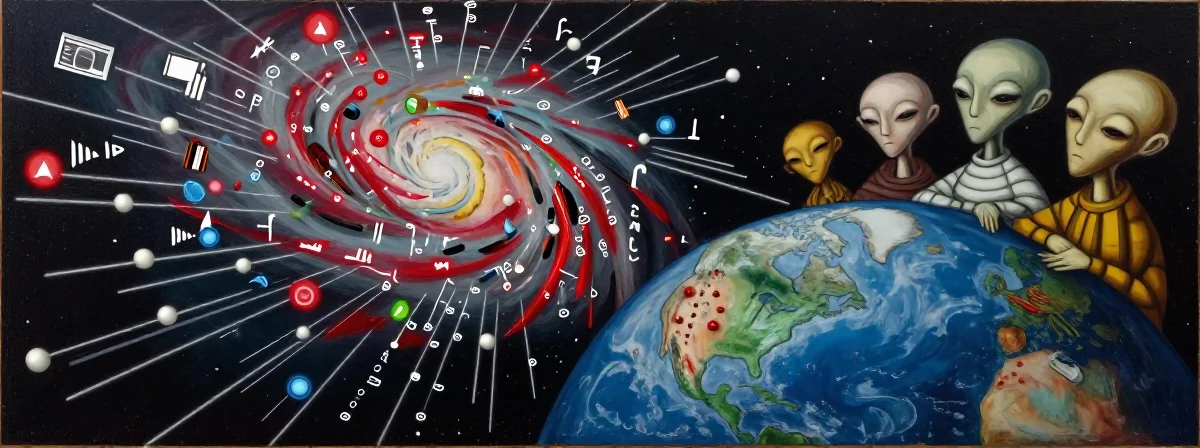
Every night, our planet leaks a faint hum of radio waves into the void—like a poorly insulated house letting out the sound of its occupants arguing. Imagine those waves reaching an alien astronomer, who sighs and mutters, “Ugh, it’s that noisy blue planet again.” We’re not just broadcasting our existence; we’re broadcasting our squabbles, our broadcasts, our entire messy civilization. And the irony? They’d probably detect us anyway, just like we’d spot a chimp tribe banging rocks together if we could hear it from space.
Think about it: If a chimp had a radio and tried beaming signals at our cities, we’d laugh at the primitive static. Or worse, imagine an insect civilization sending out pheromone signals that just say, “WE ARE BUGS, LIVE IN WOODS.” We’d either ignore it or study it with detached curiosity. Now flip the script. What if we’re the bugs? What if our entire species is just background noise to someone with a better receiver?
The truth is, our radio emissions are so weak by the time they reach even the Kuiper Belt that they’re lost in cosmic static. An RF engineer once told me that our broadcasts are detectable only up to Saturn, and even then, they’re barely distinguishable from background noise. The inverse square law is brutal—signal strength drops off exponentially with distance. By the time an alien civilization might intercept our transmissions, they’d need equipment so advanced it borders on magic.
But here’s the kicker: We’re not even deliberately broadcasting anymore. Our early radio and TV signals were the equivalent of a toddler yelling into a megaphone. Now, most communication is fiber optic or satellite-based, meaning less leakage. We’re actually becoming quieter as we get smarter—ironic, since the golden age of detectable noise coincided with our most primitive broadcast technology.
Could a Strong Signal Stand Out?
Maybe. A nuclear explosion or a directed beam like the ones from the Voyager probes could theoretically catch attention. But even those are needles in an infinite haystack. Neil deGrasse Tyson famously pointed out that Voyager’s map includes Pluto as a planet, so aliens might dismiss it if they’re looking for a system with eight planets. It’s like sending a résumé with a typo—the wrong detail could get you ignored.
And let’s be real: By the time any signal reaches another star system, we’ll either be long gone or long past the point of caring. The speed of light is our ultimate bottleneck. We’re broadcasting into the future, not the present. If aliens respond, their message won’t reach us for millennia, by which time we’ll have either evolved beyond recognition or deleted our own history.
Are We Doxxing Ourselves?
Some astrophysicists argue that Earth’s oxygen-rich atmosphere already doxxes us. From light-years away, the composition of our air screams “life!” But what if alien biology is so alien that they don’t even recognize our biosignatures? Maybe we’re like the bacteria on a microscope slide—visible but irrelevant. The Three Body Problem nailed this: advanced civilizations might view us the way we view ants.
The real danger isn’t that we’ll attract benevolent visitors; it’s that we might attract the equivalent of a cosmic landlord giving us a noise violation. Imagine the first contact message being a fine for radio pollution. Or worse, imagine being seen as a resource to exploit—like how we’d treat a planet full of bacteria if we found one. The morality of cosmic colonization is a game we’d lose before we even understood the rules.
The Quiet Truth About Cosmic Broadcasting
Here’s the uncomfortable truth: Even if we stopped all transmissions tomorrow, our past broadcasts have already traveled hundreds of light-years. We’re like a party guest who left the music on full blast and then went home. The noise is out there, and it’s traveling at light speed whether we like it or not. The only way to truly go dark is to extinguish ourselves, which is a solution no one wants.
But here’s the silver lining: The odds of an advanced civilization both noticing and caring about our radio leakage are astronomically low. The universe is vast, and we’re just one noisy pixel in a sea of static. Maybe that’s the best kind of cosmic insurance—being so insignificant that we’re left alone. Until, of course, we develop FTL communication and finally get the attention we never wanted.
In the end, our radio waves are less a beacon and more a footnote in the universe’s vast symphony. They might make someone out there roll their eyes, but they’re unlikely to invite the wrong kind of visit. For now, we can keep broadcasting our squabbles into the void. Just don’t be surprised if the universe ignores us—like the rest of us ignore the cicadas in our backyards.