
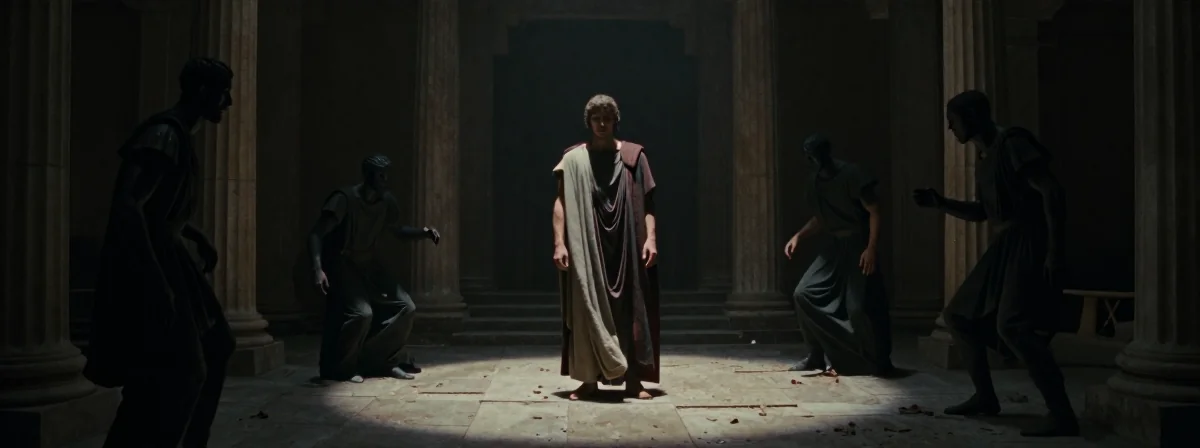
Some people walk through life as if they’ve borrowed someone else’s luck. They make the worst choices, face the direst consequences, and somehow, somewhere, the universe seems to conspire against them. But few stories capture this cosmic cruelty quite like that of an ancient Greek figure whose name would become synonymous with terror—and whose end would make even the most jaded soul shudder.
The tale begins not with glory, but with a choice. A choice to betray. A choice that would seal his fate and, in a bizarre twist of irony, enrich the man who would ultimately end his life. This is more than just a story of bad luck—it’s a cautionary tale etched in history’s bloodiest chapters.
The name itself carries weight. In modern Greek, it means “nightmare.” The man known as Efialtes made his choice during one of history’s most pivotal moments, and his consequences would echo through time. But what makes his story so compelling isn’t just the betrayal—it’s the aftermath. The emptiness. The final, fatal twist that would turn his killer into an unlikely beneficiary.
Why Do Traitors Always Get the Short End?
You might think betrayal pays. After all, traitors often act when they believe the rewards outweigh the risks. But history repeatedly shows that treason rarely, if ever, comes with a happy ending. Efialtes, who betrayed the Spartans to the Persians at the Battle of Thermopylae, received nothing for his treachery—not gold, not honor, not even a place of safety. Instead, he was forced to flee, becoming a pariah in lands that once knew him.
The pattern is disturbingly consistent. Benedict Arnold, perhaps America’s most infamous turncoat, sought glory with the British only to find himself shunned even by those he betrayed. Arnold imagined himself a hero in Britain, only to discover that both sides saw him as dishonorable—a man without a country, without honor, without purpose. Watching his former comrades achieve what he could not—victory—must have been a special kind of torture.
Then there’s the modern example of the Ukrainian engineer who defected, sharing invaluable knowledge about Soviet fighter jets with the West. He arrived in America with expertise that could have changed the balance of power, only to find himself washing dishes. Why? Because a former communist couldn’t secure the clearance needed to work in his field. His betrayal, his sacrifice, amounted to nothing more than a lifetime of menial labor.
The Killer’s Lottery: When Bad Luck Pays Off
Imagine this: You’re in a tavern, minding your own business when a stranger starts a fight. In the heat of the moment, you take his life. Later, a detachment of soldiers arrives, not to arrest you, but to reward you. They explain that the man you killed was an infamous traitor with a hefty bounty on his head. The relief must have been palpable—the moment when murder becomes not just acceptable, but profitable.
This is precisely what happened to the man who ended Efialtes’ life. He likely never knew the name of the man he killed—just that he was an annoyance, perhaps a troublemaker. But when the Spartans arrived with gold, the reality would have hit home in a way no one could have predicted. One moment, you’re a man who just killed someone; the next, you’re a hero receiving payment for ridding society of a nightmare.
The Spartans’ approach was refreshingly direct. “Yeah, but still: fuck that guy,” their actions seem to say. “Here’s your gold.” There was no moralizing, no ceremony—just recognition of a service rendered. The killer, unknowingly performing an act of justice, walked away with both relief and riches. Efialtes, meanwhile, received only oblivion.
The Unbreakable Cycle of Betrayal’s Consequences
What makes these stories so enduring isn’t just their dramatic irony—it’s how they reflect a universal truth about human relationships and trust. Betrayal, it seems, carries consequences that extend far beyond the immediate act. Genghis Khan understood this well, executing traitors even when they seemed useful. “Rome does not pay traitors,” Caepius declared, echoing a sentiment that resonates across cultures and centuries.
The pattern persists because trust is the foundation of human society. When that foundation is shattered, the structure begins to crumble. Efialtes’ name becoming the Greek word for nightmare isn’t just a linguistic coincidence—it’s a cultural acknowledgment of what betrayal represents. It’s the recognition that some actions create ripples that never stop spreading.
Consider Julius Caesar’s famous line: “I love treason but hate a traitor.” The distinction is subtle but important. The act of treason might serve political ends, but the person who commits it becomes irredeemable. This duality—treason as a tool, the traitor as an enemy—captures the complex relationship societies have with betrayal.
Can a Person Truly Disappear in History?
In an age without photographs or identity documents, one might imagine that a betrayer could simply vanish, adopt a new identity, and start anew. But history suggests otherwise. Small communities, tight-knit societies, and the simple fact that people notice strangers made disappearing acts nearly impossible.
Efialtes couldn’t just shed his identity and walk away. People remembered faces. Information traveled, albeit slowly. A lone man arriving in a new town would stick out, his presence raising questions. The suspicion that “this person is running from something” would follow him, making acceptance impossible. In a world where reputation was everything, a betrayer had no reputation to rebuild.
This is why so many traitors meet violent ends. They become walking targets, not just for those they’ve betrayed, but for anyone who recognizes them. The constant state of flight, the inability to settle anywhere, creates a kind of living death that’s perhaps worse than any execution.
The Final Twist: When Fate Plays Its Darkest Hand
Efialtes’ story isn’t just about betrayal—it’s about the ultimate cosmic joke. He made his choice, faced the consequences, and then, in his final moments, became the instrument of another man’s fortune. His name would live on, not as a cautionary tale, but as a linguistic artifact—a reminder of what happens when you become a nightmare to others.
The irony is almost too perfect. The man who received nothing for his treachery becomes the reason another man receives everything. The Spartans’ reward wasn’t just payment for a service—it was a final, cruel twist in Efialtes’ story. He died knowing only that he was being killed; he never knew he was making someone else rich.
And so, the cycle completes. The betrayer receives nothing. The killer receives everything. The society is cleansed of its nightmare. History records it all, not as a lesson, but as a story—a strange, dark tale that reminds us that some choices carry consequences that extend far beyond our graves.
The next time you consider a path of betrayal, remember Efialtes. Remember that sometimes, the universe doesn’t just punish—you might just be the last piece in someone else’s lottery ticket. The fortune might not be yours, but someone’s will be. And in that knowledge lies the true terror of treason.