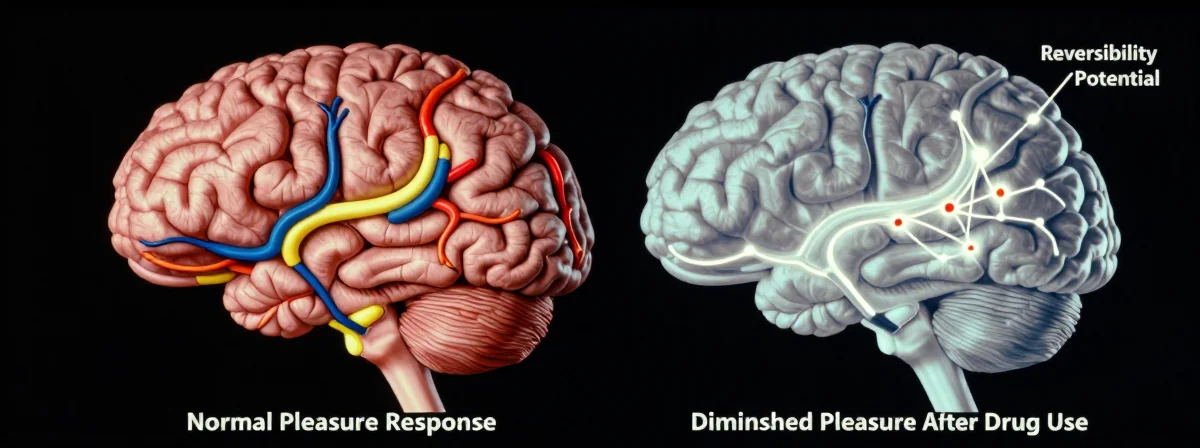
Have you ever noticed how activities that once brought you immense joy suddenly feel flat or unexciting after periods of drug use? It’s not just in your head—there’s a precise neurological mechanism at work that literally recalibrates your brain’s pleasure threshold. This phenomenon, known as anhedonia, affects everything from enjoying a favorite meal to feeling connected in relationships, and it operates through a fascinating process of neurochemical signaling that most people never learn about.
The brain’s reward system is designed to reinforce behaviors essential for survival and well-being. When you eat nutritious food, achieve a goal, or form social bonds, your brain releases dopamine—a neurotransmitter that creates feelings of pleasure and satisfaction. This natural reward system works on a delicate balance, but drugs hijack this process by flooding the system with dopamine at levels far exceeding natural rewards. The result is both immediate gratification and long-term changes to how your brain experiences pleasure.
Understanding this mechanism isn’t just academic—it’s essential for anyone who wants to comprehend the neurological basis of addiction, recovery, or even the subtle ways our experiences shape our brain chemistry over time.
Why Does That Favorite Song Suddenly Sound Meh?
The core mechanism involves what neuroscientists call retrograde signaling—a feedback loop between neurons that adjusts the intensity of future signals. Imagine two neurons communicating: Neuron A sends a signal to Neuron B, and Neuron B sends a response back. In natural circumstances, this creates a balanced communication system.
When you experience something pleasurable—like a delicious meal or a heartfelt conversation—Neuron A sends a moderate signal to Neuron B, which acknowledges receipt. Over time, repeated experiences create diminishing returns, similar to how a familiar song becomes less impactful with repeated listens. This natural adaptation helps us appreciate novelty without becoming overwhelmed by constant stimulation.
However, when drugs enter the system, they create an entirely different dynamic. Drugs force Neuron A to send an abnormally powerful signal to Neuron B. In response, Neuron B sends back a message essentially saying, “Signal received at extreme intensity—prepare to dampen future signals.” This creates a neurological instruction to weaken all future pleasure responses.
The Dopamine Deficit That Changes Everything
The most damaging aspect of this process is how it affects your brain’s natural dopamine production. Your brain adapts to the excessive dopamine levels by reducing its own production and even decreasing the number of dopamine receptors. Think of it like this: if you suddenly start getting all your water from a powerful external source, your body will eventually stop producing its own hydration mechanisms.
This creates a double bind: normal activities that should release dopamine now produce barely detectable amounts, while the drug continues to provide massive dopamine surges. Over time, your brain’s baseline shifts. What was once a neutral state becomes a deficit state, requiring the drug just to return to normal functioning.
Consider the experience of someone who abuses stimulants: initially, even mundane tasks like cleaning the house feel intensely rewarding (+5 on a pleasure scale). After prolonged use, the brain adjusts, and what was once +5 becomes the new baseline. When the drugs are removed, the person experiences a profound deficit—cleaning the house might feel like -5 instead of the original 0. This explains why someone might say they “need” the drug to feel normal, when in reality they’re just trying to escape an artificially created deficit.
The Addiction Cycle That Feels Like Choice
What makes this particularly insidious is how it manifests in relationships and daily life. Many people in early recovery report that activities they once loved—painting, hiking, spending time with family—feel utterly uninteresting. This isn’t a matter of weak willpower or character flaws; it’s a neurological reality.
The brain has essentially put up “Do Not Disturb” signs on its pleasure centers, having learned that external sources will override its own systems. This creates a cycle where the only way to feel pleasure is to use the drug, which further reduces natural pleasure capacity, reinforcing the need to use.
This explains why someone might say they could quit anytime—they’re speaking from their drug-altered reality where the drug is the only thing that provides pleasure. It also explains why relationships often suffer: the brain’s recalibration makes natural bonding experiences less rewarding compared to drug-induced states.
The Recovery Timeline No One Talks About
The good news is that this process is largely reversible, though it requires patience and commitment. When drug use stops, the brain begins to recalibrate. The “post-it notes” on the pleasure centers gradually come down as the brain realizes it no longer needs to suppress natural signals.
However, this recovery isn’t instantaneous. Studies show that dopamine receptor levels may take weeks or months to return to normal, and natural reward pathways may remain hypersensitive to the drug while underresponsive to natural rewards during this period.
This explains why relapse is so common: the brain’s reward system remains temporarily imbalanced, making natural pleasures seem insufficient while the drug remains powerfully rewarding. Recovery isn’t just about stopping drug use—it’s about patiently rebuilding the brain’s natural reward pathways through consistent engagement with non-drug rewards.
Why Some Prescribed Medications Don’t Cause This Effect
It’s worth noting that not all pharmacological interventions create this same effect. Medications prescribed to correct deficiencies (like ADHD medications for those with dopamine deficits) work differently. In these cases, the brain isn’t being overwhelmed but rather brought to a more balanced state.
The critical difference lies in the starting point: someone with a natural dopamine deficit isn’t creating a new high-threshold state—they’re simply moving from a negative to a neutral position. Their brain doesn’t have the same adaptive response because it’s not being forced into an unnatural state of overstimulation.
Building New Neural Pathways After Drugs
The most empowering aspect of understanding this mechanism is recognizing that you can actively rebuild your brain’s natural reward system. This involves:
- Consistent engagement with non-drug rewards, even when they feel insufficient
- Patience with the recovery process, understanding that pleasure sensitivity will gradually return
- Avoiding situations that trigger drug cravings while natural pathways strengthen
- Recognizing that temporary anhedonia is a normal part of recovery, not a permanent condition
The brain’s ability to change—neuroplasticity—means that with time and consistent effort, natural pleasures can once again become rewarding. This isn’t about willpower alone but about understanding and working with your brain’s adaptive capabilities.
The next time you notice that things don’t bring you joy like they used to, remember that this isn’t a character judgment but a neurological reality. By understanding how your brain’s reward system works—and how it can be recalibrated—you gain not just scientific insight but practical tools for rebuilding your relationship with pleasure in a healthy, sustainable way.