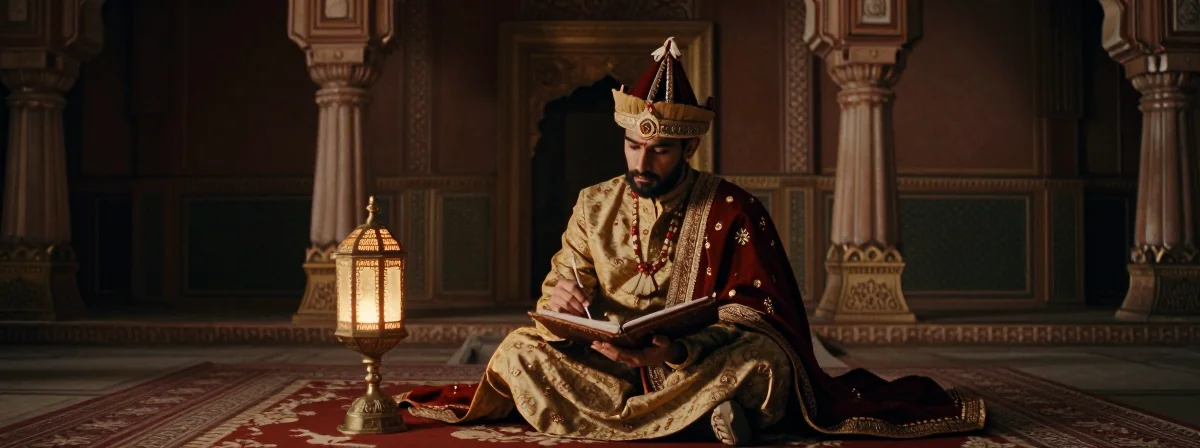
Some rulers leave behind grand monuments or blood-stained battlefields. Others leave behind… diaries. But have you ever heard of a conqueror who documented his teenage crushes alongside descriptions of skull towers? There’s something deeply unsettling—and fascinating—about the way this Mughal emperor laid bare his inner world. What are they hiding when they only show us the conqueror, not the man who wrote like a vlogger before vlogging was even a thing?
The memoirs in question aren’t just any historical documents. They’re the Baburnama, written by Zahir ud-Din Muhammad Babur, the founder of the Mughal Empire. When history podcasts discuss him, they often marvel at how, if he were alive today, he’d be the kind of influencer who livestreams his conquests between poetry readings. But that’s only part of the story…
Why Would a Conqueror Document His Most Vulnerable Moments?
It’s one thing to keep a diary; it’s another to write about how “owo why is he so cute???? >_<” while also detailing how your army just erected towers of skulls. This isn’t just teenage angst—it’s a psychological puzzle. At 13, Babur was already writing with startling candor about his first crush, then seamlessly transitioning to descriptions of war atrocities. What does this say about the man who would later rule India?
The truth is, Babur started writing his memoirs around age 11 or 12, after becoming ruler of Fergana Valley. By the time he wrote about his teenage self in his 40s, he wasn’t just reminiscing—he was crafting a raw, unfiltered account that defies the sanitized versions of history we’re fed. His couplet about that fleeting moment of seeing someone he loved—“Oh, how sweet was that moment when I saw you, and that was all”—isn’t just poetry; it’s a glimpse into a mind that saw beauty and brutality as two sides of the same coin.
The Poet and the Conqueror: A Dangerous Combination
Babur wasn’t just a warrior; he was a poet who wrote in Chaghatai Turkic, a language that remains surprisingly accessible to those who know Uzbek or Uyghur today. His descriptions of Central Asian melons—“Juicy, sweet, with a fragrance that’s out of this world”—are so vivid you can almost taste them. But then he’ll turn around and critique Indian mangoes as inferior, revealing a cultural pride that borders on arrogance. Is this genuine preference, or is he “putting on airs” to appear Persianized, as some scholars suggest?
What’s truly revolutionary about the Baburnama is how it blends the personal and political. He’ll complain about how his crush’s big hat made sneaking out complicated, then immediately describe how the caste system provided him with an “large supply of workers.” This isn’t just diary writing; it’s a masterclass in showing, not telling. The annotated editions from The Modern Library are essential reading, but even they can’t fully capture the disorienting experience of reading a man who alternates between “Well anyway so we started blasting..” and profound reflections on love.
The Unfiltered Truth About Power
When Babur writes about India, he doesn’t hold back: “He doesn’t even directly say he likes the caste system per se, just the distribution of labor.” This isn’t the kind of thing conquerors typically confess. They might boast about their victories, but they rarely admit that what they really appreciated about a conquered land was its mangoes and its workforce.
The Baburnama is filled with these contradictions. He’ll praise the Indian jackfruit and the smell after rainfall, then declare his homeland superior in every other way. He’ll write about his semi-homosexual crush with startling honesty, then lead armies that would make modern readers shudder. How did his contemporaries react to these confessions? It’s likely they either “willfully misunderstood the gayness of the crush” or simply prioritized his achievements over his personal life—much like how we today might forgive a brilliant CEO for being a terrible father.
What Are They Hiding in the Official Narratives?
In Uzbekistan, where Babur is celebrated as a great ancestor, this part of his memoirs is often ignored. “It still feels unreal for me to just say Babur had a gay side,” one observer notes. But the truth is, Babur’s legacy is more complex than any single narrative can contain. His descendants—like Akbar, who abolished the jizya tax and hosted interfaith debates—were themselves contradictions, proving that power doesn’t always breed conformity.
The Baburnama is a reminder that history isn’t just about what happened; it’s about what we choose to remember. When Babur writes about his teenage self, he’s not just preserving history—he’s challenging us to see beyond the conqueror and into the human being. And that, perhaps, is what they’re really hiding. Because once you read his words, you can’t unsee the man behind the myth.