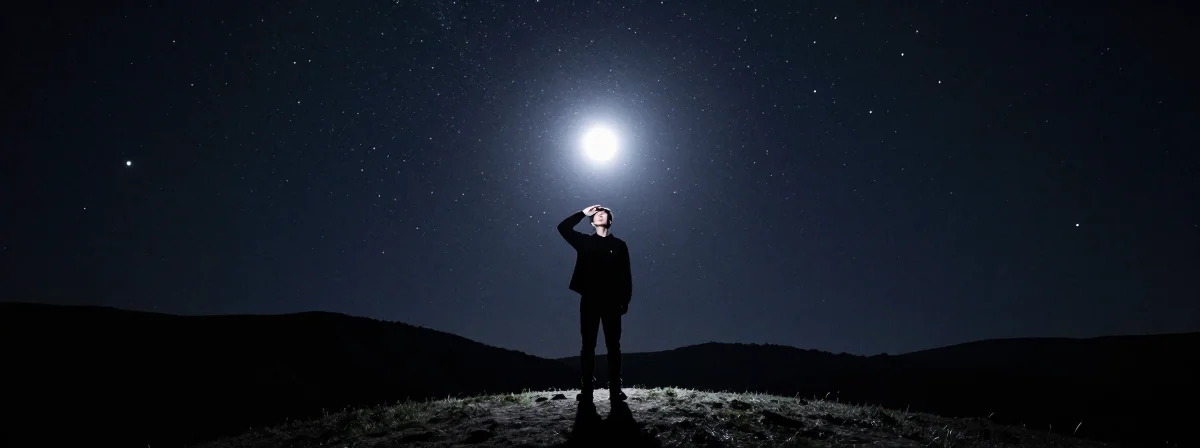
You’ve probably seen it. That fleeting shadow in the corner of your eye. You turn your head, convinced you spotted something—or someone—out of the corner of your eye, only to find nothing there. It feels like a ghost, or a trick of the light.
It isn’t a ghost. It’s biology.
That “ghost” you just saw wasn’t a supernatural apparition; it was your peripheral vision picking up on subtle shifts in light levels that your brain hasn’t processed for clarity yet. The same biological quirk that makes you jump at a sudden movement in the dark is also the reason astronomers and fighter pilots rely on a specific, counterintuitive technique to see faint objects.
It comes down to how your eyes are actually built.
Why You See Ghosts in the Corner of Your Eye
Your eyes are constantly scanning for threats. Evolution didn’t wire your central vision for beauty; it wired it for survival. The center of your retina is packed with photoreceptors designed to spot predators or prey. The edges, however, are wired for sensitivity.
When you see something in your peripheral vision, you aren’t seeing it clearly. You’re seeing a silhouette, a shape, or a shift in brightness. Your brain fills in the details. If that shift happens in the dark, your brain might interpret it as a figure, a face, or a shadow. It’s a survival mechanism gone into overdrive, prioritizing “something moved” over “what is it.”
This is why people often report seeing “ghosts” out of the corner of their eyes. They aren’t seeing a ghost; they’re seeing a faint light source—maybe a streetlamp or a distant car—hitting the sensitive rods at the edge of their vision before their brain can process the image.
The Anatomy of Darkness: Rods vs. Cones
To understand why staring directly at something in the dark is a bad idea, you have to look at the hardware. Your retina contains two distinct types of cells: rods and cones.
- Cones are located in the center of your vision (the fovea). They are densely packed, giving you sharp detail, vibrant color, and high resolution. They are terrible at low light, though.
- Rods are located in the periphery. They are less sensitive to color and detail, but they are incredibly sensitive to low light and movement.
The trade-off here is stark. The center of your eye is a high-definition screen for bright daylight. The edges are a low-resolution, high-sensitivity sensor for darkness.
When you look directly at a dim object at night, you are forcing your high-definition cones to work in a setting they weren’t designed for. You’re essentially trying to watch a 4K movie on a phone with the brightness turned all the way down. It’s a mismatch of hardware and environment.
The “Look Away” Technique: Averted Vision
If you want to see something faint in the dark, you don’t look at it. You look at the edge of your vision.
This is known as averted vision. It works because the dim object is hitting your peripheral rods, which are sensitive to low light, while your central cones continue to focus on the dark background. The contrast between the faint object and the dark background makes the object pop.
Astronomers use this constantly. When looking at a faint nebula or a distant galaxy, they don’t stare at the center of the telescope eyepiece. They look slightly to the side. It feels like you’re looking away from the object, but you’re actually maximizing the light intake.
Pilots use the same logic when scanning for traffic at night. If ATC says “traffic 9 o’clock,” a pilot doesn’t stare at 9 o’clock. They look at 8:30 or 9:30. They use their peripheral vision to spot the faint light of another plane without losing their focus on the instruments or the runway.
Evolution’s Trade-Off: Survival vs. Clarity
Why did nature build the eye this way? Why not just make everything sensitive to light?
Evolution favors function. The center of your vision evolved to identify threats and identify food sources during the day. You needed to know if a lion was crouching in the grass or if a berry was ripe. The periphery evolved to keep you alive when the sun goes down. It needed to detect the subtle glint of a predator’s eyes or the movement of leaves in the wind.
It’s a trade-off between detail and sensitivity. You can have one, but you can’t have both in the same spot. Your fovea sacrificed sensitivity for clarity. Your periphery sacrificed clarity for sensitivity.
How to Hack Your Night Vision Right Now
You don’t need a telescope or a cockpit to use this knowledge. You can hack your own biology right now.
Next time you’re trying to read a dim sign in a parking lot or look for a specific star in the sky, stop staring. Relax your eyes. Look slightly to the side of the object you want to see. Let your peripheral vision take the load.
You might be surprised at how much more you see. It feels counterintuitive—like you’re looking away from what you want to find—but you’re actually aligning your biology with the physics of light. You’re not fighting your eyes; you’re working with them.