
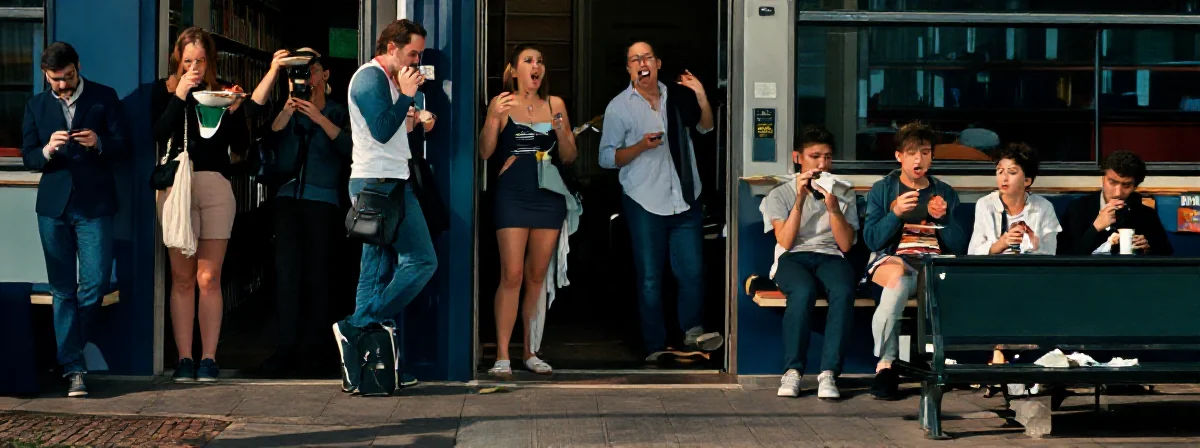
There is a specific kind of rage that only happens when you are standing in a checkout line and the person behind you is pressing their shopping cart against your lower back. It’s a physical violation that triggers an immediate, primal “fight or flight” response, yet you are trapped in a queue with no exit strategy. You aren’t just annoyed; you feel your personal boundaries being eroded by a stranger who seemingly forgot the basic rules of coexistence.
This isn’t just about bad manners. It’s a symptom of a broader societal shift where the concept of shared public space is being replaced by a chaotic individualism that treats the sidewalk, the bus, and the waiting room as private extensions of one’s living room. When you travel to places like Japan, where the collective consciousness dictates that the comfort of the group supersedes the individual, the contrast becomes jarring. Returning home, the sudden absence of that shared social contract feels less like freedom and more like a descent into disorder.
The evidence is everywhere, from the man in the doctor’s office testing ringtones at full volume to the teenager blocking the entire elevator entrance while staring at a screen. These aren’t isolated incidents; they are the daily friction of a culture that has forgotten how to be present. Understanding why these behaviors happen—and why they feel so offensive—is the only way to navigate a world that increasingly seems designed to irritate you.
Why Does the World Feel Like It’s Suddenly Become So Selfish?
The phenomenon you are experiencing is often described as “reverse culture shock,” but it’s not just about missing the polite efficiency of a foreign country. It is a collision between two different operating systems for human interaction. In many high-functioning societies, social cohesion is maintained through a silent agreement: I will not inconvenience you, and you will not inconvenience me. This creates a predictable, low-friction environment where you can move through a city without constant micro-aggressions.
When that agreement dissolves, the environment becomes a high-friction zone. Consider the grocery store aisle. In a culture with strong spatial awareness, a shopping cart is treated like a vehicle that requires signaling and checking blind spots. When someone barrels out of a perpendicular aisle without looking, they are treating the cart as an extension of their own body, oblivious to the fact that it occupies a space that belongs to everyone else. It’s not just rude; it’s a failure of cognitive empathy. They cannot simulate the perspective of the person they are about to hit because they are entirely absorbed in their own internal world.
This lack of spatial awareness is the root of the “choke point” problem. Whether it’s a doorway, a bus entrance, or a narrow sidewalk, there is always someone standing in the middle, glued to their phone. They aren’t trying to be difficult; they are simply unable to perceive the flow of traffic because their attention is captured by a digital stimulus. The world has stopped for them, and they expect the rest of humanity to stop with it. This creates a bottleneck of frustration that feels like a personal attack, even though it’s just a failure of situational awareness.
The Technology Trap: How Screens Are Rewiring Our Social Instincts
You might notice a pattern in these violations that transcends generations. It isn’t just the older generation blasting Facebook videos or the younger generation blasting TikTok sounds; it’s the device itself that has become the problem. The smartphone has created a “bubble” of privacy that exists in the middle of a public space. When you put on headphones, you create a boundary. When you use the speaker, you dissolve it.
The behavior of holding a phone on speakerphone, especially while walking or standing in a crowded area, is a profound misunderstanding of public etiquette. It assumes that your conversation is more important than the silence of everyone else. Imagine sitting in a dentist’s office, waiting quietly, only to have a stranger start playing a video about “how technology is ruining our children” at full volume. The irony is suffocating, but the behavior is consistent: the user feels entitled to broadcast their private life to the public sphere.
This is where the “boomer vs. Gen Z” distinction blurs. Both groups are guilty of the same fundamental error: they are treating the public environment as a backdrop for their private consumption. Whether it’s a Boomer yelling on a speakerphone in the kitchen or a Gen Z user blocking a subway door while scrolling, the result is the same. They have lost the ability to distinguish between “my space” and “our space.” The device becomes a shield, allowing them to ignore the social cues of the people around them. They aren’t being malicious; they are just disconnected from the reality of the room they are occupying.
The worst offenders are often those who think they are being helpful or efficient. They stand in the middle of the sidewalk, “checking their phone,” effectively becoming a traffic light that no one can bypass. They don’t realize that their “quick check” has turned the sidewalk into a parking lot. This is the modern equivalent of throwing a cigarette out of a car window: a momentary convenience that creates a lasting mess for everyone else.
The Erosion of Personal Space and the “Human Wall” Effect
There is a specific type of aggression that happens when people ignore the invisible lines of personal space. It’s not just about standing too close in line; it’s about the collective behavior of groups. When two or three people walk together, they often form a “human wall,” taking up the entire width of the sidewalk and forcing everyone else to walk around them or squeeze past. This isn’t accidental; it’s a subtle assertion of dominance.
Think of it like a physical barrier. In a crowded city, space is a currency. When you block an aisle in a grocery store, you are hoarding that currency. When you stand in front of an elevator, you are blocking the flow of traffic. These actions communicate a clear message: My presence is more important than your movement. It’s a form of passive aggression that feels like road rage but happens on foot.
The frustration peaks when this behavior happens in confined spaces, like a bus or a subway car. You are trapped. You cannot move. And yet, someone is standing right in your face, or worse, holding their phone up to their mouth like a megaphone, broadcasting their conversation to the entire car. The physical proximity combined with the auditory intrusion creates a sensory overload that makes you feel like you are being invaded.
This is why the “look” you give someone who is too close is so powerful. It’s a non-verbal signal that says, “You are violating a social contract.” Unfortunately, for many, that signal goes unheard. They don’t understand that the distance they are maintaining is not enough. They don’t realize that if your cart is touching your butt, you are already too close. The lack of spatial awareness is so deep that it feels like a different species is walking among us.
The Silent Rage of the Waiting Room and the Public Sphere
The most jarring examples of this breakdown often happen in places where we expect the most restraint: hospitals, dentist offices, and waiting rooms. These are spaces of vulnerability. You are sick, you are anxious, you are waiting for news. And yet, you are subjected to the worst of the public’s behavior.
Imagine sitting in an emergency room waiting area, trying to process a medical crisis, while a stranger is testing ringtones. Beep, beep, boop, boop. It’s not just annoying; it’s a violation of the sanctity of the moment. It shows a complete lack of empathy for the situation. They don’t care that you are worried, that you are in pain, or that you are trying to focus. They are just bored and need to entertain themselves.
This behavior extends to the simplest of actions. Spitting on the sidewalk, littering, or throwing trash out of a car window are all acts of disrespect for the shared environment. They are saying, “I don’t care about this place, and I don’t care about the people who live here.” It’s a form of environmental nihilism. When you see someone throw a cigarette out of a car window, they are treating the street as their private trash can. When you see someone spit on the sidewalk, they are treating the public square as their personal bathroom.
The irony of these actions is that they often happen in the most polite, quiet, and orderly settings. The contrast between the expected behavior of a hospital waiting room and the actual behavior of a stranger testing ringtones is what makes it so infuriating. It breaks the social contract that we all agree to follow in these spaces.
The Global Perspective: Why Some Cultures Feel So Much Calmer
The reason these behaviors feel so jarring is often because you’ve experienced a different standard. Travelers who have been to countries like Japan or parts of Europe often report a “reverse culture shock” upon returning home. They are floored by the rudeness, the noise, and the lack of consideration.
In these cultures, the social contract is written in the details. The homeless person sweeping in front of their tent isn’t just cleaning up; they are maintaining the dignity of the space. The person on the bus doesn’t talk on the phone; they respect the silence. The person in the grocery store checks the aisle before turning the corner. These are not just rules; they are a way of life that prioritizes the collective well-being over individual convenience.
When you return to a place where this contract is weaker, the friction becomes immediate. You start to notice the “noise” of the city—the people talking on speaker, the carts barreling into aisles, the people blocking doorways. It’s not that the people are inherently worse; it’s that the social pressure to conform to these standards is much lower. The “invisible hand” that guides behavior in a high-functioning society is missing, leaving you to navigate a chaotic landscape.
This isn’t about judging one culture as better than another; it’s about recognizing the impact of social norms on your daily experience. When you live in a place where everyone respects the boundaries of others, life feels smoother. When you live in a place where those boundaries are constantly tested, life feels like a constant battle.
How to Reclaim Your Sanity in a Chaotic World
So, how do you deal with a world that seems determined to irritate you? You can’t change the behavior of everyone else. You can’t force the person on the bus to put on headphones, and you can’t make the person in the checkout line step back. But you can change your own response.
First, recognize that these behaviors are often a result of a lack of awareness, not malice. The person blocking the elevator isn’t trying to annoy you; they are just lost in their own world. The person on the speakerphone isn’t trying to invade your space; they just don’t realize they are doing it. Understanding this can help you detach emotionally. It’s not a personal attack; it’s a failure of social calibration.
Second, use your own behavior as a model. Be the person who steps aside. Be the person who checks the aisle before turning. Be the person who respects the silence. By modeling the behavior you want to see, you contribute to the social fabric. You might not change the world, but you can change your corner of it.
Finally, accept that you will encounter these frustrations. They are part of the human condition in a crowded, fast-paced world. Don’t let them ruin your day. Take a deep breath, step aside, and keep moving. The world is chaotic, but you don’t have to be part of the chaos.
The Hidden Cost of Ignoring the Social Contract
The ultimate tragedy of these behaviors isn’t just the annoyance they cause; it’s the erosion of the social fabric that holds us together. When we stop respecting each other’s space, our time, and our peace, we create a society that is hostile and exhausting. We lose the ability to connect, to trust, and to feel safe in our own communities.
The next time you see someone blocking the sidewalk, blasting music, or ignoring personal space, remember that they are not just being rude. They are breaking a contract that we all agreed to. And when you break that contract, you make the world a little smaller, a little noisier, and a little less human.
The solution isn’t to fight back with anger. It’s to remember why we agreed to these rules in the first place. We agreed to them because we wanted to live in a world where we could move through our days without constant friction. We agreed to them because we wanted to feel safe, respected, and heard.
When you see someone breaking these rules, you are seeing the cost of that agreement being paid. And while you can’t force them to pay it, you can choose to keep your own side of the contract intact. That’s the only way to reclaim your sanity in a world that seems determined to take it away.