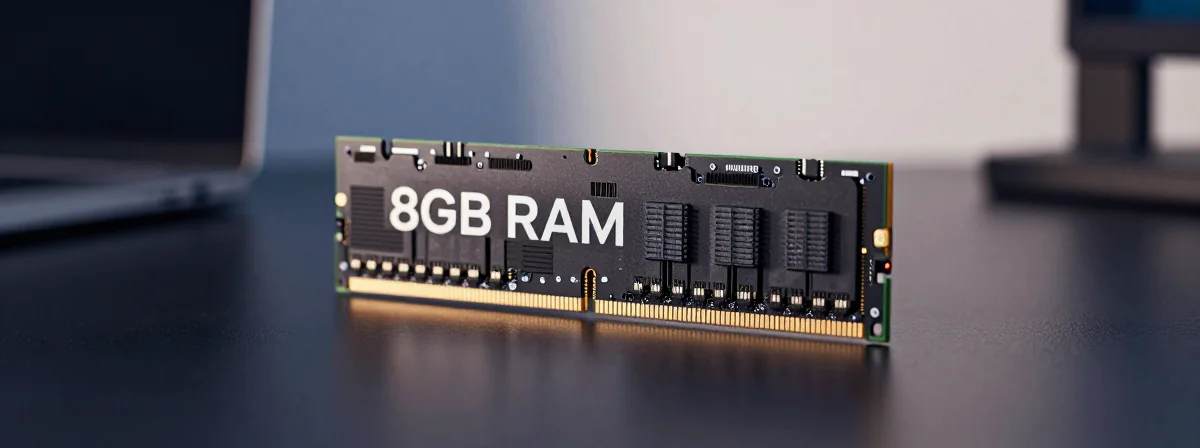
Have you ever wondered why your perfectly good PC suddenly starts sputtering when you try to do multiple things at once? It’s not your imagination — it’s likely your 8GB RAM working overtime. This humble memory component, once considered ample, now finds itself at the center of a digital tug-of-war between what we ask our computers to do and what they can actually handle.
In today’s computing landscape, where every app seems to demand more resources, understanding what 8GB RAM can and can’t do has become essential knowledge. It’s not just about whether your computer will turn on — it’s about whether it will run smoothly when you’re trying to get real work done.
Consider this: modern operating systems, web browsers, and applications have grown like digital weeds, demanding more memory than ever before. What was once considered sufficient is now often the bottleneck holding back performance in ways that aren’t always obvious but are definitely felt.
Can 8GB RAM Actually Run Modern Games?
Let’s cut to the chase: yes, 8GB RAM can run modern games, but with significant compromises. Think of it like trying to water your entire garden with a small watering can — you can do it, but you’ll be constantly refilling and some plants won’t get enough.
Games like Minecraft, Terraria, or Fortnite might run reasonably well on 8GB, but as soon as you venture into more demanding titles like Cyberpunk 2077 or Silent Hill 2, you’ll notice the limitations. These games require more memory to handle complex environments, textures, and physics calculations. When your system runs short, it starts using “swap” — essentially borrowing space from your storage drive to pretend it has more RAM. This creates a digital bottleneck that manifests as lag, stuttering, and frustrating performance drops.
The situation gets even worse when you try to do anything else while gaming — like having Discord open for voice chat, streaming to Twitch, or even just checking a web page. Each additional task creates another demand on your limited memory resources, turning what should be an immersive experience into a digital wrestling match.
Why Your PC Suddenly Freezes When You Open Multiple Tabs
Have you ever experienced that moment of dread when your perfectly functioning computer suddenly freezes, forcing you to wait (or worse, restart)? If you’re running 8GB RAM, this phenomenon is likely more familiar than you’d like.
Modern web browsers are memory hogs. Each tab, especially those with rich media content, consumes memory. Run enough tabs simultaneously, and you’ll quickly exceed your available RAM. This is why someone with 8GB RAM could run 20 Firefox tabs plus a game without slowdown on an older system — those older applications were simply less demanding.
Today’s browsers, with their complex rendering engines and background processes, are memory-intensive. Couple this with resource-heavy applications like video editors, 3D modeling software, or virtual machines, and 8GB becomes painfully limiting. It’s like trying to fit an elephant in a phone booth — eventually, something has to give.
The solution isn’t just closing tabs, either. Modern operating systems are designed to keep frequently used applications in memory for quick access. When you close an application, the memory isn’t necessarily freed up immediately, creating a complex dance of resource allocation that 8GB systems struggle to manage effectively.
The Hidden Cost of “Swap” Space
When your 8GB RAM is maxed out, your computer doesn’t just stop working — it starts using a technique called “swap.” This is when your system borrows space from your storage drive (SSD or HDD) to simulate additional RAM. While clever, this workaround comes with significant performance penalties.
Think of it like this: RAM is like a chef’s workstation with all ingredients ready at hand, while swap is like the chef having to constantly run to the pantry for ingredients. The more you rely on swap, the more your system slows down, creating that frustrating lag and hesitation that makes computing feel sluggish.
There’s an additional hidden cost: swap operations wear out your storage drive. While this might seem minor, it becomes critical with devices like the Neo that have non-replaceable SSDs. Once that storage fails, the entire device becomes unusable — a far cry from simply upgrading RAM in a traditional laptop.
The situation is even more challenging when you consider that some tasks require dedicated VRAM (Video RAM) that isn’t shared with system RAM. Without dedicated VRAM, your tiny 8GB pool gets stretched even thinner, making performance issues more pronounced.
How 8GB RAM Affects Creative Professionals
For those in creative fields, the limitations of 8GB RAM become immediately apparent and often painful. Try running Substance Painter and Unreal Engine simultaneously on an 8GB system, and you’ll quickly experience what many call the “digital wall” — that point where your system simply can’t keep up.
Creative applications like these require massive amounts of memory to handle complex textures, models, and rendering calculations. When your system runs short, it can’t just slow down gracefully — it often crashes or becomes unusably slow. This isn’t just an inconvenience; it’s a creativity killer that can derail projects and frustrate users to the point of hardware upgrades.
Consider a scenario where you’re working with a 5GB file in Blender. On an 8GB system, your available memory is already stretched thin before you even begin working. This leaves little room for additional applications, browser tabs, or even system processes, creating a fragile environment where any additional demand can cause a complete system failure.
It’s not just professional applications either. Even casual creative work like photo editing in Adobe Lightroom or video editing in DaVinci Resolve becomes a challenge on 8GB systems. The difference isn’t just speed — it’s about stability and the ability to work without constant interruptions.
The Economics of RAM: Why 8GB Persists
It’s fascinating to consider why 8GB RAM remains a common specification when its limitations are so clear. The answer lies in the economics of computing and evolving user expectations.
Historically, memory prices have followed a predictable downward trend, making larger capacities more accessible over time. However, recent market conditions have disrupted this pattern, with 16GB RAM doubling in price since 2018. This economic reality has forced many users and manufacturers to make do with 8GB, even as software demands continue to grow.
This creates a curious paradox: we’re using more memory-intensive applications than ever before, but the economic constraints have made upgrading more difficult. The result is a growing population of users experiencing frustrating performance limitations without clear paths to solutions.
It’s worth noting that this economic reality affects different user groups unevenly. Gamers, creative professionals, and developers often find the investment in 16GB or more justifiable, while casual users might stretch 8GB further through careful resource management. This creates a bifurcated computing landscape where experience varies dramatically based on both hardware and usage patterns.
Beyond Gaming: How 8GB RAM Affects Everyday Productivity
While gaming often gets the spotlight in RAM discussions, the impact on everyday productivity is equally significant — though sometimes less obvious. Consider the modern office worker who might have 15 fully loaded browser tabs open simultaneously, alongside email clients, messaging apps, and productivity software.
On an 8GB system, this scenario creates a constant memory pressure that leads to subtle but cumulative performance degradation. Tasks that should take seconds might take minutes, applications might freeze unexpectedly, and the overall computing experience becomes one of constant frustration and compromise.
The situation is particularly challenging for those who rely on virtual machines for work. Running a VM effectively doubles your memory requirements, as you need enough RAM for both your host operating system and the guest environment. This makes 8GB an almost unusable configuration for VM-heavy workflows.
Even seemingly simple tasks like using Adobe Creative Cloud applications or modern office suites can become challenging on 8GB systems. These applications have grown increasingly resource-intensive, expecting more from our hardware than ever before. The result is that what was once considered a capable system now feels like a digital straightjacket.
The Future-Proofing Question: Is 8GB RAM Worth It Today?
When considering a new computer purchase or upgrade, the question inevitably arises: is 8GB RAM worth it today, or should you invest in more? The answer isn’t straightforward, as it depends on both current needs and future expectations.
For light users who primarily browse the web, check email, and use basic productivity applications, 8GB might still provide a satisfactory experience — for now. However, this configuration offers little room for growth or unexpected demands, making it vulnerable to future software updates and new applications.
For anyone doing more intensive work — gaming, creative production, development, or virtualization — 16GB has become the practical minimum for a smooth experience. This provides enough headroom to handle multiple applications simultaneously without resorting to swap operations that degrade performance.
The most compelling argument for moving beyond 8GB comes from considering how quickly our computing needs evolve. What seems sufficient today might be frustratingly limiting in just a few years. Investing in 16GB or even 32GB today might seem like overkill, but it provides a buffer against future demands that we can’t yet anticipate.
Reimagining 8GB RAM: When Less Can Be More (If Managed Right)
Before concluding that 8GB RAM is always inadequate, it’s worth acknowledging that with careful management, it’s possible to extract decent performance from this configuration. The key lies in understanding your system’s limitations and working within them.
One approach is to minimize background processes and resource-heavy applications. Close unnecessary browser tabs, disable startup applications, and avoid running multiple memory-intensive applications simultaneously. While this requires conscious effort, it can make 8GB feel more manageable.
Another strategy is to optimize your workflow. For example, creative professionals might find that working in smaller, more focused sessions rather than keeping applications open continuously helps manage memory usage. Gamers might need to accept lower settings or avoid streaming while playing.
Ultimately, though, these are workarounds rather than solutions. They represent a compromise between what we want our computers to do and what they’re capable of, rather than a true path to optimal performance. The digital equivalent of tiptoeing through a minefield — possible, but not ideal.
The Final Verdict: 8GB RAM in Context
After exploring the capabilities and limitations of 8GB RAM across various scenarios, what’s the final verdict? The truth, as with many things in computing, lies in context.
For basic web browsing, email, and light productivity, 8GB RAM can still provide a functional experience — though not necessarily a smooth one. Users willing to carefully manage their applications and avoid pushing their systems too hard can make this configuration work.
For more intensive tasks like modern gaming, creative production, virtualization, or running multiple demanding applications simultaneously, 8GB RAM becomes a significant bottleneck. The performance limitations, while sometimes subtle, create an experience that’s far from optimal and often frustrating.
The most important takeaway isn’t that 8GB RAM is universally good or bad, but that understanding your specific needs and how they align with hardware capabilities is essential. In an era where our expectations for computing continue to grow while economic constraints sometimes limit our options, making informed decisions about memory capacity has never been more important.
The digital landscape continues to evolve, and what’s sufficient today might be limiting tomorrow. By understanding the realities of 8GB RAM, we can make more informed choices about our computing investments and better appreciate the trade-offs we’re making in pursuit of affordable technology.
**