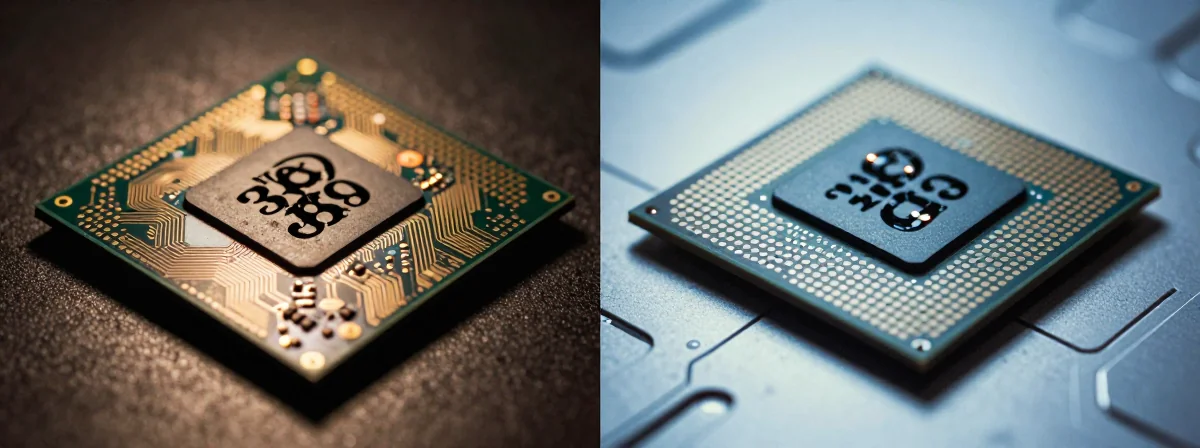
I’ve been asked more times than I can count: how do today’s chips stack up against the old guard? Watching someone marvel at the number “386” appearing again in modern tech is like seeing a ghost from the past—except this time, it’s not just nostalgia. Here’s the thing nobody’s talking about—the true measure of progress isn’t just speed, but what that speed enables.
The Teaching
SIDE A
The Intel 386 was a pioneer. It didn’t just run programs; it taught us what was possible. My first PC with that chip felt like magic—opening Windows 3.1, playing early games, the hum of the fan as it strained under the load. It had a simplicity that modern chips can’t replicate. Today’s equivalent might run circles around it, but the 386 taught us patience. It showed us that even with limited power, creativity thrives. The performance was honest—what you saw was what you got, no marketing jargon hiding behind gigahertz.
SIDE B
Modern processors like the Panther Lake X9 are marvels of engineering. They don’t just run Doom; they render virtual worlds that would have seemed impossible thirty years ago. The build quality of today’s machines is often better, too—no creaking plastic, no compromises. When I paid $440 for a machine with 32GB of RAM and an OLED screen, I wasn’t just buying hardware; I was buying the future. These chips handle multitasking like a conductor leading an orchestra, keeping dozens of tabs open without breaking a sweat.
THE REAL DIFFERENCE
Here’s what most people miss: the 386 didn’t just run slower; it required a different kind of focus. You couldn’t have 15 browser tabs open and expect it to sing. Today’s chips solve that, but they also create a new problem—they make us forget how to wait. The real difference isn’t in the numbers—386 vs. 101, or X7 vs. X9—it’s in what we do with that power. The 386 taught us to value efficiency; modern chips teach us to value convenience. But convenience has a cost: we’re always connected, always on, always demanding more from our devices—and ourselves.
THE VERDICT
If you’re building a machine for creative work or demanding tasks, the modern chip is the clear winner. It frees you from the constraints of the past. But if you’re looking for a tool that won’t distract you—something that runs quietly in the background while you think—sometimes less is more. From experience, I’d choose the modern hardware for productivity, but I’d keep a retro machine nearby for moments when I need to slow down. After using both for years, I’ve learned that the best tech is the tech you don’t notice—until you need it.
What to Remember
The numbers will always change, but our relationship with technology shouldn’t. A faster chip doesn’t make you more productive if you’re still distracted. A slower machine doesn’t hold you back if it helps you focus. The real magic isn’t in the silicon—it’s in how we choose to use it. Next time you’re comparing specs, ask yourself: what problem am I actually trying to solve? The answer might surprise you.