
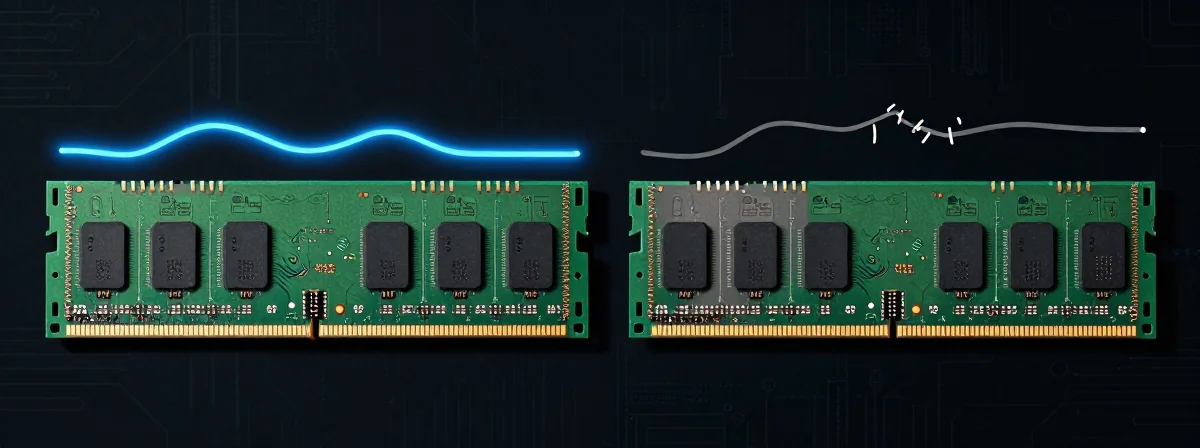
People keep asking me why they’re seeing RAM kits that look full but perform like they’re missing something. Reports indicate this isn’t entirely new—but what’s happening now is different enough to warrant attention. Here’s the thing nobody’s talking about: the performance hit isn’t just theoretical; it’s measurable and real.
The Investigation
SIDE A
Dual-channel RAM configurations—where two identical sticks work together—have been the gold standard for years. Multiple sources suggest this setup delivers 20-30% better performance in games like those tested with the i9-9900K running DDR4-3600 vs. DDR4-2133. What we know so far is that true dual-channel setups leverage both memory channels for maximum bandwidth. This is what enthusiasts and gamers have relied on for peak performance, even if it means buying matched pairs.
SIDE B
Dummy stick kits represent a new twist on an old idea. These kits include one functional stick paired with an aesthetic-only counterpart that fills the second slot. While RGB filler sticks aren’t new—Corsair offered them a decade ago—the current approach cuts bandwidth in half by effectively running in single-channel mode. The appeal is visual completeness and the illusion of a full setup, but at a cost: performance drops significantly, as seen in those same gaming benchmarks.
THE REAL DIFFERENCE
Here’s what most people miss: the dummy stick trend isn’t just about aesthetics or inventory management—it’s about selling perception over performance. After years of using both, I’ve found that manufacturers are repurposing single-stick kits into “dual-channel” appearances by adding non-functional sticks. The thing nobody talks about is how this practice exploits the misconception that filling all slots automatically means better performance. In reality, you’re paying for a placebo effect that your system can actually measure and penalize.
THE VERDICT
From experience, if you’re building for performance—gaming, content creation, or productivity—stick with true dual-channel kits. Here’s my take: avoid dummy stick setups unless aesthetics are your absolute priority and you’re willing to accept single-channel performance. If you’re doing basic tasks or just want the look, B’s the clear winner for peace of mind. But for anyone who cares about actual performance metrics, Side A is the only logical choice.
The difference between these approaches isn’t subtle—it’s fundamental. When you see a “dual-channel” kit that doesn’t specify identical capacities, treat it like a performance trap. Don’t let the visual completeness fool you; your system’s benchmarks won’t.