
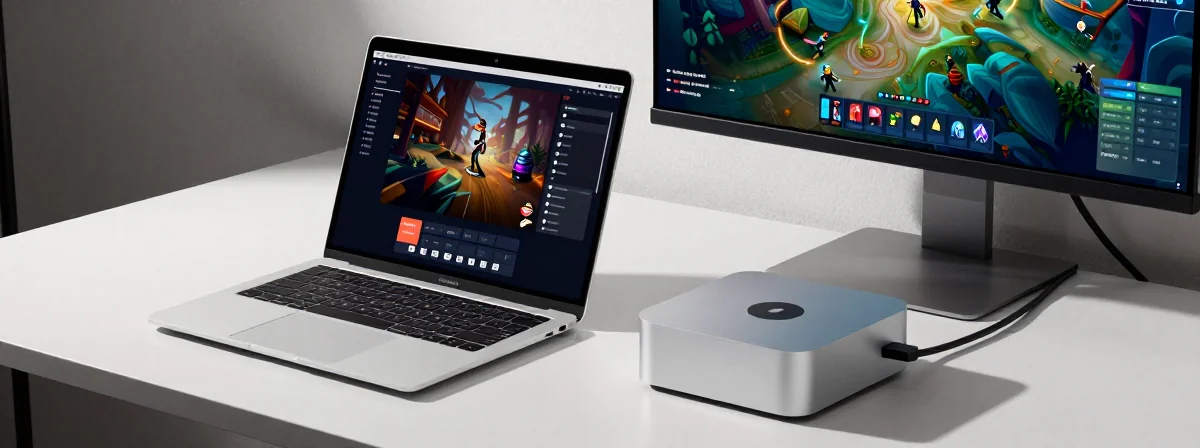
People keep asking me if Apple is serious about gaming. They point to the M5 chip in the MacBook Air and the refreshed Mac mini, wondering if these devices signal a shift. Here’s the thing nobody’s talking about—the debate isn’t just about hardware; it’s about Apple’s entire approach to a market it hasn’t truly competed in for decades.
Building the Case
SIDE A: MacBook Air The MacBook Air with the M5 chip represents Apple’s ultra-portable vision—thin, quiet, and efficient. It doesn’t throttle under typical gaming loads, as some users report playing demanding titles like Cyberpunk 2077 for extended periods. The Air’s passively cooled design means it can’t sustain high-end gaming, but for 60fps experiences at 1080p, it delivers surprisingly well when games support Metal API properly. It’s the model for casual gamers who prioritize mobility and don’t need console-level performance. The Air’s strength lies in its balance of portability and acceptable performance for less demanding titles.
SIDE B: Mac mini The Mac mini, now featuring the same M5 chip as the Air, becomes the entry-level desktop alternative. It offers more consistent performance than the Air since it isn’t constrained by thermal limitations. With the M5’s improved GPU capabilities, the mini can handle more graphically intensive games than its predecessor. However, its $400 price point doesn’t make it competitive with consoles offering three times the raw power. The mini is for users who need a compact desktop solution and are willing to accept compromises in gaming performance for the sake of Apple’s ecosystem.
THE REAL DIFFERENCE Here’s what most people miss: Apple’s gaming limitations aren’t just hardware-related. The M5 GPU’s sequential execution model—compared to competitors’ dual-issue architectures—limits its peak performance. While Apple’s unified memory design saves space and power, it hampers gaming performance compared to systems with dedicated graphics RAM. More critically, the lack of native game support remains the biggest hurdle. Even with tools like Crossover from CodeWeavers, Mac users face a vicious circle—developers won’t prioritize macOS until there’s a larger user base, and users won’t switch until games run natively. The real difference isn’t the M5 chip itself, but Apple’s unwillingness to address these systemic software and developer ecosystem issues.
THE VERDICT If your priority is portability and occasional gaming at 60fps, the MacBook Air makes sense—but only if you’re willing to accept compromises. For desktop users who need more consistent performance, the Mac mini is the logical choice, though it still falls short of console-level gaming. From experience, neither device is a serious gaming contender. Apple needs to either invest in a dedicated gaming platform with discrete graphics or embrace compatibility layers like Proton for ARM. Until then, serious gamers should stick with consoles or Windows PCs—Apple’s hardware isn’t the issue; its ecosystem strategy is.
Reasonable Doubt Remains
The debate about Apple’s gaming ambitions often overlooks the company’s historical approach. For over 35 years, Apple has treated gaming as a byproduct rather than a primary focus. While the M5 chip shows incremental improvements, the lack of native game support and developer tools means Apple isn’t serious about competing in the gaming market anytime soon. Make your choice based on your actual needs—not on wishful thinking about Apple’s potential.