
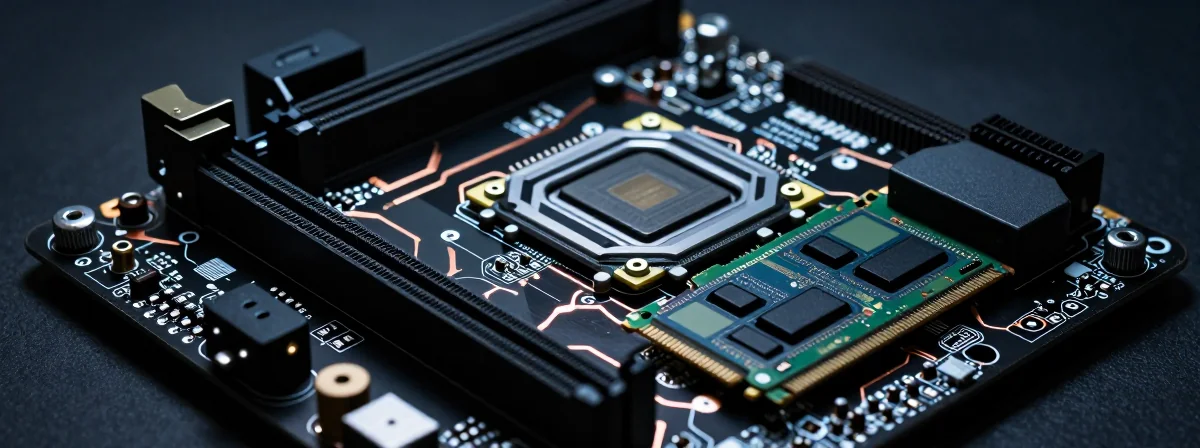
Remember the golden age of PC building when you weren’t just buying a motherboard; you were designing a Frankenstein experiment? There was a time when you could pop open a case and see a chaotic mess of RAM slots—some for SDRAM, some for DDR, maybe even DDR2 if you were feeling adventurous. It was a glorious, messy buffet of memory standards. Now? It’s a monoculture. You pick your poison—DDR4 or DDR5—and you stick to it until your computer finally rots away. It’s not just boring; it’s rigid. You look at the modern landscape and wonder why the industry decided to kill the “dual-generation” slot in favor of forcing you to choose a religion.
The nostalgia trip usually starts with the legendary ECS K7S5A. If you were a broke kid in the early 2000s, you know this board. It was the king of “bang for buck” because it was incredibly stupidly versatile. It had two slots for the ancient SDRAM your Pentium II was using and two slots for the shiny new DDR memory you desperately wanted. You could upgrade your RAM in baby steps, stretching your budget until it snapped. It wasn’t elegant, but it worked. You could run a Radeon 8500 LE or a GeForce 4 Ti 4200 on that thing without breaking a sweat. It was the ultimate tool for the broke enthusiast who had more time than money. You spent hours researching forums to find the sweet spot between performance and price, and when that board finally died, it took a piece of your soul with it.
Not every experiment in dual-generation memory was a success, of course. There were plenty of trash boards out there that promised the world and delivered a headache. Remember the VIA chipsets? They were the nightmare fuel of the early DDR era. You could have a board with both DDR and SDRAM slots, but good luck trying to actually use the SDRAM. It would run so slowly it felt like it was trying to process information through molasses. The Asrock K7VM2 is a prime example of this. You could use DDR, sure, but the SDRAM slots were effectively decoration. It was a trap for the unwary, a lesson in why sometimes “compatible” doesn’t mean “usable.”
The modern equivalent of that “Frankenstein” approach is the “transition” board. You know the ones. They have two DDR4 slots and two DDR5 slots. It sounds like a dream come true if you have a drawer full of old DDR4 sticks gathering dust, right? Wrong. It’s a stopgap measure, a crutch for the manufacturer to clear out inventory. It’s rarely a good deal. These boards are usually designed to force you into buying the new standard. If you want the DDR5 slots, you’re paying a premium for the privilege of having those extra two slots sitting empty while you stare at your dusty DDR4 sticks. It’s a psychological trick, designed to make you feel like you’re getting a deal when you’re really just overpaying for a feature you can’t use.
This rigid standardization is exactly why the used market is still a goldmine for the budget-conscious. If you’re smart, you’re not buying new DDR5 kits. You’re buying used DDR4. The value proposition hasn’t changed in years. DDR4 is still vastly superior to DDR5 in terms of price-to-performance on the second-hand market. You can snag a stick of high-end DDR4 for pennies on the dollar compared to what you’d pay for the same capacity in DDR5. It’s the smart play. It’s the “I’m not a sucker” play. Unless you absolutely need the bandwidth of DDR5 for some specific, niche workload, sticking to DDR4 is a financial decision, not a technological one.
The real irony is that the “free motherboard” bundles you see at places like Microcenter are just a modern version of that old ECS strategy. They know you’re looking for a deal, so they throw a motherboard into the mix to make the RAM look cheaper. It’s a bundle of desperation. They have a massive oversupply of these boards, so they need to get rid of them. You snag a solid X870E board with a DDR5 kit, and sure, it feels like a win. But you’re still stuck with the rigid ecosystem. You’re still paying for the “future-proofing” that never actually arrives. You’re just playing their game, moving the pieces around the board while they change the rules.
We traded flexibility for stability, and honestly, we deserve it. The chaos of mixing SDRAM and DDR is gone, replaced by a boring, predictable landscape where everything just works. But that predictability comes at a cost. You can’t just slap in whatever RAM you have lying around. You have to plan, budget, and buy new. It’s the death of the hobbyist spirit, replaced by the consumerist drone. You can complain about it, or you can just buy the bundle and pretend you’re getting a discount. Either way, you’re stuck in the system.