
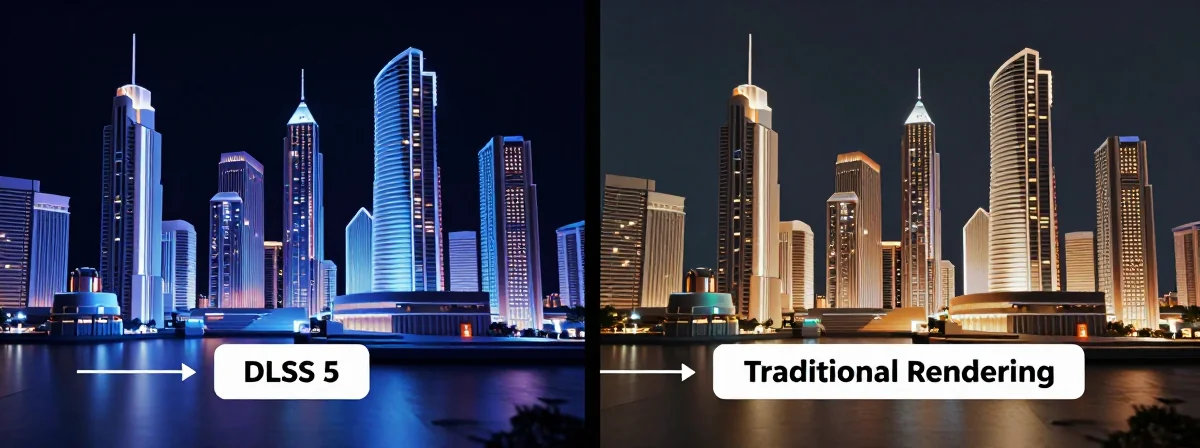
People keep asking me what the real difference is between DLSS 5’s AI-generated frames and traditional rendering. The debate’s heating up—especially after those Capcom and AC Shadows demos left developers and players scratching their heads. Here’s the thing nobody’s talking about: this isn’t just about upscaling anymore. It’s about fundamentally changing what we see on screen.
Here’s the thing nobody’s talking about: DLSS 5 isn’t just interpolating frames—it’s hallucinating them. The evidence is in the shadows. In the Capcom demo, direct shadows vanish like they were never there. In the AC Shadows example, an afternoon sun suddenly becomes overcast—complete with a monotonous white sheen that looks like someone ran a Reshade filter over the entire scene. Nvidia’s “detailed controls” turn out to be just an intensity slider and basic color grading—hardly the granular control developers need when their artistic vision is getting rewritten frame by frame.
Traditional rendering, on the other hand, stays true to the source material. When developers craft volumetric fog or specific shadow angles, those details remain intact. The control is absolute—from lighting direction to color temperature. There’s no guesswork, no unexpected “enhancements” that turn characters into unexpected caricatures or landscapes into overcast monotones. It’s what the artist intended, period.
Here’s what most people miss: DLSS 5’s AI doesn’t just upscale—it reinterprets. That “not changing geometry” claim falls apart when you see facial features morphing or shadows completely disappearing. The model, despite Capcom’s tuning, still produces uncanny results—Grace’s sudden makeup and the purple streaks at the bottom of some frames aren’t artistic intent; they’re artifacts of a system that’s trying to fill in gaps with educated guesses. After years of using both, I’ve found that traditional rendering gives you predictable results every time, while DLSS 5 gives you surprises—some pleasant, many not.
From experience, if you’re working on a project where artistic integrity is paramount—where every shadow angle and color grade matters—stick with traditional rendering. DLSS 5 might be the clear winner if you’re chasing maximum frame rates on cutting-edge hardware and can afford to treat the AI output as a suggestion rather than a final product. But if you’re seeing results like the yassified Grace or the missing fog, it’s time to question whether the trade-offs are worth it.
Case closed. The technology might evolve, but the core issue remains: when an AI starts making decisions that artists didn’t intend, we’re no longer enhancing games—we’re fundamentally altering them. And that’s a line worth watching closely.