
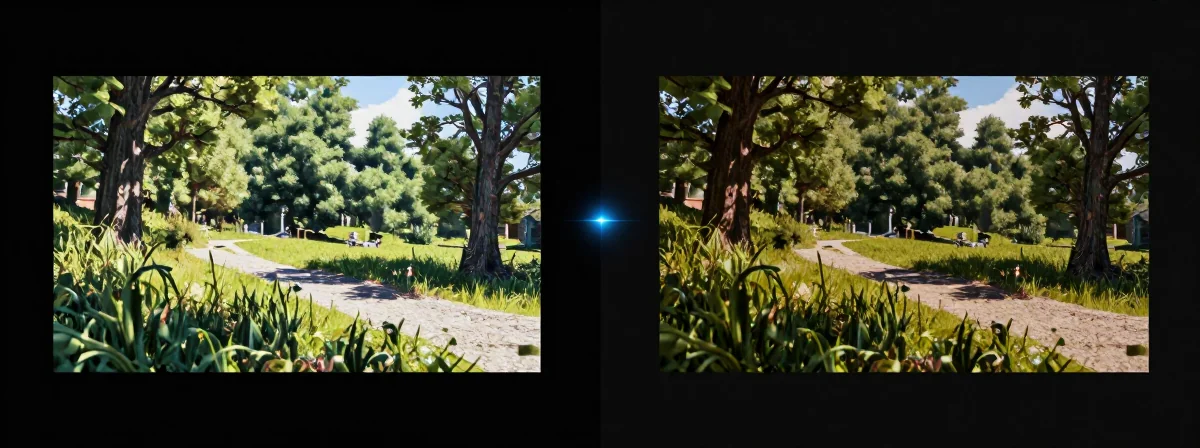
People keep asking me to compare DLSS5 with how games used to look. It’s not just about sharper edges or brighter colors—it’s about understanding what this tech actually does and what it’s replacing. Here’s the thing nobody’s talking about: DLSS5 isn’t just another upscaler; it’s a fundamentally different approach to rendering that’s still being fine-tuned.
Analyzing the Pattern
SIDE A: DLSS5 DLSS5 uses generative AI to enhance lighting and textures in real-time. It excels at making environments like Starfield’s scenery or leather materials look richer without the heavy performance cost of path tracing. The tech can dramatically improve scene depth and material detail when configured properly—some developers are already seeing impressive results with carefully tuned implementations. It’s designed to be an optional enhancement, not a replacement for traditional rendering, which means it can coexist with existing graphics pipelines. The potential is there for a sub-path tracing render cost that still delivers significant visual upgrades.
SIDE B: Traditional Rendering Traditional rendering relies on rasterization or path tracing to produce images. This method is predictable and gives artists full control over every pixel. It doesn’t introduce unexpected color shifts or lighting anomalies—what you see is exactly what the developer intended. While it can be performance-intensive, especially with path tracing, it’s the gold standard for accuracy and consistency. Developers know exactly how their assets will look, and players get a faithful representation of the game’s art direction without AI interference.
THE REAL DIFFERENCE Here’s what most people miss: DLSS5 isn’t just applying a filter—it’s analyzing the scene and making educated guesses to enhance it. The problem is, those guesses aren’t always right. The AI can overemphasize wrinkles, misinterpret shadows, or alter colors in ways that clash with the original design. Traditional rendering, on the other hand, doesn’t guess—it calculates. The inconsistencies in DLSS5 stem from its screen-space limitations and the fact that it’s still learning how to handle complex lighting interactions. After years of using both, I’ve seen this pattern before: new rendering tech always has growing pains, but DLSS5’s current issues—like blown-out colors or misaligned shadows—suggest it’s not quite ready for prime time in uncontrolled environments.
THE VERDICT If you’re building a game or optimizing for performance and you have the resources to fine-tune DLSS5, it could be a game-changer for visual fidelity at lower costs. But if you need reliability and want to avoid the risk of unintended visual artifacts, stick with traditional rendering. From experience, DLSS5 is best suited for scenarios where developers can dedicate time to calibration—otherwise, you’re better off with the tried-and-true methods. For now, it’s a powerful tool in the right hands, but not a magic bullet for every situation.
The gap between what DLSS5 promises and what it delivers right now is closing, but it’s not there yet. Until the AI can consistently match the intent behind a game’s art design without introducing quirks, traditional rendering remains the safer bet. When you do decide to experiment with DLSS5, expect to spend extra time tweaking it—because the difference between a great result and a messy one often comes down to that final polish.