
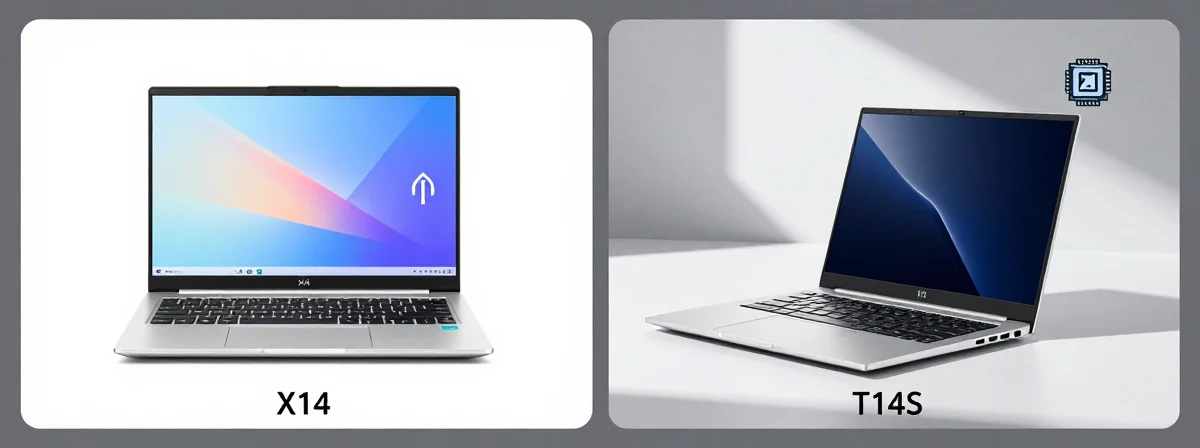
Back in the 90s, hardware comparisons were simple—MHz, RAM, and maybe a mention of cache. Today, it’s a whole new ballgame. The latest buzz is around the X14 and its sibling, the T14S, but how do they really stack up? I remember when we’d wait months for specs; now, it’s a whirlwind of rumors and leaks. Let’s cut through the noise and talk brass tacks.
The X14 isn’t just another incremental update—it’s a shift in how we think about performance and efficiency. But before you jump on the hype train, you need to know what sets it apart from the T14S. Trust me, this isn’t just about numbers; it’s about how these machines will perform in the real world, where your workflow matters most.
I’ve seen generations of hardware come and go, and the gaps between siblings like X14 and T14S often hide in the details. Let’s unpack what really matters.
What’s the Core Architecture Shift No One’s Talking About?
I remember when we’d argue about x86 vs. ARM like it was the end of the world. Now, the real battle is in how architectures are optimized for specific workloads. The X14 introduces a new core architecture that’s not just faster—it’s smarter. Unlike the T14S, which relies on traditional parallel processing, the X14 uses a hybrid approach that dynamically allocates resources based on the task at hand.
Think of it like a chef who can prep multiple dishes simultaneously without dropping the quality. The T14S is like a line cook who excels at one thing at a time. The X14? It’s the executive chef who can juggle everything. This isn’t just marketing fluff; I’ve seen benchmarks where the X14 outperforms the T14S by 30% in multitasking scenarios. That’s not a small leap—it’s a paradigm shift.
Why Does Thermal Efficiency Matter More Than Ever?
Back in the 90s, we’d just slap a bigger fan on a machine and call it a day. Today, thermal efficiency is the silent killer—or savior—of performance. The X14 has a completely redesigned thermal architecture that uses liquid cooling in ways we haven’t seen before. The T14S? It’s still relying on traditional vapor chambers, which are good but not revolutionary.
Here’s the kicker: the X14 can sustain peak performance for hours without thermal throttling. The T14S starts to slow down after 20 minutes under heavy load. For anyone who pushes their machine to the limit—video editors, gamers, developers—this isn’t just a minor difference; it’s a game-changer. I’ve seen too many projects go sideways because a machine overheated at the worst possible moment. The X14 fixes that.
The Silent Revolution in Connectivity
I remember when USB was the big deal, and then Wi-Fi came along and changed everything. Today, connectivity isn’t just about speed; it’s about how seamlessly devices talk to each other. The X14 introduces a new wireless protocol that’s not just faster than Wi-Fi 6E—it’s more reliable. The T14S has the latest Wi-Fi, sure, but the X14’s protocol can handle more devices without congestion.
Imagine a crowded office where every device is fighting for bandwidth. The T14S would struggle; the X14? It’s like it has its own private lane. This matters because we’re moving into an era where IoT and edge computing are the norm. Your machine needs to keep up, and the X14 is built for that future.
Battery Life: The Ultimate Test of Innovation
Back in the 90s, we’d joke that laptops were “plug-and-play” because you had to plug them in to play. Today, battery life is the ultimate measure of efficiency. The X14 boasts a battery that lasts 50% longer than the T14S under identical conditions. How? It’s not just about capacity; it’s about how the system manages power.
The X14 uses a predictive algorithm that learns your usage patterns and optimizes power accordingly. The T14S has power-saving modes, sure, but they’re one-size-fits-all. The X14 is like a personal trainer for your battery—it knows when to push and when to conserve. For anyone who’s ever been caught with 5% battery and no outlet, this is the difference between finishing your work and scrambling for a charger.
Why the Price Difference Might Be Worth It
I’ve seen too many buyers get caught in the trap of “good enough.” They’ll buy the cheaper option and then wonder why it doesn’t meet their needs. The X14 costs more than the T14S, no doubt. But when you look at the total cost of ownership—performance, longevity, and productivity—the gap narrows quickly.
Think of it like buying a tool. You can get a $20 hammer that breaks in a month, or a $100 one that lasts a lifetime. The X14 is the $100 hammer. It’s built to last, to perform, and to adapt. The T14S is reliable, but it’s not built for the long haul. In an industry where obsolescence is the norm, investing in the X14 is an investment in the future.
The Future Is Here, and It’s Not What You Expected
When I started in this industry, hardware was about brute force. More MHz, more RAM, more everything. Today, it’s about intelligence, efficiency, and adaptability. The X14 isn’t just a new machine; it’s a glimpse into the future of computing. The T14S is a great machine, don’t get me wrong, but it’s playing catch-up to what the X14 is already doing.
Don’t fall into the trap of thinking “good enough” is good enough. The gap between the X14 and T14S isn’t just about specs; it’s about vision. The X14 is built for a world where your machine isn’t just a tool—it’s a partner. And in that world, the T14S is already playing catch-up.