
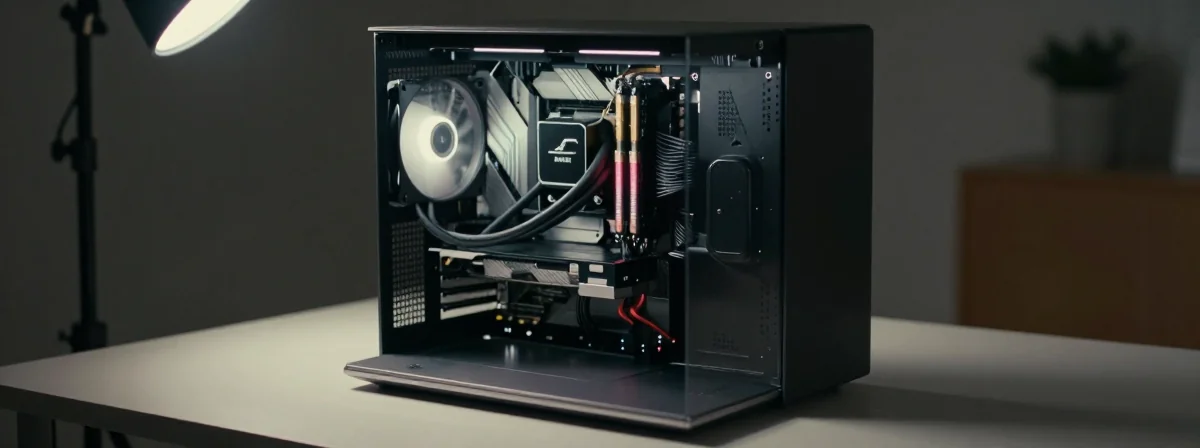
Ever wonder why your high-end laptop still chokes under pressure? You paid top dollar, you’ve got the latest specs—but when the stakes are highest, it’s like someone just pulled the plug. What are they hiding? The truth is, most laptop manufacturers故意 underdeliver to keep costs low. But what if I told you there’s a way to break free?
I’ve spent years wrestling with throttling, fan noise, and disappointing benchmarks. My 3060 mobile GPU should scream, not whisper. The CPU? A nuclear reactor waiting to explode. But then I stumbled on something… something they don’t want you to know. It’s not magic, but it’s close. And it starts with water.
No, not a bucket. We’re talking precision engineering, hidden in plain sight.
Why Your Laptop’s “Optimal” Cooling Is a Lie
Ever notice how your laptop’s fan sounds like a jet engine one minute, then nothing the next? That’s thermal throttling—your hardware’s way of saying, “I’m about to melt.” Tech companies call it “normal,” but is it? What are they hiding in those tiny specs?
My 10th-gen Intel rig was hitting 95-100°C before I even opened a game. The GPU? Cool as a cucumber. Why? Because Intel’s power draw is a black hole, and manufacturers know it. They don’t fix it—they just shrug. But here’s the kicker: with a water block and some thermal paste magic, I dropped that CPU to 82°C under full load. Full throttle, no apologies.
This isn’t some gimmick. It’s about conductivity, power delivery, and breaking the chains of “factory settings.”
The Secret Weapon: Water Blocks and Peltier Modules
When I first saw someone stick a water block to a laptop, I thought, “WTF?” Then I tried it. The idea is simple: replace the weak stock heatsink with a direct-attach water block. But here’s where it gets wild—some are using Peltier modules to pull heat away from the chip before it even hits the block.
Imagine this: a thin metal plate pressed against your CPU, with tiny thermoelectric coolers sucking heat into a custom loop. The thermal pads? Just a placeholder until you’re ready to go full nuclear. My rig now runs at 110W turbo—way beyond Intel’s “safe” limit. And guess what? It works.
Why don’t they tell you this? Because it voids warranties. Because it exposes their cheap thermal designs. But here’s the truth: if you’re serious about performance, you’re already outside their rules.
The 3060 Dilemma: GPU Cool, CPU Melting
My RTX 3060 stays under 70°C. My CPU? A different story. The imbalance is infuriating. Why does the GPU get priority? Simple: because GPUs sell laptops. CPUs? They’re just along for the ride.
After replacing the fan and repasting with Kryonaut Extreme, I got some relief. But the real fix? Dropping the CPU power limit to 55W. Suddenly, my temps normalized. But why settle? By tweaking the VBIOS and overclocking the GPU, I gained 10% FPS in every game. The catch? It’s not for the faint of heart.
But here’s the question: if you can unlock this potential, why buy “optimized” hardware at all?
Breaking the Rules: Overclocking Without the Fuss
Most people think overclocking means complex software and endless tweaking. Not anymore. With a custom water loop, you’re not just cooling—you’re redistributing power. My 10700H now hits 4.5GHz all-core, something Intel never intended. How? By forcing the system to ignore thermal limits.
The risk? Overheating if you mess up. The reward? A laptop that actually matches its specs. It’s like finding a secret level in a game—you’re not supposed to get there, but once you do, nothing’s the same.
The Hidden Cost: Why This Isn’t for Everyone
Before you grab a soldering iron, consider this: not all laptops are built for this. Some have soldered CPUs, some have tiny PCBs. But if you’ve got a modular rig, the sky’s the limit. My setup? A custom block, Peltier modules, and a quiet pump. The result? A silent machine that outperforms its peers.
Why isn’t this mainstream? Because it demands skill. Because it exposes how lazy manufacturers really are. But for those who demand more, it’s the only way.
The Final Question: Are You Ready to Break Free?
Laptop cooling isn’t a solved problem. It’s a war. Every time you hit that high-temp warning, you’re losing. But what if you could rewrite the rules? What if your rig didn’t just meet expectations—it shattered them?
The water-cooling hack isn’t just about temps. It’s about power, control, and the refusal to accept “good enough.” Tech companies want you locked into their cycle of upgrades. But the truth is out there. And once you see it, there’s no going back.
What are they hiding? Everything. What can you do about it? Everything. Now go make your laptop scream—on your terms.