
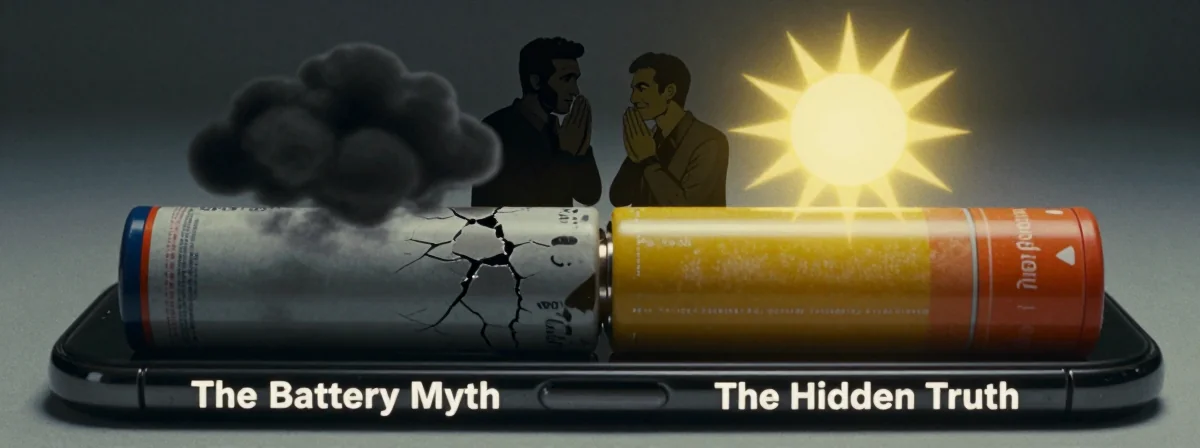
Every flagship phone launch brings the same promises: “unprecedented battery life” and “lightning-fast charging.” But there’s a disconnect between these claims and real-world performance that few are willing to address. When you look past the marketing gloss, you’ll find that battery technology has plateaued while manufacturers push charging speeds that actively harm longevity. This isn’t just about specs—it’s about understanding what you’re actually getting for your premium price.
The numbers tell a revealing story. Premium devices tout 1200-2000 charge cycle ratings, but few disclose that these figures assume slow charging and ideal conditions. In reality, the 60W+ charging that’s become standard is degrading batteries at a rate that would make those cycle counts vanish much faster. It’s a trade-off most consumers don’t realize they’re making until it’s too late. The industry knows this, but marketing demands speed over sustainability.
Professional teardowns consistently show that manufacturers could implement better thermal management and slower charging defaults, but they choose not to. The psychology is simple: consumers equate charging speed with technological advancement, even when it sacrifices long-term performance. This isn’t about capability—it’s about marketing strategy.
Is Your “Big and Heavy” Phone Actually Lightweight Compared to Competitors?
The perception of smartphone weight has been completely inverted. A 214-gram device would have been considered absurdly heavy just a few years ago, yet today it’s positioned as surprisingly light. When you compare it to equivalent models from Apple and Google (which are typically 20-30 grams heavier) or even some Chinese manufacturers that push 240+ grams, this perspective makes sense. The reality is that modern engineering has optimized for structural integrity and thermal dissipation, which inherently adds weight.
What’s particularly interesting is how this weight distribution affects handling. The Samsung Galaxy S26 Ultra, for instance, feels lighter because its mass is better balanced across the larger 6.9-inch display. This contrasts with iPhone designs that concentrate weight in the top half due to camera modules and internal components. The result is that despite similar absolute weights, the user experience of “heaviness” varies dramatically based on design philosophy.
Don’t be misled by marketing that frames weight reduction as a primary innovation. In premium devices, additional grams often indicate better construction, improved thermal performance, or more durable materials. The true metric to watch isn’t just absolute weight, but how that weight contributes to overall device longevity and user comfort during extended use.
Fast Charging Isn’t Free—Here’s What You’re Really Paying For
The 60W+ charging speeds that manufacturers brag about come with a hidden cost that’s rarely discussed in reviews. Every high-speed charge cycle generates significantly more heat, which directly accelerates battery degradation. While manufacturers have adjusted cycle estimates from 2000 to 1200-1600 to account for this, they rarely explain that these figures assume ideal conditions that few users actually maintain.
Consider this: a battery charged at 10W might last through 2000 cycles under lab conditions, but the same battery charged at 60W might only make it through 1200 cycles in real-world use. That’s a 40% reduction in lifespan for a feature most users only employ occasionally. The math doesn’t add up for daily charging, yet manufacturers continue to push these speeds as selling points.
The most revealing metric is cycle time degradation. While manufacturers now acknowledge that cycle counts are longer in time terms (due to faster charging), they don’t clarify that this simply means your battery will degrade to 80% capacity faster. It’s a semantic trick that obscures the fundamental issue: high-speed charging actively reduces battery longevity.
Why Battery Cycle Estimates Are Meaningless Without Context
The 1200-2000 charge cycle ratings you see in specifications are essentially meaningless without understanding the testing conditions. These figures are derived from laboratory tests that use slow charging, controlled temperatures, and perfect voltage regulation—conditions that virtually no consumer will replicate. In real-world use, especially with fast charging and variable power sources, these batteries degrade much faster.
What’s worse is that manufacturers know this. They’ve adjusted their cycle estimates downward from earlier claims, but they haven’t changed their marketing approach. The cycle count numbers remain prominent in specifications while the fine print about testing conditions is buried or omitted entirely. This creates a false sense of security about battery longevity that disappears once the warranty expires.
The most practical metric consumers should focus on isn’t cycle count but capacity retention over time. A battery that maintains 80% capacity after 2 years is far more valuable than one that theoretically supports 2000 cycles but degrades to 60% in the same period. Unfortunately, this information is rarely provided in marketing materials or even in independent reviews.
The Real Cost of Premium Phone Batteries
When you pay premium prices for flagship devices, you’re not just paying for the latest processor or camera technology—you’re also paying for a battery that will degrade faster than advertised. The industry has normalized this through gradual adjustments to cycle estimates and by framing fast charging as an essential feature rather than an optional convenience.
Consider the economic implications: a phone that needs replacement after 2 years due to battery degradation effectively doubles your total cost of ownership. While manufacturers offer battery replacement services, these often cost hundreds of dollars and don’t address the fundamental issue of accelerated degradation from high-speed charging.
The most revealing metric is the difference between lab-tested cycle counts and real-world degradation. While a battery might theoretically support 1600 cycles, real-world conditions (fast charging, temperature fluctuations, inconsistent power sources) will likely reduce this to 800-1000 cycles. This gap represents a significant value proposition that consumers rarely consider when making purchasing decisions.
Beyond the Specs: What Actually Matters for Battery Longevity
Forget the cycle count numbers and focus on what truly affects battery performance over time. The three critical factors are charging habits, temperature management, and power source consistency. Manufacturers know these factors influence longevity, but they’re difficult to control in consumer products, so they emphasize what they can control: charging speed and theoretical cycle counts.
The most practical advice for extending battery life contradicts manufacturer recommendations: avoid frequent fast charging, maintain moderate temperatures, and use consistent power sources when possible. These practices might save 6-12 months of battery life, which is significant when considering the 2-3 year typical smartphone replacement cycle.
Don’t be swayed by marketing that positions fast charging as essential. For most users, a 25-30W charger provides 90% of the convenience of 60W+ chargers while significantly reducing battery stress. This small compromise can extend battery life by nearly 50%, making it a worthwhile trade-off for anyone planning to use their device for more than 18 months.
Reimagining Smartphone Battery Expectations
The current paradigm of pushing faster charging speeds while simultaneously acknowledging shorter battery lifespans represents a flawed approach to smartphone design. Manufacturers have prioritized immediate convenience over long-term value, creating a cycle where consumers feel compelled to upgrade more frequently to maintain performance.
What if we approached smartphone batteries differently? Imagine a system where charging speeds are matched to battery chemistry that supports longer lifespans, where manufacturers transparently report real-world degradation rather than theoretical cycle counts, and where design prioritizes sustainable performance over transient benchmarks.
The most promising direction isn’t faster charging—it’s better battery management. Technologies like adaptive charging that learn your usage patterns and optimize charging cycles could extend battery life by 30-40% without sacrificing convenience. These innovations are already available but rarely highlighted because they don’t create the same marketing buzz as doubling charging speed.
Until the industry shifts focus from immediate performance metrics to sustainable longevity, consumers will continue paying premium prices for batteries that degrade faster than advertised. The solution isn’t better marketing—it’s better engineering that aligns with actual user needs rather than artificial benchmarks.