
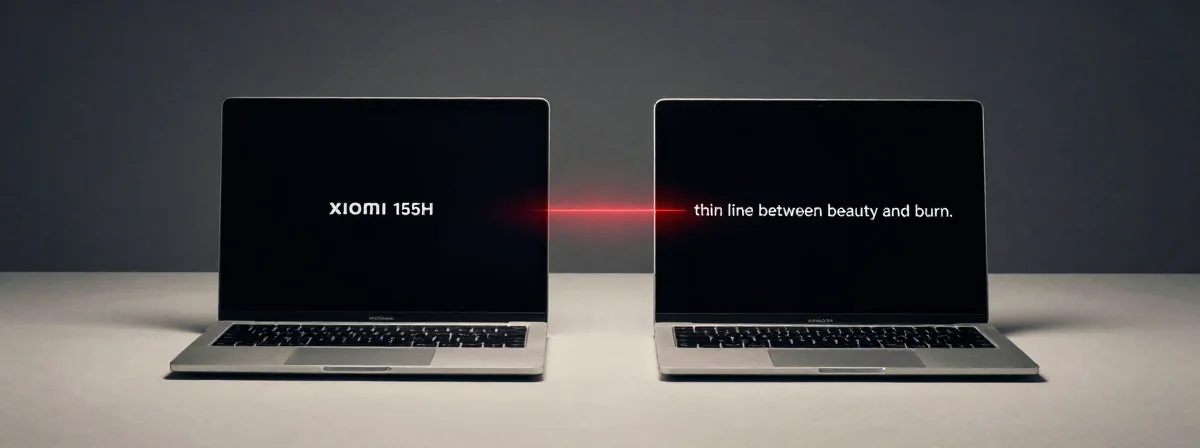
People keep asking me how this new Xiaomi laptop stacks up against the MacBook Air. The hype is real—OLED screens, featherlight designs, and specs that punch above their weight. Here’s the thing nobody’s talking about: this isn’t just about specs; it’s about what happens when you push a thin laptop too far.
Designed Right
SIDE A
The Xiaomi 155H is a marvel of modern design—under a kilogram with an OLED screen that makes colors pop like nothing else. It’s a powerhouse in a tiny package, sustaining 50W of power draw when pushed. The battery is a welcome upgrade over many gaming laptops, and that sky blue finish is pure eye candy. For gamers who need portability, it’s tempting—lighter than a MacBook Air yet far more capable. Xiaomi clearly poured resources into the display and thermal solution, even if that means compromises elsewhere. It’s a banger deal if thermals hold up, and the dual M.2 slots show thoughtful engineering.
SIDE B
The MacBook Air remains the benchmark for silent, seamless computing. It doesn’t have the jaw-dropping specs of the Xiaomi, but who cares when it just works? The thermal performance is legendary—no fan noise, just cool operation. For productivity and creative work, Apple’s ecosystem still delivers the smoothest experience. The port situation on the Xiaomi is a nightmare compared to the Air’s simplicity, and while the Xiaomi’s screen is better for gaming, the Air’s display is perfectly adequate for most tasks. It’s the device that makes you forget it’s even there—until you need serious power, that is.
THE REAL DIFFERENCE
Here’s what most people miss: the Xiaomi’s 50W sustained performance comes at a steep cost. Those 93°C CPU temperatures aren’t just numbers—they’re the sound of a laptop screaming in pain. The 52dB fan noise is louder than many desktop PCs, and those 45°C surface temperatures mean your lap will feel it too. After years of using both thin gaming laptops and premium ultraportables, I’ve learned that silent mode isn’t just about noise—it’s about longevity. The Xiaomi’s silent mode at 46dB sounds promising, but without knowing the power limits, it’s a gamble. The MacBook Air might not have the raw power, but it doesn’t need to throttle itself into oblivion to perform.
THE VERDICT
If you’re a gamer who needs to travel light and can tolerate the compromises, the Xiaomi 155H is worth considering—especially at $1400. But if you value your sanity and your lap, stick with the MacBook Air. From experience, the Air is the clear winner for anyone doing serious creative work or long sessions of web browsing. The Xiaomi is a fascinating experiment, but it’s not ready to replace Apple’s silent, smooth experience. If you’re doing X (gaming on the go), go with the Xiaomi. If you’re doing Y (everything else), the MacBook Air’s the clear winner.
Style Points
The Xiaomi 155H shows what’s possible when you prioritize specs over sanity, but the MacBook Air proves that sometimes less really is more. When you’re choosing a laptop, remember that the numbers on a spec sheet don’t tell the whole story. The real test is in the daily grind—how it feels in your hands, how quiet it is, and how long it lasts. Don’t chase the highest numbers; chase the experience that works for you.