
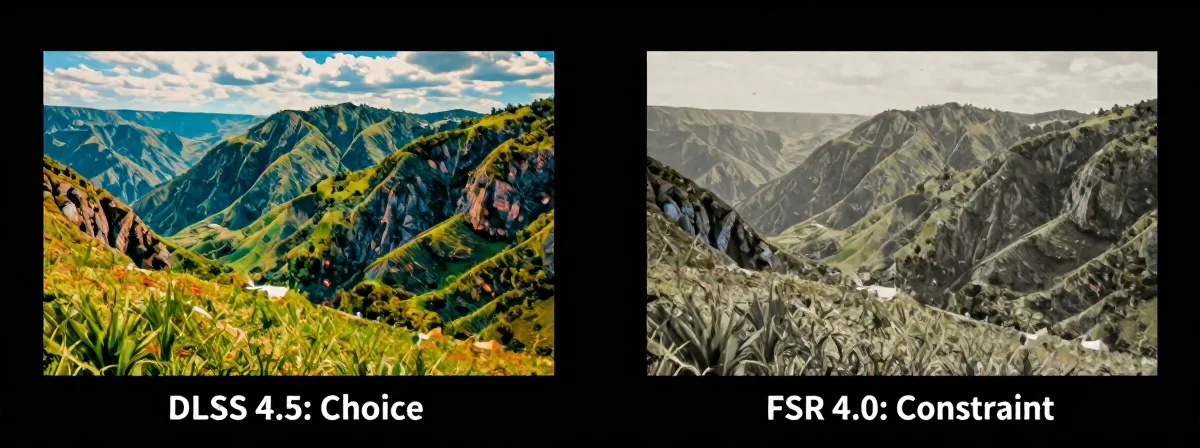
People keep asking me why they feel locked out of certain features depending on their graphics card. They see others enjoying smoother gameplay or sharper visuals while they’re left with a “sorry, not supported” message. Here’s the thing nobody’s talking about—the difference between DLSS 4.5 and FSR 4.0 isn’t just about technology; it’s about philosophy.
I’ve been using both for years now, and the pattern is clear. Let me break it down.
The Teaching
SIDE A: DLSS 4.5 NVIDIA’s approach feels like a gardener who tends to every plant in the garden. DLSS 4.5 works even on older GPUs—just slower. It’s like having a classic car that can still make the journey, maybe not as fast as the latest model, but it gets you there. The tech is there, and the company makes it available to those who invested in their ecosystem years ago. It’s a system that respects your past decisions and gives you options, even if they’re not top-tier. This is why you see older RTX cards still able to use DLSS 4.5, even if Frame Generation is off the table. It’s about keeping the door open.
SIDE B: FSR 4.0 AMD’s approach is more like a gardener who only waters the newest plants. FSR 4.0 is locked to their latest RDNA 5 architecture, with no official way to use it on older cards. It’s not that the older cards can’t handle it—modders have shown that a modified version works just fine. But AMD hasn’t given users the option, not even a toggle to sacrifice performance for the ability to use the feature. It feels like being told you need to buy new seeds for a feature your current garden could support. The performance hit on older cards is real, but the lack of choice is what stings most.
THE REAL DIFFERENCE Here’s what most people miss: the difference isn’t about whether the older hardware can run FSR 4.0—it’s about whether the company chooses to let it. The leaked FSR 4.1 that works on RDNA 3 and even RDNA 2 shows that the tech is possible. The same principle that powers the PS5’s PSSR 2.0 (which is essentially FSR 4.1) could have been adapted for desktop GPUs. But AMD hasn’t done it. Why? It’s not about capability—it’s about strategy. Newer hardware sells better when older hardware can’t keep up. It’s the same reason NVIDIA locks Frame Generation to their latest cards, even if older ones could handle it with some compromises. The real difference is that NVIDIA at least gives you the option, while AMD leaves you with none.
THE VERDICT From experience, if you’re on an older GPU and want the latest upscaling tech, DLSS 4.5 is the clear winner. You get to keep using your card, even if it’s not at peak performance. If you’re on a new AMD card, FSR 4.0 is a powerful tool, but be aware that you’re part of an ecosystem that doesn’t look back. Here’s my take: if you’re considering a new GPU, think about what happens in a year or two. Will you be left behind, or will you still have options? If you’re doing everyday gaming and want longevity, NVIDIA’s approach gives you more breathing room. If you’re all-in on AMD and don’t mind potentially being on the upgrade treadmill sooner, then the latest RDNA cards are still great performers.
What to Remember
The lesson here isn’t about which tech is better—it’s about how companies treat their users. AMD’s silence on FSR 4.0 for older cards isn’t just a technical decision—it’s a choice to leave users feeling like their investment is already obsolete. NVIDIA, while also prioritizing new hardware, at least acknowledges that users with older cards still deserve some level of support. When you’re making a tech investment, consider not just what you get today, but what you’ll be able to do tomorrow. Choose the ecosystem that respects your past decisions as much as your future ones.