
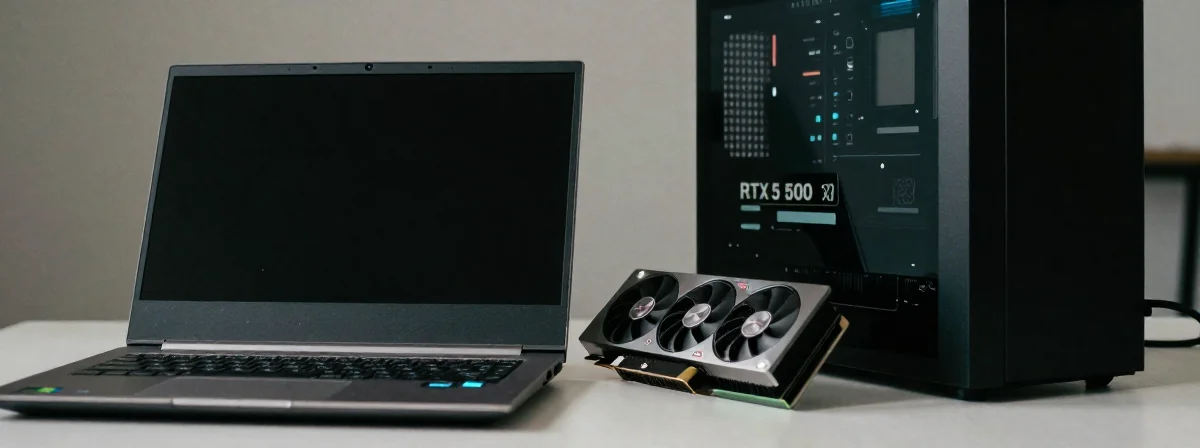
People keep asking me why they should care about the laptop RTX 5070 when it seems so close to the desktop RTX 5060. The confusion runs deep—especially with VRAM configurations and performance claims. Here’s the thing nobody’s talking about: what you’re actually getting depends on power limits, thermal design, and real-world use cases, not just the model number.
The Technical Truth
SIDE A (Laptop RTX 5070) The laptop RTX 5070 is essentially a desktop RTX 5060 Ti with 8GB VRAM, repackaged for mobile platforms. It offers higher clock speeds than the 5060 in laptops but comes with severe power constraints—most models cap at 45-100W, which cripples sustained performance. Gamers who prioritize portability might appreciate the extra oomph over a 5060 laptop, but the thermal and power limitations mean it rarely reaches its full potential. It’s a decent choice for those who need a balance of performance and mobility, but don’t expect desktop-level results.
SIDE B (Desktop RTX 5060) The desktop RTX 5060 is a straightforward, no-nonsense GPU. It runs at a consistent 145W+ power limit, ensuring stable performance in most scenarios. While it lacks the headline-grabbing specs of higher-tier cards, it delivers reliable 1080p gaming and productivity performance. For desktop users who don’t need extreme settings or the latest AAA titles at max resolution, the 5060 is a solid, cost-effective option. Its consistent power delivery and lack of thermal throttling make it a safer bet for long gaming sessions or creative work.
THE REAL DIFFERENCE Here’s what most people miss: the laptop 5070’s performance advantage over the desktop 5060 is purely theoretical. In practice, the 5070’s power limits mean it often underperforms the desktop 5060, especially in sustained workloads. Benchmarks show the 5070 can even trail behind older cards like the desktop 3070 Ti or even the 6750 XT. The thing nobody talks about is that the 5070’s higher clocks are meaningless without the power to sustain them. After years of using both, I’ve seen countless laptops with “high-end” GPUs that can’t maintain their advertised performance—this is no exception.
THE VERDICT From experience, if you’re gaming on the go and prioritize portability, the 5070 might be worth considering—just manage your expectations. But if you’re building or upgrading a desktop, the 5060 is the clear winner. Here’s my take: for desktop use, the 5060’s consistent performance and reliability make it the smarter choice. If you absolutely need a laptop with a 50-series GPU, look for models with better cooling or higher power limits, but don’t expect miracles. After using both for years, the desktop 5060 is simply a more capable card for the money.
Bottom Line
Don’t let the model numbers fool you—the laptop 5070 is often a step down from the desktop 5060 in real-world performance. If you’re buying a laptop, focus on the power limit and cooling solution, not just the GPU name. For desktop users, the 5060 is a no-brainer—reliable, consistent, and far more practical for everyday use. Make your decision based on actual performance needs, not marketing hype.