
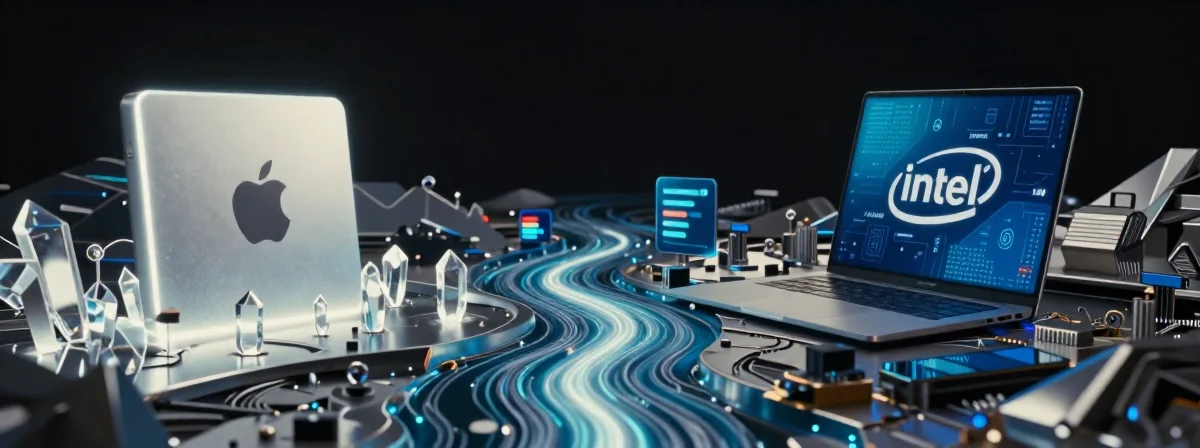
People keep asking me—after years of watching Intel struggle to keep up—whether Lunar Lake finally changes the game. I’ve used both for years now, seen the hype cycles and the real-world performance. Here’s the thing nobody’s talking about: this isn’t just about CPU benchmarks anymore.
This Changes Everything
SIDE A Intel’s Lunar Lake represents a desperate bid to reclaim relevance. The CPU performance is genuinely impressive—finally delivering the efficiency Intel promised since the Atom era. Battery life on the Lunar Lake laptops is truly remarkable, with some models hitting under 2W idle and lasting nearly two days with the screen on. Dell’s XPS 16 with Lunar Lake shows what’s possible when Intel commits to efficiency across the board, not just in the CPU. But here’s what most people miss—the real gains come from the entire platform, not just the silicon.
SIDE B Apple’s M series still sets the standard for what a laptop can be. The M4/M5 chips deliver performance that Lunar Lake can only dream of, with the 15" MacBook Air using just 2.2W during idle. That’s not just a marginal improvement—it’s a fundamental rethinking of how laptops should work. The M series has consistently pushed the industry forward, forcing Intel and AMD to finally address efficiency after years of complacency. Even with Lunar Lake’s improvements, Apple’s six-year head start shows in every benchmark and real-world task.
THE REAL DIFFERENCE Here’s what most people miss—the power draw numbers being thrown around are misleading without context. Comparing a thin-and-light MacBook to a laptop with a discrete GPU and 4K OLED panel is comparing apples to futuristic space ships. The real test comes in consistent, everyday use. Lunar Lake excels at making x86 viable again for all-day productivity, but it can’t match Apple’s integrated approach where the entire system—from CPU to display—is optimized as one unit. The Linux support on Lunar Lake business models is a game-changer, finally giving Windows users the option to skip the OS tax and run their preferred OS from day one.
THE VERDICT If you’re doing creative work or need absolute peak performance, Apple’s M series is still the clear winner—don’t let Lunar Lake’s hype make you downgrade. But if you need a Windows machine that lasts all day and runs Linux flawlessly, Lunar Lake is finally worth the wait. From experience, Intel has delivered a platform that democratises what Apple showed was possible—now it’s up to the OEMs to build on this foundation. If you’re doing business or development work that requires Windows, this is your moment to finally get a laptop that doesn’t compromise on battery life.
The Truth Is Out There
The industry is finally moving past the endless benchmark wars and focusing on what matters: real-world efficiency and platform coherence. Lunar Lake represents Intel’s best chance to pull itself out of the shadow of Apple’s innovation, but it’s not a magic bullet. The real revolution comes from choosing the tool that matches your workflow—not chasing the lowest power numbers. Now that you know what to look for, make your decision based on actual needs, not marketing hype.