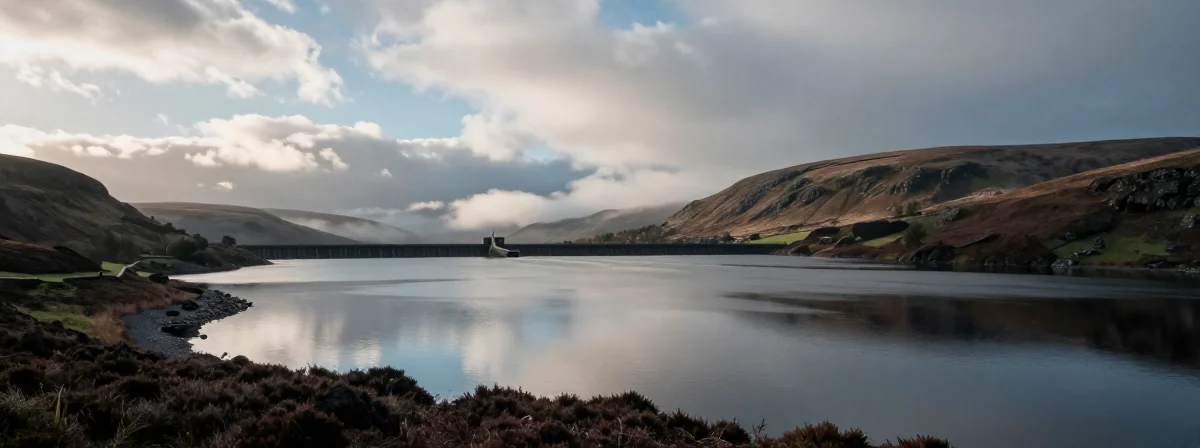
Water holds memory. It is patient, still, and often, it keeps secrets we are desperate to uncover. When a man was found floating in a remote reservoir, clad only in a wetsuit, the ripples of that discovery reached far beyond the shores of the Welsh countryside. It was a tableau of solitude and finality that forces us to look not just at the facts of a case, but at the fragile nature of our own journeys.
We often seek comfort in concrete answers. We want to know how a stranger arrived at such a secluded place, why they were there, and where their possessions have gone. But sometimes, the landscape itself offers the only wisdom we have. In the quiet expanse of the Claerwen Reservoir, the geography tells a story of limitation and containment, reminding us that even our wildest movements are often bounded by the nature of the world around us.
Consider the wetsuit. It speaks of intention, of preparation, and of a human being seeking communion with the cold, dark water. It suggests an athlete, perhaps a triathlete, drawn to the silence of the reservoir for training or peace. Yet, the absence of a vehicle, a bike, or clothing turns a story of sport into a philosophical riddle about presence and absence.
Could the Water Itself Have Provided the Journey?
When we stand before a vast body of water, it is easy to imagine it as a highway connecting distant places. We theorize that perhaps the man entered a stream miles away, drifting silently to his final resting place. It is a comforting thought—the idea that nature carried him gently along a tributary, depositing him where he was found.
But the land does not always support our narratives. Looking at the map of this region, the truth is more grounded. The reservoir is not fed by a raging river or a distant mountain torrent. It is nourished entirely by runoff from the local hills. The streams that feed it are small, modest trickles that a person could hop across without wetting their ankles. They originate merely two to four kilometers from the shore.
This geography teaches us a lesson about origins. We often look for complex, far-away causes for the events in our lives, but the source is usually right in front of us. If the man entered the water upstream, he did not travel far. The water did not transport him from a distant life; he was already there, held within the small, confined embrace of the immediate valley. The water kept him close.
Why Do We Assume Malice When Simplicity Will Do?
The missing belongings—the car, the bike, the clothes—invite our minds to wander toward theft and foul play. We imagine a villain in a striped shirt stealing a bicycle twenty kilometers from the nearest town. We construct scenarios of robbery and abandonment because the idea of random chance is harder to accept than intentional malice.
Yet, consider the perspective of a passerby. Imagine a rusty bike left by the side of the road in a beautiful nature reserve. To one person, it is evidence of a crime; to another, it is simply litter left by a careless stranger. In the wild places of the UK, there is an unspoken etiquette to tidy up after those who do not respect the land. A tent standing unattended for days might be seen not as a base camp for a missing person, but as debris to be removed.
We must pause before we judge these actions. A person seeing a “free bike” or removing an abandoned tent is acting from their own truth. They may never connect the object they took to the mystery of the man in the wetsuit. It is a profound reminder that our realities are subjective. What looks like a clue to one person looks like trash to another. The belongings are likely gone not because of darkness, but because of the mundane, unthinking flow of human activity.
Does the Solitude of the Athlete Blind Us to the Danger?
There is a specific kind of peace found in endurance sports. The triathlete, the open-water swimmer—these are people who seek the edge of their capability, often in isolation. The wetsuit found at the scene is designed for this specific pursuit. It is armor against the cold, allowing the human body to merge with the element of water for longer periods.
But this pursuit of solitude carries a weight. When we travel to remote places to train, we step away from the safety net of community. We become small dots in a large landscape. If the man arrived by bike, riding for an hour from the nearest cycle route, he was engaging in a ritual of self-reliance. Perhaps he stashed his bike, hid his clothes in a daypack to prevent theft, and entered the water alone.
It is a cautionary meditation. We seek the tranquility of the water, the “skin swimming” that connects us to the earth, but we often forget how invisible we become in that stillness. A tow buoy, a fluorescent marker, a simple ID—these are tethers to the world of people. Without them, we return to nature completely, and sometimes, nature does not let us go.
Is It Possible to Vanish Without a Destination?
We look for patterns. We search missing person databases in Ireland, Scandinavia, or Germany, looking for an athlete who disappeared in the summer of 2024. We try to fit this man into a narrative of a life interrupted. But what if the journey was simpler? What if he accepted a ride from a stranger, a chance encounter on a winding road, and was dropped off at the water’s edge?
A driver might remember giving a lift to a man in a wetsuit, or they might have thought nothing of it at the time. We pass by hundreds of people in our lives, barely registering their presence. The man could have arrived with a friend who left, or a stranger who continued on their way, unaware that the interaction was significant.
Life is full of these loose threads. Not every journey is documented, and not every arrival is announced. The reservoir is a place of stillness, and it is possible to walk into its gravity without leaving a footprint on the digital world we rely on for answers. The lack of a vehicle is not a paradox; it is simply an empty space where memory failed to take hold.
What Does the Water Reflect Back to Us?
Ultimately, the mystery of the Claerwen Reservoir is not a puzzle to be solved, but a reality to be accepted. The geography limited the flow of the water. The eyes of passersby interpreted the abandoned belongings through their own lens. The man’s desire for solitude led him to a place where identity dissolves into the landscape.
We search for answers to soothe our own anxiety about the unknown. We want to believe that if we map the streams and account for the bikes, we can make sense of loss. But the water remains dark and deep. It holds the man gently, just as it holds the silence of the hills. Perhaps the lesson is not to find out where he came from, but to respect the peace he found, and to acknowledge that in nature, we are all eventually just travelers returning to the source.