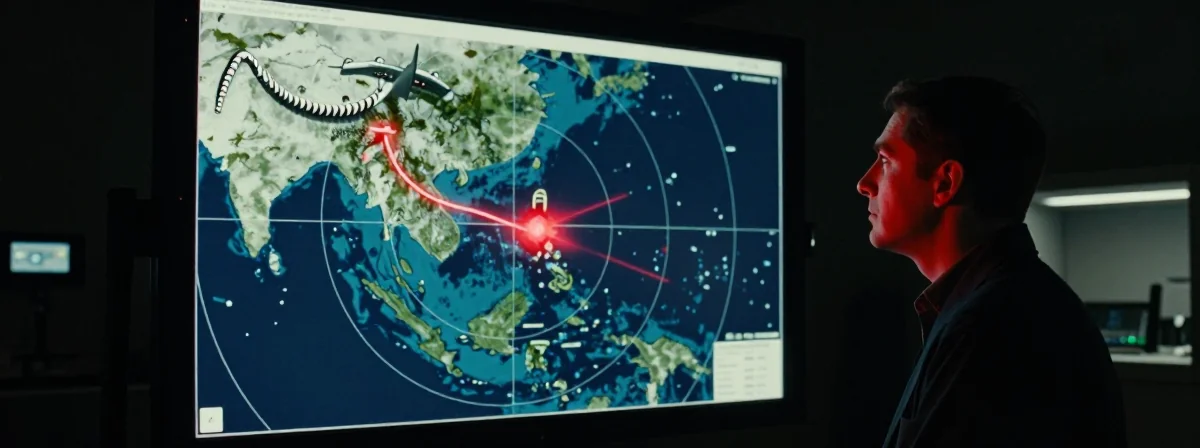
It has been over a decade, yet the disappearance of Malaysia Airlines Flight 370 remains one of the most baffling puzzles in modern aviation history. We love a good mystery, but when you strip away the geopolitical drama and the internet folklore, you are left with cold, hard technical data that tells a story much darker than any conspiracy novel. The truth isn’t about aliens or secret bases—it is about what happens when human intent collides with complex machinery.
If you look closely at the publicly available technical logs, the answers aren’t just hidden; they are practically screaming at you. From the way the communication systems were shut down to the specific path flown over the Indian Ocean, the evidence points in one very specific direction. We need to stop looking for shadowy governments and start looking at the raw telemetry.
Did the Transponder Cycle Give It All Away?
Let’s talk tech for a second. The transponder is that device in the cockpit that talks to air traffic control, telling them who you are, where you are, and how high you are flying. When MH370 vanished, the transponder didn’t just “fail” or lose power like a blown fuse. If it had lost power, it would have gone dark instantly. Instead, the data logs show it cycled through different modes.
Here is why that matters. A pilot doesn’t just flip a switch to “OFF” by accident. To turn it off, you have to physically rotate a knob, spinning it past “Standby” and other active modes like “TA Only” (Traffic Advisory). You have to deliberately choose “OFF” and rotate past perfectly functional settings to get there. This mechanical sequence proves the shutdown was a manual, intentional act by someone in the cockpit who knew exactly what they were doing. It rules out a sudden catastrophic failure or a fire that took out the electronics instantly.
What Does a Semiconductor Patent Have to Do With a Missing Plane?
One of the most fascinating tech-focused theories involves four employees of Freescale Semiconductor who were on board. They allegedly held shared rights to a patent (US8671381) regarding semiconductor manufacturing. Naturally, the internet ran wild with theories that a rival government or corporate entity took the plane to seize this intellectual property. But does the tech actually support that?
Let’s break down what that patent actually does. Think of a silicon wafer like a giant, circular vinyl record. You are trying to cut as many rectangular “dies” (the individual chips) out of that circle as possible without wasting the expensive silicon. You can fit big squares in the middle, but then you have curved edges left over. So, you squeeze smaller rectangles and squares into those gaps. This patent is essentially a super-optimized algorithm for solving a high-school geometry problem: how to pack rectangles into a circle efficiently. It is valuable, sure, but is it “steal a 777” valuable? Probably not. It is a great example of how we can over-index on technical details that sound sinister but are actually just mundane industry innovation.
Are the ‘Orb’ Videos Real or Just Glitch Art?
Recently, footage has circulated online claiming to show the plane being consumed by three “orbs” or disappearing into a portal. It is captivating, terrifying stuff that induces what psychologists call “ontological shock”—that feeling when your reality framework shatters. But as a tech analyst, you have to look at the metadata and geolocation, not just the pixels.
Independent investigators have used radio wave triangulation data from the flight’s path and compared it to the supposed location in these videos. They do not match. The triangulation puts the plane thousands of miles away from where these videos were filmed. Furthermore, actual physical debris from a Boeing 777—specifically flaperons and other unique parts—has washed up on the east coast of Africa. There is no record of any other 777 crashing in that region to explain that debris. It is cool to think about UAP intervention, but the physical evidence on the ground contradicts the digital fiction on screen.
Why the Diego Garcia Theory Doesn’t Hold Water
There is a persistent theory that the plane was hijacked and flown to Diego Garcia, a secretive US military base in the Indian Ocean. It sounds like a plot from a spy thriller, but the physics and the data say otherwise. We are talking about a massive Boeing 777 trying to approach a heavily monitored military installation undetected.
Beyond the absurdity of sneaking a massive jumbo jet onto a military base, we have the radio wave data again. Signals picked up by the nearest towers triangulate the plane moving deep into the southern Indian Ocean, away from Diego Garcia. And let’s not forget the satellite “handshake” data—the periodic pings the aircraft sent to the Inmarsat satellite. That arc points squarely to the ocean west of Australia. To believe the Diego Garcia theory, you have to believe that multiple, independent data streams were all spoofed perfectly in real-time.
The Hard Truth in the Simulator Data
If you want the most chilling piece of evidence, look no further than the captain’s home flight simulator. Investigators recovered deleted data from his hardware, and it paints a grim picture. Weeks before the flight, the captain had simulated a flight path that remarkably similar to the final route of MH370—a path that flew deep into the Indian Ocean until fuel exhaustion.
This wasn’t a generic flight. It was a specific, rehearsed scenario. Combine that with the audio recordings of the pilot’s voice. If you listen closely to the transmissions, everything sounds normal until the handover between Malaysian air traffic control and Vietnam. That is the moment the tone shifts, the call-outs are missed, and the silence begins. It mirrors the transponder data perfectly—a deliberate transition from a routine flight to a planned disappearance.
Why We Still Struggle to Accept the Boring Answer
We crave a villain we can fight, or a mystery we can solve, because the alternative is too dark to contemplate. The idea that a trusted pilot could execute a murder-suicide, taking 239 people with him into the abyss, is horrific. It is easier to invent stories about patents, US cover-ups, or teleportation because those are external threats.
But the ocean is unforgivingly vast, and the technology to find a plane in it is still surprisingly limited. We have better maps of the moon than we do of our own ocean floor. The most likely reality is that the plane is lying in pieces on the ocean bed, a victim of human intent rather than technological failure or alien intervention. Sometimes the most technical, data-driven answer is also the most heartbreaking one.