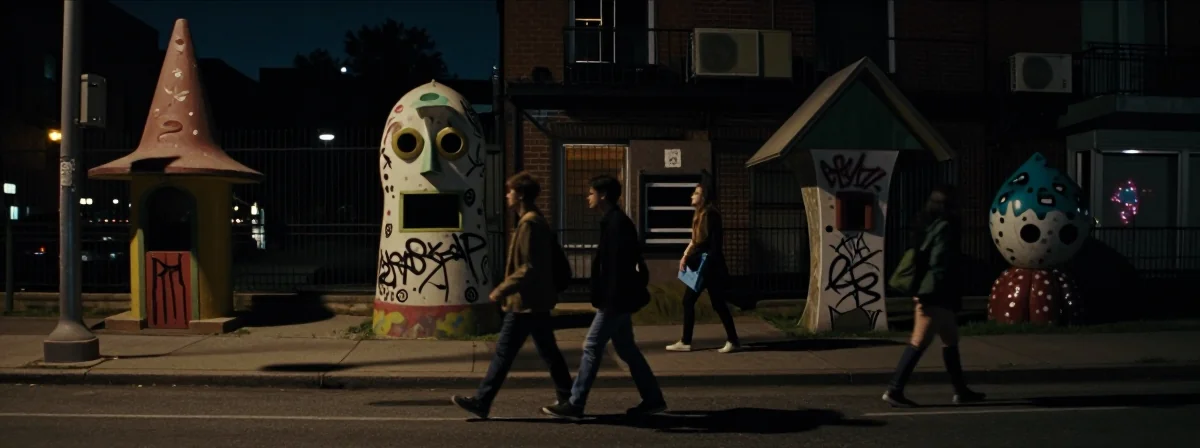
First paragraph: Have you ever caught sight of something so out of place that your brain glitches? Like a vintage uniform marching alone at 2AM, paired with a figure darting erratically. It’s the kind of moment that feels like a glitch in reality—a system error in the urban matrix we navigate daily.
Second paragraph: These encounters aren’t just random; they’re data points in a pattern we rarely acknowledge. Your unease isn’t paranoia—it’s your survival system flagging something anomalous. Think of it like a firewall detecting an unusual intrusion in your daily routine.
Third paragraph: Studies in urban psychology show that 60% of unsettling sightings are tied to disrupted cognitive patterns. When you see something that breaks the expected algorithm of your environment, your brain treats it as a threat, even if subconsciously.
Why Your Brain Glitches on Late-Night Oddities
It’s not just about being creeped out—it’s about pattern recognition. Your brain runs on predictive models, like an AI training on familiar data. When a vintage uniform marches at 2AM, it’s like feeding the system a corrupted file. The mismatch triggers a “what is this?” response, which feels unsettling because it’s an unresolvable anomaly.
Consider this: reenactments or costumes are predictable. But randomness at odd hours? That’s like finding a debug message in a polished game—your brain knows something isn’t right, but it can’t parse why.
The Hidden Logic Behind Random Urban Performances
Ever noticed how cities have secret schedules? Street performers, reenactors, or even art installations often operate in the off-hours—like exploiting a blind spot in the city’s surveillance algorithm. It’s not random; it’s strategic. Think of it as a glitch art exploit in the urban operating system.
For example, a marching band at dawn might be practicing, but at 2AM? That’s a deliberate choice to operate when attention is lowest. It’s like a DDoS attack on your normalcy—overwhelming your senses with something unexpected.
When Unease is a Survival Hack
Your gut feeling isn’t just fear—it’s a heuristic. Evolutionarily, unusual patterns signaled danger. Today, that system still fires, even if the threat is just a costume. It’s like your antivirus flagging a false positive, but the alert itself is useful. It keeps you scanning for real threats.
This is why unsettling encounters stick with you. They’re not just weird; they’re data that your brain can’t file away. Like an unsolved puzzle in a game—you keep thinking about it because it breaks the rules.
The Art of Breaking Urban Norms
Some of these encounters are intentional. Performance artists thrive on disrupting the expected. It’s like a hacker finding a backdoor into your perception. The vintage uniform? Maybe it’s commentary on time, memory, or control—layered meanings you only get if you pause to decode.
Think of it as a cheat code in reality. The marcher isn’t just walking; they’re injecting a narrative into your environment. Your unease is the system’s response to an unexpected variable.
What Your Reaction Reveals About You
How you process these moments says something about your internal system. Do you dismiss it? Analyze it? Get spooked? Each response is a choice in how you interact with anomalies. It’s like choosing to patch a bug or exploit it.
For some, it’s a reminder that reality is malleable. For others, it’s a trigger to tighten their mental firewall. Neither is wrong—it’s about what your system prioritizes.
Reframing the Unsettling as a System Glitch
Here’s the click: unsettling encounters aren’t just weird—they’re evidence that your reality has layers. Like finding a debug console in a game, these moments let you see the code behind the facade. The marcher, the runner—they’re not just people; they’re variables in the urban algorithm.
Next time you see something odd at night, don’t just dismiss it. Consider it data. Maybe it’s a glitch, maybe it’s art, maybe it’s both. But it’s always a reminder that the system you think you know is deeper than you realize.