
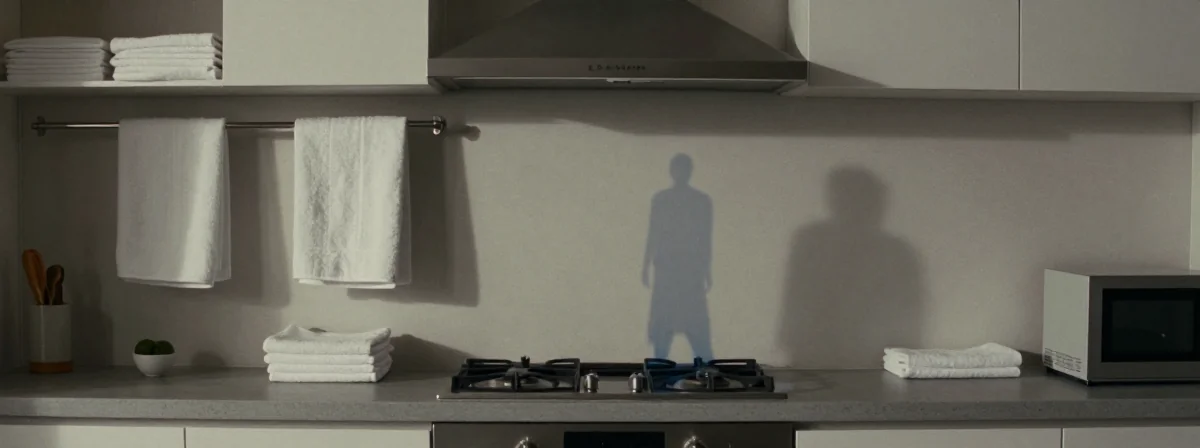
The human brain is a pattern-seeking machine, constantly trying to make sense of the world around us. Sometimes, this innate tendency leads to extraordinary conclusions from ordinary phenomena. When you think you see a child’s figure hovering over your kitchen island, your first instinct might be to suspect something supernatural. But what if the explanation is far more mundane—and yet equally fascinating?
Our perception isn’t always a reliable guide to reality. The brain fills in gaps, creates connections, and imposes meaning on ambiguous stimuli. This natural tendency, combined with specific environmental factors, can create experiences that feel paranormal but have perfectly rational explanations. Understanding these mechanisms can help us distinguish between genuine supernatural phenomena and perceptual illusions.
The town of Ephrata in Pennsylvania has a rich history that might contribute to heightened paranormal beliefs in the area. With its proximity to funeral homes and documented historical events, it’s no wonder that unusual occurrences are often interpreted through a supernatural lens. But before jumping to conclusions about spirits and hauntings, let’s examine the evidence methodically.
What Makes Us See Ghosts Where None Exist?
The phenomenon of seeing figures that aren’t there—particularly human or child-like forms—is remarkably common. Our brains are wired to recognize human shapes quickly, a survival mechanism that helped our ancestors identify threats or companions in their environment. This “hyperactive agency detection” causes us to perceive intentional beings even when none are present.
In the case of the kitchen island figure, several visual cues can create this illusion:
- Shadows falling in unexpected ways
- Partially obscured objects that suggest a human form
- The brain’s tendency to complete incomplete shapes (a psychological phenomenon called “closure”)
- Lighting conditions that create depth perception challenges
When you turn the image sideways, as one observer noted, the illusion often breaks immediately. This simple test reveals how dependent our perception is on orientation and context. The “child” that seemed so clear suddenly becomes just a collection of ordinary objects arranged coincidentally.
Why Do Specific Locations Seem More Haunted Than Others?
Certain areas, like the one described in Ephrata, Pennsylvania, develop reputations for paranormal activity. When you consider that the home was across from a funeral home and had a history of deaths, it’s understandable why residents might interpret unusual events as supernatural. But what’s actually happening?
Research into reported haunted locations shows a pattern: people tend to notice and remember “anomalous” events in places they already believe to be haunted. This confirmation bias creates a feedback loop where the environment itself seems to validate paranormal expectations. The history of the area—whether real or传闻—sets the stage for these interpretations.
The Smurl family case, which inspired The Conjuring franchise, exemplifies how local legends can amplify reported paranormal experiences. When multiple factors align—personal grief, environmental factors, and local folklore—the resulting experiences can feel deeply real and supernatural, even when they have natural explanations.
How Can You Distinguish Between Pareidolia and Actual Paranormal Activity?
Pareidolia is the psychological phenomenon where our brains perceive patterns or meaningful images in random or ambiguous stimuli. Seeing faces in clouds, the “man in the moon,” or a child’s figure in your kitchen are all examples. While fascinating, pareidolia isn’t supernatural—it’s just how our brains work.
To differentiate between pareidolia and genuine paranormal phenomena, consider these factors:
- Reproducibility: Can the same phenomenon be observed consistently under controlled conditions?
- Physical effects: Does the phenomenon cause verifiable changes in the environment (temperature shifts, object movement, etc.)?
- Corroborating evidence: Do multiple independent observers report the same phenomenon?
- Temporal patterns: Does the activity follow logical patterns or seem random?
In the case of the kitchen figure, the evidence strongly suggests pareidolia. The figure appears only when viewed from a specific angle, disappears when the image is rotated, and lacks any verifiable physical effects. These characteristics are consistent with an optical illusion rather than an actual spirit presence.
What Do Unexplained Physical Marks Really Mean?
The reported appearance of letters and numbers on the person’s arms adds another layer to this paranormal investigation. When these marks appeared spontaneously and then vanished, it created a compelling case for supernatural intervention. But what might explain this phenomenon?
Several natural explanations could account for such marks:
- Skin conditions that temporarily manifest in patterned ways
- Psychological factors like psychosomatic responses to stress or suggestion
- Environmental factors like chemical reactions or temperature changes
- Even simple explanations like accidental markings that weren’t immediately recognized
The fact that these marks appeared and disappeared quickly suggests a transient cause rather than something supernatural. While the experience was undoubtedly unsettling, scientific investigation would likely reveal a natural explanation rather than paranormal activity.
Why Do We Fear the Unexplained So Intensely?
The human response to unexplained phenomena reveals something profound about our psychology. When faced with events that don’t fit our understanding of reality, we experience a primal mix of fear and fascination. This reaction has evolutionary roots—uncertainty about potential threats required immediate attention for survival.
In modern contexts, this same mechanism drives our fascination with paranormal experiences. The home in Ephrata, with its reported unusual occurrences, created exactly the kind of uncertainty that activates our pattern-seeking brains. The fear response, while uncomfortable, is a natural consequence of encountering phenomena that challenge our worldview.
Understanding this psychological mechanism doesn’t diminish the validity of the experience—it simply reframes it. What feels like a supernatural encounter is often our brain’s attempt to make sense of ambiguous stimuli in a way that feels meaningful and important. This interpretation process is as fascinating as any ghost story.
How Can We Approach Paranormal Claims With Both Openness and Skepticism?
The most productive approach to paranormal phenomena combines openness to unusual experiences with rigorous skepticism. This balanced perspective acknowledges that:
- People genuinely experience events they can’t explain
- Our perception and memory systems are prone to error
- Natural explanations often exist even for seemingly supernatural events
- The burden of proof lies with extraordinary claims
When examining reports like the kitchen figure or the marks on arms, we should ask:
- What’s the simplest explanation that accounts for all observations?
- Have we considered all possible natural explanations?
- Is there any verifiable evidence beyond personal testimony?
- How does this experience fit with established scientific understanding?
By applying this methodical approach, we honor the significance of unusual experiences while avoiding hasty conclusions about supernatural causes. The truth, as often happens, may be more fascinating than any ghost story.
What’s Really Haunting Our Perception of the Paranormal?
The real mystery isn’t whether ghosts exist, but why our brains create ghostly perceptions in the first place. The kitchen figure, the marks on arms, and countless other reported paranormal experiences reveal something profound about human perception and cognition.
Our brains are prediction machines, constantly generating interpretations of sensory input. When presented with ambiguous or incomplete information, these predictions can create experiences that feel completely real but aren’t accurately representing external reality. This isn’t a failure of our brains—they’re doing exactly what evolution designed them to do.
The most haunting aspect of paranormal experiences may be how they reflect our own cognitive processes back to us. What we perceive as external supernatural forces might actually be internal cognitive patterns made manifest. In this sense, we’re not haunted by ghosts—we’re haunted by the remarkable complexity of our own minds.