
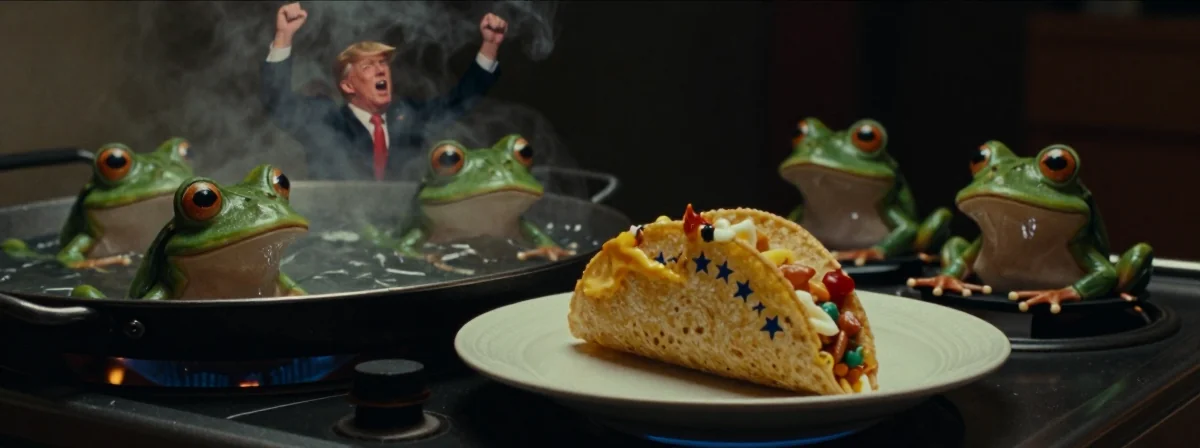
Political memes have a strange way of cutting through the noise and revealing uncomfortable truths. The image of Venezuela represented as a taco in a political cartoon isn’t just an odd visual—it’s a metaphorical warning sign that many have missed. When you look past the surface absurdity, you’ll find a disturbing pattern about how gradual manipulation works in politics and society.
The internet often reduces complex political ideas to simple, shareable formats. But sometimes, these simplified representations accidentally capture something profound about our collective experience. The “Venezuelan taco” meme and the boiling frog analogy aren’t just random internet jokes—they’re actually revealing something important about how we respond to gradual change.
Consider this: the boiling frog myth itself has a fascinating origin. The experiment that gave rise to the ‘boiling frogs’ analogy was conducted on frogs with their brains removed, precisely because researchers were trying to determine the location of the soul in the body. Healthy frogs, it turns out, simply climb out as the water starts to warm. They don’t stay and boil to death.
Why Does The Venezuelan Taco Matter?
The absurdity of representing Venezuela as a taco isn’t just for laughs—it’s a deliberate simplification that makes a complex political point accessible. This kind of metaphorical shorthand has become increasingly important as political discourse becomes more polarized and complex. When you see someone “chilling” over there as part of this meme, it’s not just random—there’s a specific political commentary being made.
The boiling frog metaphor has been misapplied for decades, but its core insight remains relevant: we often don’t notice gradual changes in our environment until it’s too late. This applies not just to literal temperatures but to political climates, social norms, and economic conditions. The Venezuelan taco meme is a visual representation of this principle applied to political awareness.
What makes this particular meme so effective is how it combines multiple layers of meaning. There’s the obvious geographical inaccuracy (tacos are Mexican, not Venezuelan), which serves as a deliberate simplification. There’s the “TACO” acronym itself, which can stand for “Trump Always Chickens Out.” And there’s the visual of someone seemingly oblivious to their surroundings, which speaks to political awareness—or lack thereof.
The Psychology Of Gradual Manipulation
When you examine political manipulation techniques, you’ll notice a consistent pattern: the most effective approaches don’t involve dramatic, obvious changes. Instead, they implement small, incremental shifts that are difficult to notice in isolation. This is precisely why the boiling frog analogy, despite its scientific inaccuracy, remains a powerful metaphor for political and social manipulation.
The brain has evolved to notice threats that appear suddenly—a predator jumping from the bushes—but it’s less adept at recognizing threats that develop gradually. This evolutionary blind spot is precisely what political manipulators exploit. The Venezuelan taco meme, with its absurd simplification, is actually highlighting this very phenomenon.
Consider how political narratives evolve. Rarely does a political movement suddenly advocate for something extreme without any warning. Instead, they gradually shift the Overton window by first normalizing seemingly minor positions, then gradually moving further from the center. By the time people realize what’s happening, the landscape has changed dramatically.
Recognizing The Warning Signs
The most disturbing aspect of gradual manipulation isn’t the manipulation itself, but how difficult it is to recognize in real-time. Looking back at historical examples, the path seems obvious—but during the moment, the incremental changes are almost impossible to detect. This is why the boiling frog metaphor, despite its scientific flaws, remains so powerful.
Healthy frogs don’t stay and boil—they jump out. What does this tell us about human political awareness? It suggests that we need to develop our own “jumping out” mechanisms—ways to recognize gradual shifts before they become irreversible. The Venezuelan taco meme, with its absurdity, is actually serving this function by forcing us to question our assumptions.
When you see political content that seems too simple, too obvious, or too absurd to be effective, consider that it might be precisely the opposite. The deliberate oversimplification of complex issues can serve as a cognitive shortcut that bypasses our analytical defenses. This is why memes like the “Venezuelan taco” have such staying power—they operate at a level that bypasses our usual critical thinking processes.
The Role Of Absurdity In Political Awareness
Political discourse has become increasingly abstract and complex, making it difficult for ordinary citizens to maintain genuine awareness of what’s happening. This is where absurdity serves a surprisingly important function. The Venezuelan taco meme, with its deliberate geographical inaccuracy and acronym, is actually a form of political inoculation.
Absurd political metaphors have a unique ability to cut through the noise because they force us to engage with the underlying issues on a different level. When something is clearly simplified or exaggerated, we’re more likely to question our assumptions about it. This is precisely why political analysts sometimes use exaggerated examples—they know that subtlety often fails to penetrate our cognitive defenses.
The most effective political awareness doesn’t come from detailed analysis alone—it comes from developing a sensitivity to patterns and shifts. The boiling frog metaphor, despite its scientific inaccuracies, serves this purpose by reminding us that gradual changes are often the most dangerous. The Venezuelan taco meme is a modern iteration of this same principle.
Beyond The Meme: Real-World Implications
What does this have to do with actual political manipulation? Everything. The most sophisticated political campaigns don’t rely on dramatic shifts—they implement small, incremental changes that are difficult to notice individually but significant in aggregate. This is precisely why the boiling frog metaphor remains relevant, even if the science is flawed.
When you look at how political movements gain traction, you’ll notice they rarely advocate for their ultimate goals directly. Instead, they gradually shift the boundaries of acceptable discourse by first normalizing seemingly minor positions. The Venezuelan taco meme, with its absurd simplification, is actually highlighting this very process.
The most concerning aspect isn’t the manipulation itself, but our collective inability to recognize it in real-time. Looking back at historical examples, the path seems obvious—but during the moment, the incremental changes are almost impossible to detect. This is why developing political awareness requires more than just paying attention—it requires actively looking for patterns.
Developing Your Own Political Thermometer
If the boiling frog metaphor teaches us anything, it’s that we need our own “jumping out” mechanisms—ways to recognize gradual shifts before they become irreversible. The Venezuelan taco meme, with its absurdity, is actually serving this function by forcing us to question our assumptions about political representation.
What does this mean for your own political awareness? It means developing sensitivity to patterns rather than focusing on individual events. It means recognizing that the most dangerous political shifts are rarely dramatic—they’re incremental. And it means understanding that political manipulation often works by making us believe we’re in control when we’re not.
The most effective defense against gradual manipulation isn’t more information—it’s better pattern recognition. The Venezuelan taco meme, with its deliberate absurdity, is actually a form of political inoculation that helps us recognize when something feels “off” even if we can’t immediately articulate why.
The Uncomfortable Truth About Political Awareness
The most disturbing realization about gradual manipulation is that it works precisely because we believe we’re too smart to fall for it. The boiling frog metaphor, despite its scientific inaccuracies, remains powerful because it speaks to our collective denial about how political manipulation actually works.
When you examine how political movements gain traction, you’ll notice they rarely advocate for their ultimate goals directly. Instead, they gradually shift the boundaries of acceptable discourse by first normalizing seemingly minor positions. The Venezuelan taco meme, with its absurd simplification, is actually highlighting this very process.
The most concerning aspect isn’t the manipulation itself, but our collective inability to recognize it in real-time. Looking back at historical examples, the path seems obvious—but during the moment, the incremental changes are almost impossible to detect. This is why developing political awareness requires more than just paying attention—it requires actively looking for patterns.
The Venezuelan taco meme isn’t just a funny image—it’s a warning sign that we need to develop better political thermometers. We need ways to recognize gradual shifts before they become irreversible. And we need to understand that the most dangerous political manipulation isn’t obvious—it’s subtle, incremental, and often disguised as something else entirely.
The boiling frog metaphor, despite its scientific flaws, remains relevant because it captures something essential about our political awareness: we’re often the last to notice when the water is getting too hot. The Venezuelan taco meme is a modern iteration of this same principle—a visual reminder that we need to pay attention to the gradual changes happening around us.