
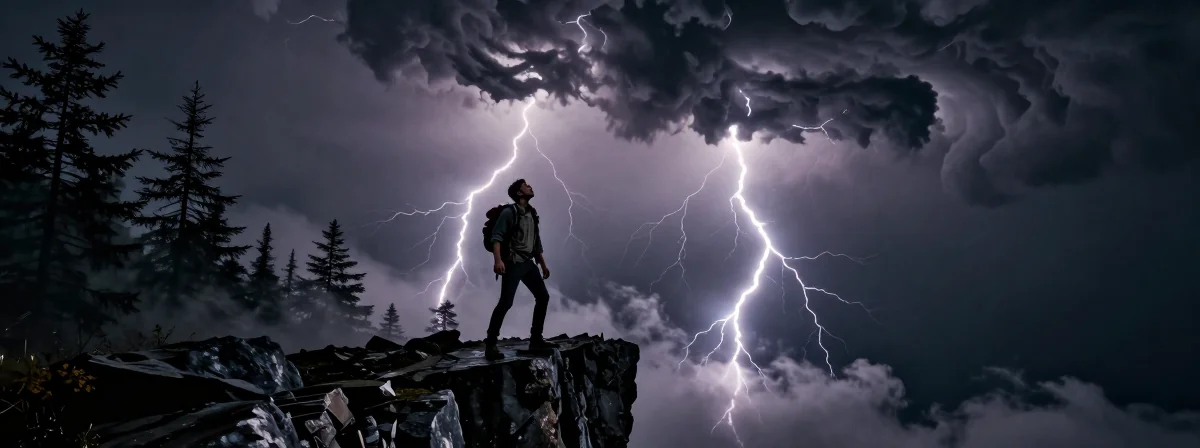
Nature is great. It has trees, wind, and squirrels. Unless, of course, you are the one currently sprinting through a forest in Ireland while your crystal necklace shatters into a million pieces. Then, nature is just a terrifying obstacle course designed to test your cardio and your faith in physics.
We love to pretend that the woods are peaceful, that the woods are just… trees. But history and folklore suggest that the woods are actually a crowded apartment complex for things that really, really don’t want to be disturbed. From the “Not a Deer” phenomenon in Appalachia to the banshees wailing outside Irish windows, there is a long, spooky history of people encountering things they can’t quite explain. It turns out, the “just a trick of the light” excuse is usually a lie we tell ourselves to sleep at night.
Is It Just a Deer, or Is It “Not a Deer”?
In Appalachia, there is a specific creature known colloquially as “Not a Deer.” It sounds like a punchline, but it is genuinely terrifying. It looks like a deer, sure. It walks on four legs, maybe. But something is fundamentally, horrifyingly wrong with it. Maybe its eyes are too wide, or it’s holding its leg out like it’s asking for a handout at a traffic light.
One witness described seeing one on a twisty road. It didn’t run away; it just stood there, awkwardly, until it jerkily retreated into the woods. The witness didn’t brake, didn’t acknowledge it, and didn’t hit it. Why? Because you don’t negotiate with “Not a Deer.” You don’t make eye contact with the wrongness. It’s the ultimate hedge against stupidity—nature gives you a chance to ignore the supernatural, and if you ignore it, you live to tell the tale.
Why Your Jewelry Is Trying to Tell You Something
There is a very specific kind of panic that comes from standing in a forest and watching your necklace disintegrate into a pile of beads. It wasn’t cheap costume jewelry; it was solid, it was sturdy, and it just… fell apart. It wasn’t a manufacturing defect. It was a warning.
This is a classic trope in folklore. If a crystal breaks or a mirror shatters, the universe isn’t telling you you’re clumsy; it’s telling you that something is attacking your energy. It’s the universe hitting the “panic” button. In Ireland, where the veil between worlds is apparently paper-thin, this is even more common. You take a picture of a fairy door, and suddenly your jewelry decides it’s had enough. The fairies don’t like being photographed. They don’t like having their privacy invaded by tourists with smartphones. It’s basically the same as that one aunt who yells at you for being on your phone at the dinner table, but with more teeth.
The Devil Monkey and the Dybbuk: Urban Legends Come to Life
Sometimes, the creepiest encounters happen in the suburbs. Take the story of the Devil Monkey. A high school friend was driving a buddy home past a cemetery. They saw a dark figure, hunched over, moving with impossible speed. It wasn’t a person, it wasn’t a dog. It was a cryptid with a black aura trailing behind it.
Years later, a Jewish friend mentioned the Dybbuk—a shape-shifting evil spirit from folklore that clings to the dead and seeks a new host. The theory? Someone died at that cemetery that day, and the entity was trying to find a new body. It sounds like a plot for a horror movie, but the coincidence of the timing and the description is too specific to ignore. It makes you wonder how many times we’ve walked past something that shouldn’t be there, pretending we didn’t see it.
When a Mango Tree Becomes a War Zone
If you live in the Philippines, you know about the Duwende. They are mischievous, dwarf-like creatures that live in mango trees. They don’t want to hurt you; they just want you to leave their house alone. But if you mess with their home? Oh, you will pay.
One witness had a mango tree right outside their room. The landowner cut it down. Suddenly, the witness’s brother started losing everything. Keys, wallet, phones—misplaced constantly. It was bad luck on a loop. Then, a snake appeared. The brother showed the snake kindness, let it go outside, and the bad luck stopped. The Duwende had manifested as a snake to get shelter. It’s a reminder that in many cultures, nature isn’t just an ecosystem; it’s a housing market, and if you evict a tenant, you can expect a messy breakup.
The Icelandic Rule of “Leave the Rocks Alone”
Iceland is beautiful, yes, but it’s also a graveyard for machinery. Farmers there know better than to plow through “elf stones”—massive rocks that could fit a house. Equipment breaks, tractors flip, and people get hurt. Why? Because the elves are watching.
It’s not just superstition; it’s a survival strategy. Icelanders have seen orbs drifting near the ground—wisp-like lights that look like basketballs. Are they elves? Probably not. But does it matter? If you’re driving a tractor and a glowing orb is floating five feet off the ground, you’re going to stop driving that tractor. It’s the ultimate “do not disturb” sign.
Is That a Dog, or a Shadow with a Soul?
The “Black Dog” is a legend found across the UK and beyond. It’s not a regular dog. It’s large, jet black, and moves with a terrifying intelligence. One witness saw one trotting down a suburban street at night. It didn’t have an owner. It didn’t have a leash. It just looked at the witness with eyes that seemed to understand the weight of the universe.
The creature kept trotting with purpose, ignoring the human entirely. It wasn’t aggressive; it was just… there. It’s the kind of creature that makes you question if dogs are actually just angels in fur coats, or if they have a secret society of shadow-dogs running around while we sleep. It’s unsettling to see an animal that seems smarter than you.
The Conclusion: Are We Just the Ignorant Ones?
We like to think we’ve evolved past believing in magic or monsters. We say “it was just a bear” or “it was just the wind.” But when you have a crystal necklace shattering in your hand and a banshee wailing outside your window the next day, you have to admit: maybe we aren’t the smartest ones in the room.
Whether it’s a “Not a Deer,” a Dybbuk, or a Duwende protecting its mango tree, the message is clear: nature has layers. And sometimes, the scariest layer is the one that watches you back.