
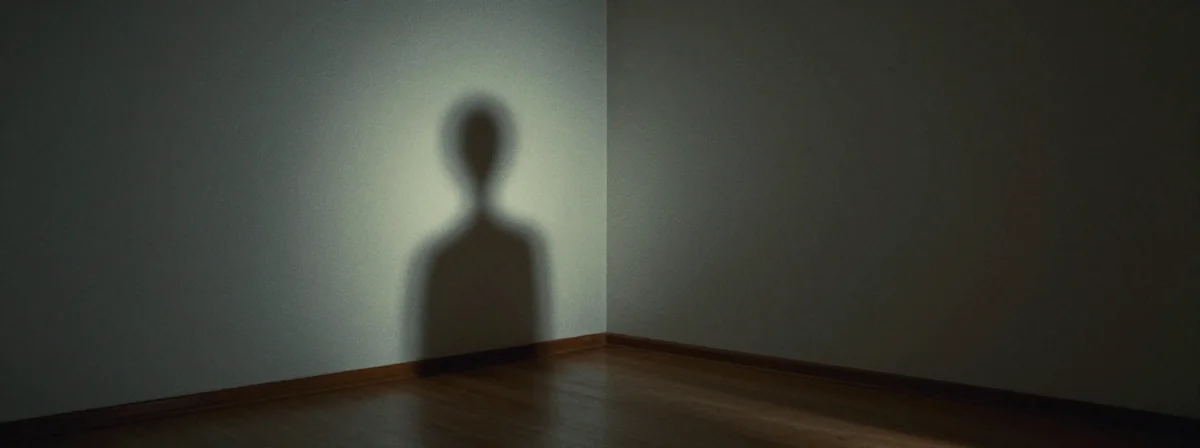
Some things in this world only reveal themselves when we’re not looking. It’s as if certain entities operate on a different plane of existence—one that intersects with our reality only when our attention is elsewhere. The evidence suggests that shadows and figures have been captured on recording devices that remain completely invisible to human perception in the same moment.
What we can verify is that countless accounts exist of unexplained shadows appearing on camera footage while remaining undetected by anyone present. This phenomenon isn’t limited to specific locations or individuals—it appears to be a consistent pattern across different environments and circumstances. The most compelling aspect is that the person recording never actually sees these entities with their own eyes, only discovering them later when reviewing the footage.
In one documented case, a visitor to an elderly relative’s home unknowingly captured a shadowy figure on video. This occurred in a room where even young children reported feeling uncomfortable and anxious without explanation. What’s particularly striking is that the individual never saw this figure during the recording—only noticing it upon later review. This remains unconfirmed but suggests a pattern where these entities may be deliberately avoiding direct human detection.
Why Would Something Appear Only on Camera?
The most logical explanation would be that these entities exist in a different perceptual frequency or dimension that our cameras somehow capture while our eyes cannot. Think of it like radio waves—our ears can’t hear them, but with the right equipment, we can convert them into audible sound. Similarly, cameras might be acting as transducers for these unperceivable phenomena.
Another possibility is that these entities are deliberately avoiding direct human contact. The timing often seems strategic—appearing in moments when no one is directly observing them. This raises questions about intentionality. Are these shadows passive phenomena, or are they actively choosing to remain undetected? The evidence suggests both possibilities exist simultaneously across different cases.
Consider the farmhouse example where footsteps were heard descending stairs at night, stopping precisely where doors used to be, followed by the smell of cigar smoke. These occurrences happened consistently enough to become a pattern, yet no one ever visually confirmed the presence of anyone. The sensory experiences were real enough to be noted, yet the source remained invisible. This creates a fascinating paradox of presence without visual confirmation.
The Psychology of Unseen Entities
Our brains are wired to detect patterns and potential threats. What we can verify is that humans have a natural tendency to perceive meaningful patterns even in random stimuli—a phenomenon known as apophenia. However, when multiple people in different locations report similar experiences, especially with corroborating evidence like recordings, the pattern seems too consistent to dismiss as mere coincidence or psychological projection.
What’s particularly intriguing is the emotional component. In many cases, these phenomena appear in spaces where occupants already feel uneasy or where traumatic events have occurred. This doesn’t necessarily prove causation, but it does suggest correlation worth examining. The farmhouse with the cigar-smelling footsteps had a history that might have influenced the occupants’ perception, yet the physical sensations (footsteps, smell) were consistent enough to be noted objectively.
Technology as a Medium for Perception
Modern recording devices have expanded our perceptual capabilities in ways we’re still discovering. Early photography revealed double exposures and anomalies that weren’t visible to the naked eye. Digital cameras have their own quirks and sensitivities that might capture phenomena beyond human visual range. The evidence suggests that what we’re seeing in these recordings might not be what we think they are—perhaps distortions, reflections, or even glitches in perception rather than literal entities.
This brings up an important question: Are we interpreting technical artifacts as paranormal phenomena? In some cases, yes. But when multiple types of recording devices (cameras, audio recorders, thermal imaging) capture similar anomalies in the same location, the explanation becomes more complex. The shadow that appeared in the dark corner of the photo taken at the farmhouse wasn’t a camera glitch—it appeared in a location significant to previous events at that property.
The Pattern of Invisibility
What we can consistently observe is a pattern: these phenomena appear when least expected and when no one is directly looking. They often manifest in transitional spaces—stairways, hallways, doorways—or in rooms with emotional significance. The timing is frequently during moments of transition or vulnerability, such as when someone is sleeping or when a space is being revisited after time away.
This pattern suggests something more than random chance. It might indicate entities that exist in a state of partial manifestation, only becoming detectable under specific conditions. The farmhouse footsteps stopping precisely where doors used to be suggests awareness of the space’s previous configuration, implying a connection to past rather than present reality.
What Does This Mean for Us?
The most compelling evidence comes from consistent patterns across unrelated cases. When multiple people in different locations report similar experiences with corroborating evidence, we must consider the possibility that we’re encountering something real, even if we don’t understand what it is. The shadow that appears only on camera but not to the naked eye represents a fundamental challenge to our understanding of perception and reality.
Perhaps these entities exist in a state that intersects with our reality only under specific conditions. Maybe they’re not “ghosts” in the traditional sense but rather residual energy patterns or information imprints from past events. The truth may be that we’re not seeing them because they don’t exist in the way we assume—they might be something entirely different from what we’re expecting.
Redefining Our Perception of Reality
The most significant implication of these phenomena is that our perception of reality might be more limited than we assume. If entities can exist and interact with our environment in ways that remain undetectable to our senses but visible through technology, what else might be happening around us that we’re completely unaware of? The evidence suggests that reality might have layers beyond our current understanding.
Consider the shadow that appeared in the photo taken at the farmhouse—it wasn’t just any shadow. It appeared in a specific location that held significance to the property’s history. It wasn’t a random anomaly but seemed purposefully positioned. This raises the possibility that what we’re encountering isn’t random phenomena but something with awareness or intentionality.
What we can verify is that these experiences have real effects on people. The fear, unease, and confusion reported by those who encounter these phenomena are genuine responses to something that appears to be real, even if we can’t fully explain it. The most compelling evidence isn’t the phenomena themselves but the consistent patterns in how they manifest and how they’re perceived—or not perceived.