
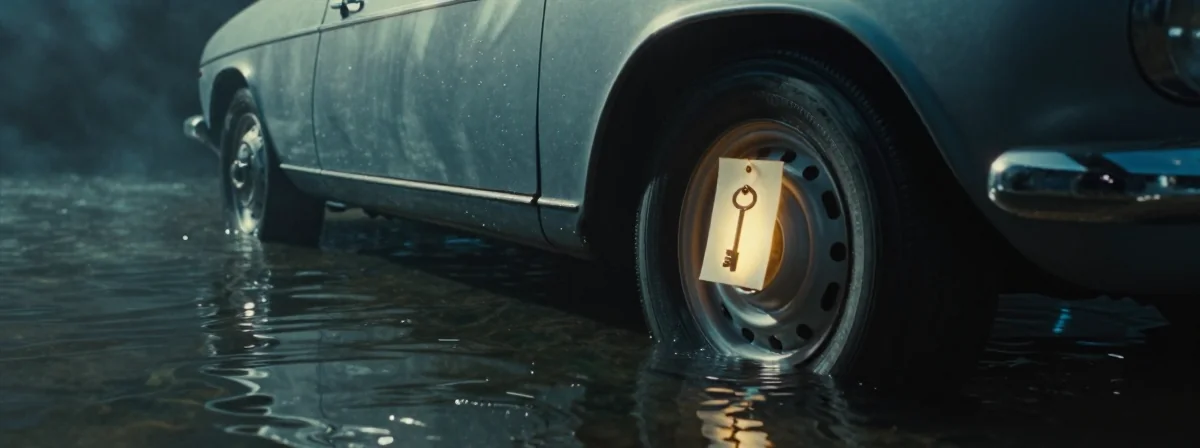
Disappearing cars aren’t just mysteries—they’re system failures. Every year, vehicles vanish without a trace, and the search patterns remain stubbornly terrestrial. But what if the answer isn’t on land at all? The pattern here is disturbingly consistent: when a car goes missing, it’s often submerged in water, hidden in plain sight.
The assumption that a missing car stays on the road is flawed. Water acts as nature’s perfect eraser. A few inches can obscure a vehicle entirely, and currents can carry it miles from where it entered. This isn’t speculation—it’s what the data shows. Time and again, advanced sonar and diving teams find submerged cars just feet outside original search zones, sometimes with the occupants still inside.
Take the case of a high-profile couple missing since the 1970s. Authorities searched everything but the small retaining pond next to their hotel. Only when Adventures With Purpose—a team specializing in underwater searches—scanned the water did they find the car, as if it had simply driven off the road and into the pond. The pond was visible from the parking lot, yet never checked.
Why Do Missing Cars End Up in Water?
The reasons are as varied as the cases themselves. Sometimes it’s accidental: a driver distracted, drunk, or lost takes a wrong turn and ends up in a river or lake. Other times, it’s intentional—a suicide, a murder-suicide, or even a cover-up. The Charente River case mentioned earlier fits this pattern: the route required crossing two bridges, making it a prime candidate for an accidental or deliberate plunge.
What’s truly striking is how easily water conceals evidence. A car can disappear into a river without leaving skid marks or debris. Even a shallow stream can have hidden drop-offs—a 10-foot hole in an otherwise shallow area—where a vehicle can fall without disturbing the banks. This is why traditional searches often miss them.
The Limits of Traditional Search Methods
When a car vanishes, authorities typically focus on the last known route: roads, fields, and wooded areas. But water is the ultimate blind spot. Rivers, ponds, and even drainage ditches are rarely prioritized, and when they are, the methods are outdated. A diver with a pole poking the water every few meters won’t find a submerged car in silt or a hidden depression.
Modern underwater search teams use side-scan sonar and magnetometers—tools that can detect metal objects even in murky conditions. These technologies have turned up decades-old wrecks in places authorities never dreamed of checking. The pattern here is clear: the more advanced the search, the more likely water is the answer.
Case Studies That Changed Everything
The Oregon couple missing since the 1950s is a perfect example. Authorities searched for years, assuming they’d been abducted or ran off. It wasn’t until decades later that their car was found in the Willamette River, where they’d apparently driven off Highway 84. The same happened in the Charente River case—the route went right over the water, yet no one looked there first.
These aren’t outliers. Adventures With Purpose has closed dozens of cold cases by focusing on waterways. Their success rate is unnervingly high, proving that when a car disappears, the first place to look isn’t the last road—it’s the nearest body of water.
The Psychology of Overlooking Water
There’s a cognitive bias at play here. We assume missing persons stay on land because that’s where we live. Water feels like a separate domain—something to cross, not to disappear into. But this assumption has cost lives. Many missing persons cases involve vehicles, and many vehicles end up in water. The connection is undeniable.
Even when water is nearby—like a river running under a highway—it’s often dismissed as too obvious. Authorities assume someone would have noticed a car entering the water. But as the Adventures With Purpose team shows, cars can submerge without a ripple, especially at night or in remote areas.
What This Means for Future Searches
The takeaway is simple: when a car goes missing, water must be the first suspect, not the last resort. Search teams should prioritize bodies of water along the route, especially rivers, ponds, and drainage areas. Advanced sonar should be standard equipment, not a last-ditch effort.
The Charente River case underscores this. Even if the car isn’t there, the principle holds. Water is the great equalizer—it doesn’t matter if it’s December or summer, deep or shallow. A missing car in water is a missing car, period.
The Hidden Pattern in All Missing Car Cases
What the data shows is that water isn’t just a possibility—it’s the most likely scenario. Whether accidental or intentional, submerged vehicles are the hidden variable in missing persons cases. The next time you hear about a missing car, ask: was there water nearby? The answer might be staring you in the face, just below the surface.