
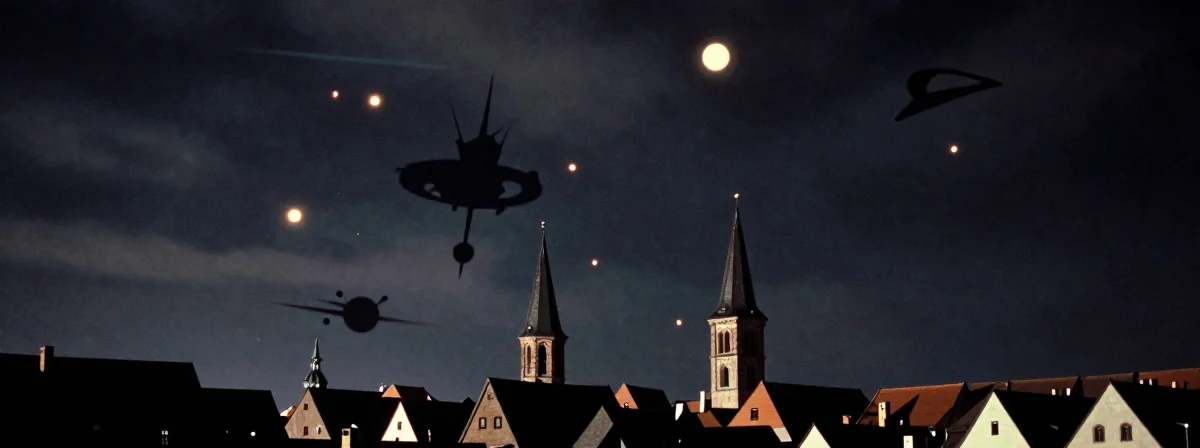
The sky above Nuremberg in 1561 wasn’t just a canvas for clouds—it was, according to one account, a battleground of celestial objects. Swords, globes, and black spears allegedly danced in the heavens before crashing to Earth. But here’s the unsettling truth: what we think we know about this event might be built on a single, possibly embellished, source. The pattern here isn’t just about a mysterious sky show; it’s about how history, eyewitness accounts, and human perception intertwine in ways that still confound us today.
What the data shows is a gap between the dramatic story and the evidence. The Nuremberg sky event, as recorded in Hans Glaser’s broadsheet, describes a spectacle that sounds like something out of science fiction. Yet, when we dissect the accounts, inconsistencies emerge. This anomaly suggests that not everything is as it seems—and that’s where the real mystery begins.
Did Multiple Witnesses Really See the Nuremberg Sky Battle?
The most famous account claims “multiple eyewitnesses” saw the celestial battle. But what the data shows is a single source: Hans Glaser’s woodcut broadsheet. No independent firsthand accounts survive. This isn’t just a minor detail—it’s a red flag in historical analysis. The pattern here is familiar: claims of multiple witnesses often collapse under scrutiny, leaving only a single narrative repeated.
Consider this analogy: if a modern news article claims “witnesses saw a UFO,” but only one person’s testimony is documented, the story’s credibility weakens. The same applies here. Hans Glaser, a woodcutter and letter painter, wasn’t a historian. His profession allowed creativity—a fact that shouldn’t be dismissed. The unsettling truth is that we might be trusting a single, possibly imaginative, source as undeniable proof.
Could It Have Been a Natural Phenomenon?
Before you dismiss the Nuremberg event as entirely fabricated, consider this: the sky is full of optical illusions. Sun dogs, parhelia, and unusual cloud formations have deceived observers for centuries. What if the “battle” was just a rare alignment of ice crystals and sunlight? The pattern here is that nature often creates phenomena that look extraordinary but have scientific explanations.
For example, staring at the sun can produce afterimages—fiery figures that seem real but are just your eyes’ way of coping with overexposure. Add a haze that partially blocks the sun, and the effect intensifies. The unsettling truth is that a combination of natural effects could explain the shapes described without invoking supernatural battles. This isn’t to say the event didn’t happen, but to question whether we’re interpreting it correctly.
Why Did Printing Make This Story Stick?
The 16th century was the dawn of print culture—an era where sensational stories sold better than mundane ones. Early printing presses weren’t just tools for spreading news; they were engines of misinformation. People made up stories about monstrous births, witchcraft, and even colonies on the sun. The pattern here is that technology amplifies human tendencies—whether it’s exaggeration or fabrication.
Hans Glaser’s broadsheet fits this pattern perfectly. Printing could stylize descriptions, making a mundane event seem extraordinary. The speed and detail in his account suggest it was based on something observed, but not necessarily a “battle.” The unsettling truth is that we might be mistaking a crafted narrative for a factual record.
Could It Have Been a Combination of Events?
What if the Nuremberg sky event wasn’t one thing but two? Modern analysis suggests that combining rare natural phenomena with a meteorite fall could explain the entire spectacle. Ice crystal effects would create the “battling objects,” while a meteorite would provide the “crashing” finale. This isn’t just speculation—it’s a systems-thinking approach to history.
The pattern here is that complex events often have multiple causes. The unsettling truth is that we might be oversimplifying the Nuremberg event by treating it as either “real” or “fake.” A combination of natural and human factors could be at play.
What Does This Mean for How We View History?
The Nuremberg sky event isn’t just a historical curiosity; it’s a mirror reflecting how we process information. The pattern here is that eyewitness accounts, even in the modern era, are fallible. We see what we expect to see, and sometimes, what others tell us to see. The unsettling truth is that history isn’t a perfect record—it’s a reconstruction, often colored by bias and technology.
So, the next time you hear a “multiple witnesses” claim, pause. Ask for the evidence. The Nuremberg sky event teaches us that even the most dramatic stories deserve a second look. After all, the sky might not always be what it seems—and neither are the accounts we rely on.