
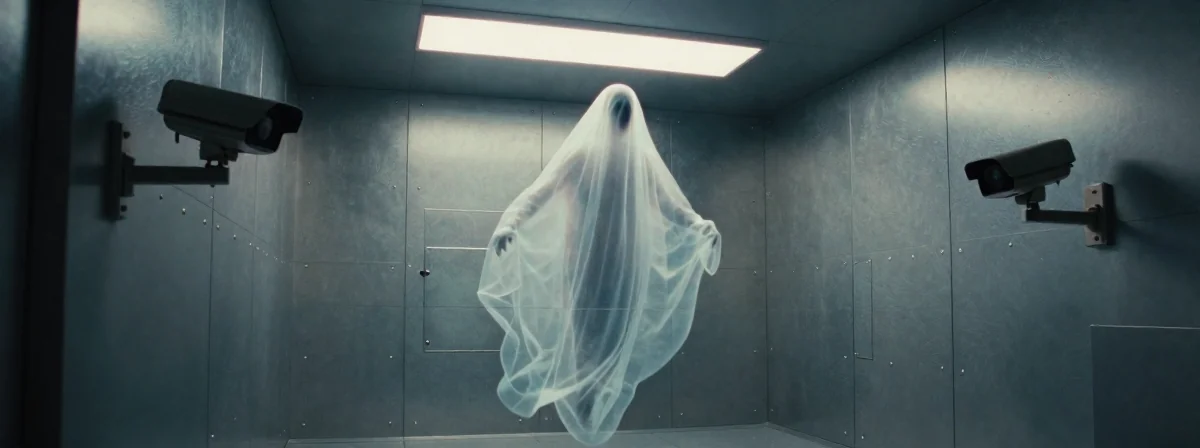
Something doesn’t add up. How can a camera that can count eyelashes from 40 feet away suddenly lose the ability to see a face? It all starts with the most disturbing detail in the entire account.
Spec Check
THE FIRST CLUE It starts with the ECP supervisor’s claim: “We have two of you.” The fact that this wasn’t a glitch or misinterpretation becomes clear when you consider the context. This wasn’t a civilian facility—it was a military base with hardened security systems, triple-layered access controls, and motion detectors that don’t lie. And yet, when the narrator turns to look at the spot where someone supposedly stands, there’s nothing there. The first thing that doesn’t add up is that the ECP operators could see something the narrator couldn’t—and not just any something, but a figure in BDUs that hadn’t been standard issue for four years.
FOLLOWING THE THREAD And that’s when it hit me—the cameras weren’t the only ones seeing things. The motion alarms that went off across the facility weren’t random. Thirty-plus alarms on separate circuits, all going off simultaneously in sealed areas, suggests something far more coordinated than a simple systems malfunction. But wait, it gets even stranger when you consider the timing. This all happens just after midnight, during the shift change when staffing is at its lowest but security awareness is at its peak. Once you see this pattern, you can’t unsee it: the facility’s own security systems were somehow being triggered by something that shouldn’t exist.
THE BIGGER PICTURE And suddenly, it all makes sense. The figure in BDUs wasn’t a person at all—it was a spectral projection, a ghost that somehow interacts with physical systems. The cameras could detect its presence because it had physical properties that affected light, but couldn’t resolve its features because it wasn’t fully material. The motion detectors picked it up because it occupied space, and the alarms cascaded because whatever was there was moving deliberately through the facility. The pieces were there all along: the specific uniform, the impossible visibility, the synchronized alarms. Now you’re starting to see the real picture: this wasn’t a security breach—it was a spectral infiltration.
WHAT IT MEANS This wasn’t just a ghost story—it was a demonstration of how the paranormal can interact with our technological world. The military’s own security infrastructure became the medium through which this presence revealed itself, turning cutting-edge surveillance into a paranormal detection system. What we’re looking at isn’t just a haunted building; it’s a case where the veil between worlds was thin enough for something to cross over—and our technology was the first to notice.
The Honest Take
The most disturbing part isn’t that something unseen was there—it’s that our systems were designed to detect exactly what they detected. This wasn’t a failure of technology; it was a success. The facility’s security systems did exactly what they were supposed to do: they detected an unauthorized presence. The question isn’t whether something was there; it’s whether we’re prepared to accept what our own technology is telling us when it points to the impossible.